August 20, 2026
EXECUTIVE SUMMARY
Earlier this year, original equipment manufacturer (OEM) Polestar was blocked from selling new cars in the US market after the Department of Commerce denied Polestar’s authorization under the Connected Vehicle Rule. Why? Well, Polestar is majority owned by China’s Geely, bringing the brand into conflict with the new legislation that prohibits the sale of connected vehicle software and hardware tied to foreign adversaries. US government concerns may well be justified given that research from Norwegian cybersecurity expert Tor Indstøy has shown that Chinese vehicles are constantly transmitting data to China.
Meanwhile, in Europe, 46% of respondents in Escalent’s Connectivity Forward study said they were at least somewhat concerned about data privacy related to their vehicle location data. Additionally, the Financial Times in London reported that “some of Britain’s most secure military sites are restricting access to electric cars over concerns that Chinese technology embedded within the vehicles could be used for spying,” suggesting that the same concerns driving the US government’s ban on new Polestars are shared by consumers and authorities in Europe. Yet despite this, Polestar remains on sale in Europe alongside a myriad of other Chinese names. Indeed, in both Europe and South America, Chinese brands are upending the traditional rules as new-vehicle buyers vote with their wallets.
As Ford CEO Jim Farley recently noted:
“We know we’re in a fight for our lives in our industry. There is no better example than here in Europe.”
Sales figures show that in the UK, Norway and Brazil, Chinese brands are already mainstream players but for different reasons. In Brazil, Chinese brands offer strong value for the money. In Norway, the heavy prevalence of electric vehicles (EVs) makes it a rich hunting ground for EV specialist Chinese brands. In the UK, the “British” MG brand on Chinese vehicles, the Range-Rover-lookalike Jaecoo 7, and the propensity for Chinese brands to hook up with smaller dealerships in smaller towns that traditional brands have long since abandoned has made it easier for Brits to shift to Chinese brands. Spain, Italy and Poland are not far behind.
Vehicle Brand Purchase Consideration: A Fast-Changing Picture
Based on Escalent’s EVForward Europe study data from 2025, 14% of new-vehicle buyers in the EU5 (France, Germany, Italy, Spain and the UK) were likely to consider at least one Chinese brand for their next vehicle. The incumbent brands most at risk included Tesla, BMW and Kia, whose owners were most likely to consider a Chinese brand.
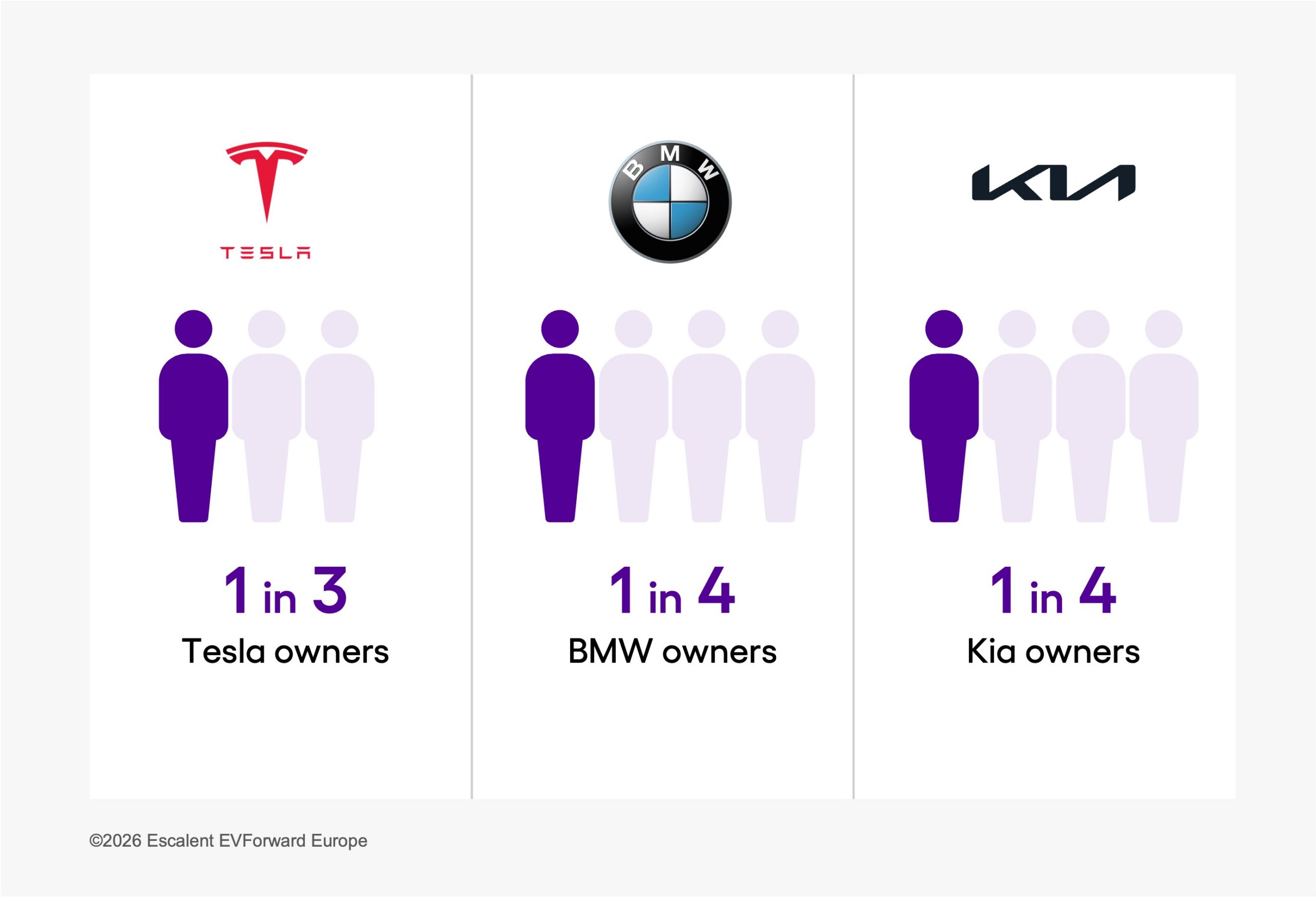
Since these findings are from 2025, we expect to see major shifts in the data we are collecting in our 2026 studies. As already mentioned, Chinese brands are not taking a one-size-fits-all approach to Europe and South America; instead, they are using sophisticated marketing strategies that are market appropriate. According to our 2025 EVForward Europe data, BYD was far and away the most-considered Chinese automotive brand in Europe, with 11% of new-vehicle buyers saying they’d consider a model from BYD for their next vehicle—but the emergence of Chery-owned brands such as Omoda and Jaecoo in the last 12 months could lead to a very different picture in 2026.
There Is No “Chinese OEM Brand”
Those who compare the coming of new Chinese brands to Europe with the influx of Japanese brands in the 1970s and South Korean brands in the 1980s are not really understanding the scale of this challenge for local legacy manufacturers.
The Japanese invasion of the European markets was largely confined to four manufacturers—Toyota, Nissan, Mitsubishi and Mazda—with a little help from Subaru, Daihatsu and Suzuki. South Korea has made strong inroads in the past 40 years with just two related brands, Hyundai and Kia. In all cases, these have been mainstream rather than premium brands.
Even coming up with an accurate number of Chinese car brands can be difficult: depending on your definition, there are upwards of 30 brands from around 13 parent companies—and these include premium players such as Polestar, Nio and Zeekr. Each brand has its own positioning and its own strategy (often learned from observing and working with European partners for the past 15 years), making the influx of Chinese brands much harder to deal with for legacy manufacturers. Additionally, Chinese brands have learned from the Japanese and are employing their growth strategies more quickly through partnerships with established automakers (such as Ford with Geely, Stellantis with Leapmotor, and JLR with Chery), local manufacturing in Europe and South America and, of course, pseudo-European branding.
When Is a Chinese OEM Brand Not a Chinese OEM Brand?
As the Polestar example from the US shows, Chinese OEM ownership extends beyond brands that consumers explicitly associate with being Chinese.
Indeed, our 2025 data from Escalent’s Chinese Automotive Brand Impact Study in Europe showed that whilst 61% of European consumers knew that BYD was Chinese, this was the only brand that more than half of consumers knew to be Chinese; next in line was Xiaomi at 34%. Fewer than one-quarter of consumers were convinced that MG and Polestar were Chinese. As for Volvo? Well, as far as consumers were concerned, that brand was very much not Chinese—despite 78% of it being owned by Geely. Indeed, even the US government wasn’t convinced with the Department of Commerce continuing to allow Volvo to be sold in the US unlike its sister brand, Polestar.
The picture for consumers is confusing—and this is dangerous for legacy brands. BMW, Tesla and Kia and many more all stand to lose ground to these Chinese-but-not-Chinese brands. Our data show that whilst 14% of consumers would consider an explicit Chinese brand, that figure rises to 21% when considering these pseudo-European brands.
Navigating the Competitive Shift in Europe’s Evolving Automotive Landscape
The arrival and growth of new OEM competitors in Europe and South America is a catalyst for strategic clarity. Our Chinese Automotive Brand Impact Study in Europe, now in its third year with a new report to be released in the autumn of 2026, helps our clients understand which of their brands and customers are at risk of defection to Chinese-owned OEM brands and how our clients can best position themselves to retain these customers.
Are you prepared to meet the needs of your customers before they look elsewhere?
Contact us today to learn how Escalent’s European automotive and mobility experts can help you understand the evolving market and secure your brand’s competitive advantage.
About Escalent’s China Automotive Brand Impact Study in Europe—Second Edition
Escalent’s second edition of its Chinese Automotive Brand Impact Study was conducted across a market-representative sample of 1,692 respondents ages 18 to 80 with a primary vehicle model 2017 or newer and who are planning to purchase a new vehicle within the next five years. The respondents were from five European countries: Italy (n=353), Spain (n=348), France (n=343), Germany (n=330) and the United Kingdom (n=318). The survey fielded from May 21 to July 31, 2025. Data were weighted by age and gender to match the demographics of the new-vehicle buyer population and by vehicle segment to match current vehicle sales. The sample for this research came from an opt-in, online panel. As such, any reported margins of error or significance tests were estimated and relied on the same statistical assumptions as data collected from a random probability sample. Escalent will supply the exact wording of any survey question upon request.
About Escalent’s Connectivity Forward Europe Study
Escalent conducted a survey across five European countries—France (n=1,746), Germany (n=1,867), Italy (n=1,808), Spain (n=1,656) and the United Kingdom (n=1,817)—that was fielded between April 23 and June 10, 2025. The sample was drawn from multiple panel source partners. To qualify, respondents had to be 18 to 80 years of age, be owners of new or used vehicles whose primary vehicle must have been purchased within the last five years, and have at least 50% of the vehicle purchase decision. The data were weighted by age, gender and vehicle segment ownership. Escalent will supply the exact wording of any survey question upon request.
About Escalent’s EVForward Europe Study
The EVForward Europe study was conducted across five European countries: France (n=1,666), Germany (n=1,832), Italy (n=1,684), Spain (n=1,602) and the United Kingdom (n=1,676). It included a survey that was fielded between February 18 and November 17, 2025. The respondents were 18 to 80 years of age with a primary vehicle model 2019 or newer and planning to purchase a new vehicle within the next five years. Data were weighted by age and gender to match the demographics of the new-vehicle buyer population and by vehicle segment to match current vehicle sales. The sample for this research came from an opt-in, online panel. As such, any reported margins of error or significance tests were estimated and relied on the same statistical assumptions as data collected from a random probability sample. Escalent will supply the exact wording of any survey question upon request.

Steve Hill
Senior Research Director, Automotive & Mobility Europe
Steve Hill is a Senior Research Director in Escalent’s Automotive & Mobility Europe practice and is based in our Guilford, UK office. With over 20 years of client-side experience working across the automotive and tech sectors before joining Escalent, Steve has a strong understanding of client needs and how consumer research can drive business decisions in an industry going through seismic change. Working at JLR through a period of huge expansion, he led the brand and product development research underpinning the new Land Rover Defender and the expansion of the Range Rover range, winning a Market Research Society award for international research in the process. While at Amazon, he worked across the Prime Video brand, understanding how market research can come together with broader data sets to revolutionize and speed up decision-making. With experience working across all continents, Steve has a keen eye for how cultural nuance is vital to market success.

Corey Reiter
Senior Business Development Executive
Corey is a business development professional with 20 years of experience managing strategic partnerships and revenue growth. He works with Escalent's Automotive & Mobility and Energy teams. His background includes consultative sales, pipeline management, and navigating complex stakeholder relationships across industries such as automotive, financial services, logistics, and renewable energy. In his current role as a Senior Business Development Executive at Escalent, he focuses on leading acquisition initiatives and translating technical service offerings into commercial agreements. Over the course of his career, he has held various business development and account management positions, working with founders and executive teams to implement client acquisition strategies.