July 22, 2026

EXECUTIVE SUMMARY
The vehicle is becoming a thinking machine. In this edition of Interview with an Expert, Hall & Partners’ Matt Vicenzi sits down with Managing Director of Escalent’s Automotive & Mobility practice, Jason Mantel, to explore why the research methods used to evaluate vehicles haven’t kept pace. Building the AI-enabled vehicle is only half the challenge. Knowing whether consumers actually trust, value, and want to live with it is the other.
What Does the Future of Automotive and Mobility Look Like?
Q1: How is AI reshaping what a vehicle actually is?
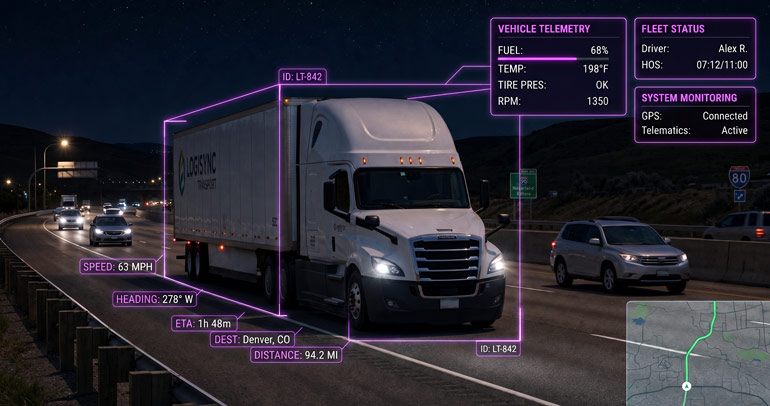
AI holds the promise of fundamentally transforming the vehicle from a “useful muscle” into a connected, intelligent and adaptive mobility platform. Automakers are building software and AI into vehicles to create more responsive, individualized experiences for both drivers and passengers, based on real-world usage patterns and behavior. This is laying the foundation for connected ecosystems where vehicles interact with drivers, riders, other vehicles, infrastructure, and the energy grid, accelerating the path toward fully integrated vehicle-to-everything (V2X) mobility.
Vehicle connectivity also extends the customer relationship well beyond the initial purchase, enabling automakers to deliver ongoing value through digital services, remote diagnostics, and predictive maintenance…while generating new revenue streams. Supporting technologies (alternative powertrains, autonomous driving, voice recognition) are advancing quickly. The industry is still closing a critical gap: connected vehicle capabilities are expanding faster than consumer adoption or willingness to pay.
The Opportunity and Challenge Facing Automakers
Q2: What’s the biggest opportunity — and the hardest part of capturing it?
The real challenge is the pivot away from legacy vehicle development and production models toward a pace of iteration closer to technology products: learning quickly how customers respond, what they actually use, and what they’re willing to purchase.
To capture this opportunity, automakers need to:
- Identify the needs of time-strained consumers facing increasingly complex vehicle purchase decisions, and build solutions with demonstrable value
- Treat the vehicle as an ecosystem of potential — building partnerships that create a synchronous experience across drivers and passengers
- Balance core transportation needs with an ecosystem of in-vehicle solutions consumers will actually pay for
- Reinforce the vehicle’s role and importance in daily life, much as the smartphone redefined its category over the past two decades
How Should the Industry Solve This Challenge?
Q3: If today’s vehicles need 21st-century evaluation, what does that toolbox actually look like?
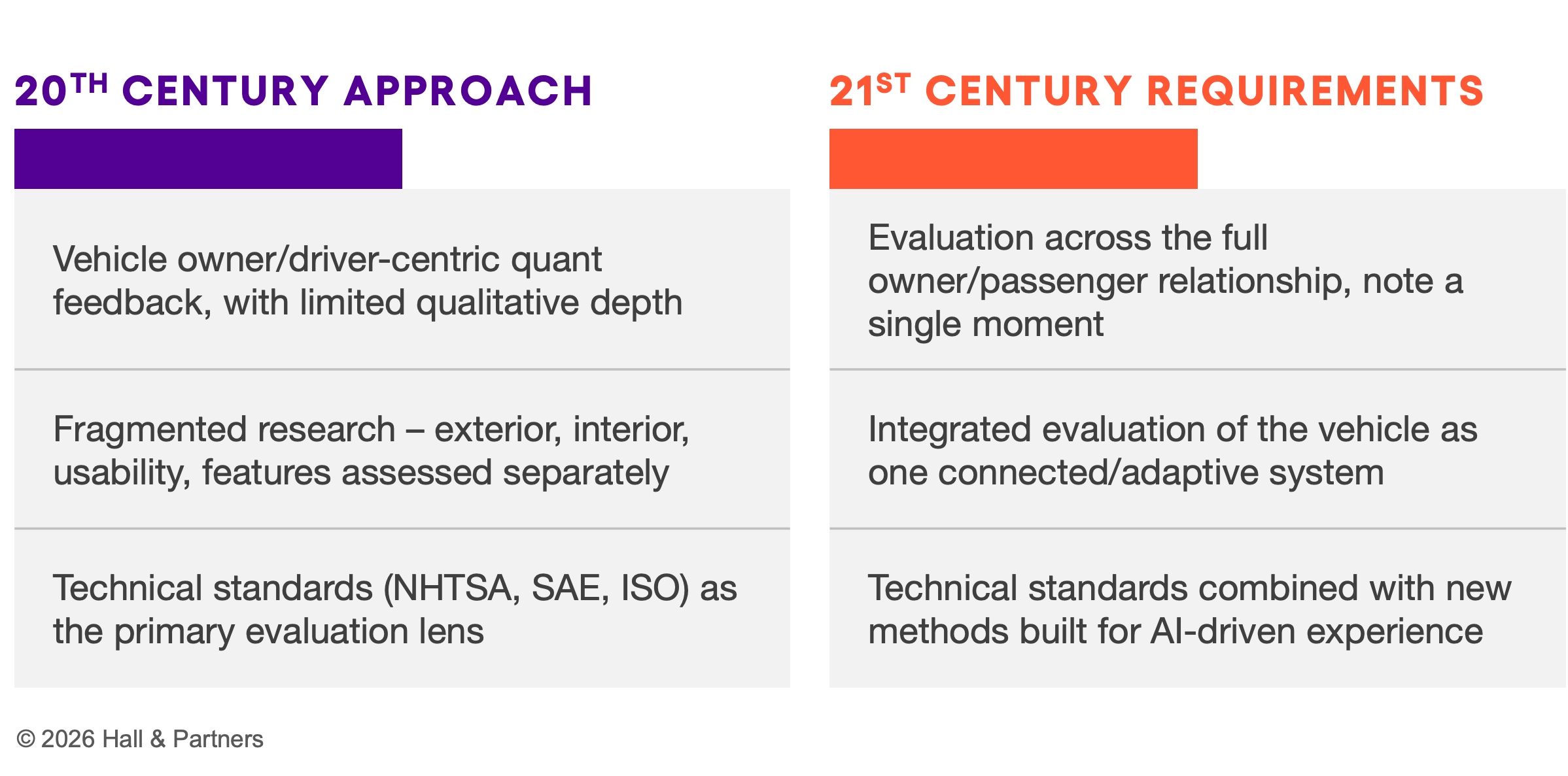
Vehicle personalization, AI enablement, and connectivity represent a significant expansion of the addressable market. But the research methodologies used to evaluate these vehicles are still rooted in the 20th century, and increasingly unable to capture the customer experience that will determine the future purchase reasons.
Escalent’s response was a design-thinking initiative (internally called FutureDrive) focused specifically on redefining how consumer insight evaluates advanced vehicle products. Future vehicle evaluation must move from judging isolated features at a single point in time to assessing an intelligent, adaptive, connected mobility system across real moments, repeated use, and the broader ownership relationship.
It’s about expanding existing research methods by adding new tools that matter for an AI-enabled vehicle. As vehicles and autonomous systems become more intelligent, those new tools can also extend upstream to the data used to train AI, including real-world human motion data that helps AI systems learn from how people actually move and behave.
"Future vehicle evaluation must move from judging isolated vehicle features at one point in time to evaluating an intelligent, adaptive, connected mobility system across real moments, repeated use, and the broader ownership relationship."
Jason Mantel
Executive VP, Managing Director, Automotive & Mobility, Escalent
New dimensions for evaluating the AI-enabled vehicle
Q4: What does this look like in practice?
Escalent has identified six dimensions of future-ready vehicle evaluation, alongside dozens of new research methods and a three-phase approach for transitioning to AI-enabled techniques. Two methods illustrate the shift:
- Contextual Intelligence & Predictable Behavior evaluates whether vehicle AI behavior feels appropriate for the moment, comparing responses across trips, weather, urgency, and environment to ask: did the timing feel right, and would this behavior feel helpful or intrusive?
- Adaptive Learning & Relationship Trajectory evaluates how trust and perceived value shift over time (through onboarding, updates, failures, and recovery) asking whether trust would grow or decline with repeated use, and whether a single AI mistake would change how the vehicle gets used.
Key Takeaways
- AI is turning vehicles into adaptive, ecosystem-like platforms comparable to smartphones
- Adoption, not technology, is the bottleneck. Connected capability is outpacing what consumers are willing to pay for
- Legacy, fragmented research methods can’t capture how consumers actually experience an AI-enabled vehicle
- Evaluation must shift from single-moment feature testing to trust and value across the full ownership relationship
- New dimensions like contextual intelligence and adaptive learning trajectory are key to understanding how consumers respond to AI behavior over time
Conclusion
The vehicle of the future will be judged on whether it earns trust, adapts appropriately, and proves itself worth living with overtime.
That requires a fundamentally different research toolbox, one built for relationships rather than single transactions. At Escalent and Hall & Partners, we partner with automotive and mobility clients navigating exactly this shift, helping them understand not just what consumers will buy, but what they’ll trust enough to keep.
Key Questions
1. How is AI changing the future automotive and mobility?
AI is transforming vehicles from mechanical machines into connected, intelligent platforms that can personalize experiences, support autonomous features, enable predictive maintenance, and integrate with broader mobility ecosystems.
2. Why do traditional automotive research methods needs to evolve?
Traditional research often evaluates vehicle features in isolation or at a single point in time. AI-enabled vehicles require research that measures trust, usability, adaptation, and the overall ownership experience over time.
3. What AI-enabled vehicles?
AI-enabled vehicles use artificial intelligence to power features such as voice assistants, driver assistance systems, predictive maintenance, personalized settings, and adaptive in-vehicle experiences that improve with continued use.
4. What factors influence consumer trust in AI-powered vehicles?
Consumer trust depends on whether AI behaves predictably, provides value in real-world situations, respects user preferences, recovers well from errors, and consistently delivers a helpful, reliable driving experience.
5. How can automotive brands prepare for the future of mobility?
Automotive brands can prepare by combining technological innovation with consumer-centric research, evaluating the full ownership journey, and designing AI experiences that customers trust, value, and are willing to adopt over time.

Jason Mantel
Managing Director, Automotive & Mobility
Recognized as a corporate leader and visionary, Jason leads the Automotive & Mobility practice at Escalent. With over 25 years of experience in automotive and research, he is focused on fostering emerging methods to differentiate his team in the industry.

Matt Vicenzi
Senior Vice President, Hall & Partners
Matt Vicenzi is a senior VP with Hall & Partners, an Escalent company. A nearly 20-year Hall & Partners veteran, Matt is a seasoned brand strategy and insights leader who helps brands thrive by connecting data, culture, and strategic clarity. He leads teams across New York and Chicago, guiding research which fuels growth for Fortune 500s and emerging disruptors across food and beverage, technology, retail, financial services, apparel, gaming, and more. With deep expertise in brand tracking, segmentation, and marketing effectiveness, Matt translates human insight into meaningful action which shapes stronger brands and drives growth.