August 5, 2026

EXECUTIVE SUMMARY
- The loss of federal EV incentives has widened an already significant affordability gap between what buyers expect to pay and current EV prices, which is dissuading vehicle buyers from considering EVs.
- Consumers are willing to make trade-offs on certain EV features, but some attributes remain essential, revealing where OEMs have flexibility to reduce EV prices without compromising the attributes that matter most to prospective buyers.
- Automotive brands that align vehicle packaging, pricing and product strategies with consumer priorities will be better positioned to meet expectations and encourage EV adoption in a post-incentive market.
The rollback of the $7,500 federal electric vehicle (EV) tax credit has widened the affordability gap for consumers. More than half of vehicle shoppers (56%) think EVs are unaffordable without incentives or tax credits, a figure that rises to 58% among EV Intenders (identified by Escalent’s algorithms as buyers who are over 15 times more likely to purchase an EV than the average new-car buyer).
This creates a challenge for original equipment manufacturers (OEMs). With affordability weighing heavily on consumers’ minds, automotive brands will need to make a compelling financial case for EV ownership to win over the next wave of buyers. To understand how automakers might approach this issue, we surveyed more than 1,000 respondents of the largest, most comprehensive study on EV buyers and electrified powertrain adoption, Escalent’s EVForward®. The resulting report, the 2026 EVForward Affordability DeepDive, examines how consumers define “affordable” and explores which product and pricing strategies OEMs can use to encourage EV adoption in the post-incentive market.
EV Affordability Remains a Barrier as Vehicle Prices Outpace Consumer Budgets
As noted in Escalent’s 2026 EVForward Market Profile Report, many buyers believe new-vehicle prices are at all-time highs. In response, buyers have gradually increased their anticipated spend. Yet findings from our 2026 EVForward Affordability DeepDive show that, even as consumers adjust their expectations, market prices are still outpacing buyers’ capacity to absorb higher costs.
On average, respondents indicated they expect to spend $43,950 on their next vehicle. That places the average new vehicle price ($49,461 according to Kelley Blue Book) more than $5,000 above buyers’ threshold, while the average cost of a new EV ($55,211) exceeds the threshold by more than $11,000. In this context, it is unsurprising that buyers see EVs as financially out of reach.
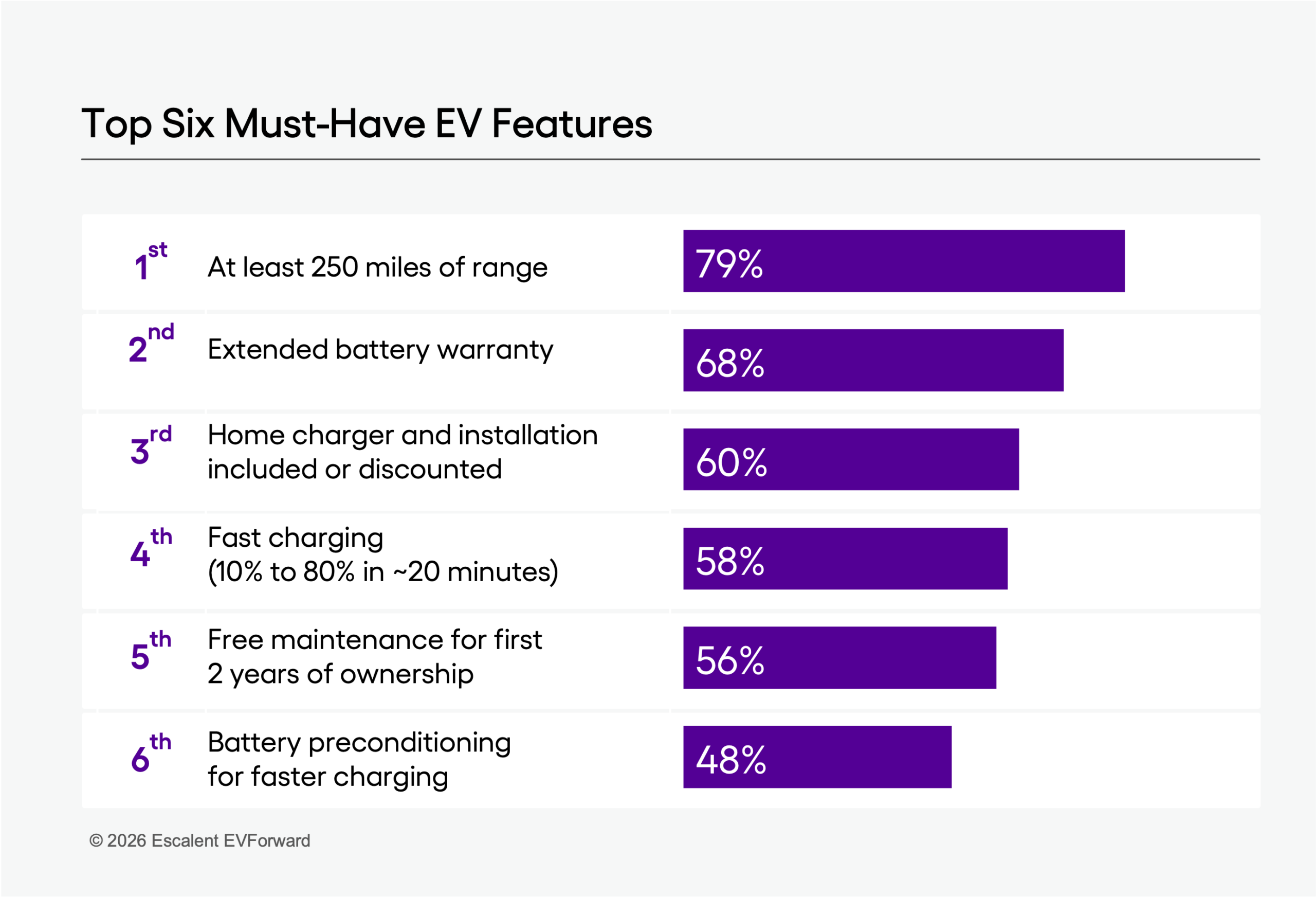
However, our research suggests there are approaches automakers can take to address affordability concerns outside of simply slashing prices. When asked what attributes an EV would need to meet baseline expectations, buyers identified several “must-have” requirements. These included at least 250 miles of range (79%), an extended battery warranty (68%), home charging support (60%) and fast charging (58%). Beyond these nonnegotiables, shoppers may be willing to trade off less important features if doing so keeps costs lower.
What Would EV Buyers Give Up to Lower the Purchase Price?
To get a clearer picture of where automakers could adjust their product positioning, we asked participants to consider a hypothetical new EV priced around $30,000. We then asked buyers to weigh where they would make concessions to stay close to this price point. While respondents were generally unwilling to compromise on quality and reliability, almost half (47%) indicated fewer features would be an acceptable trade-off.
When evaluating specific vehicle attributes in more depth, EV Intenders demonstrated more flexibility. Whereas EV Owners expressed a preference for fully loaded vehicles, our research found that EV Intenders were more likely to favor a lower base price, with the option to customize the vehicle based on their needs and budget. For instance, 62% of EV Intenders said both lane keep assist and a mobile app for charging and climate control are nice-to-haves but not deal-breakers, compared with 46% and 40% of EV Owners, respectively. Similarly, 60% of EV Intenders considered remote start a nice-to-have but not a deal-breaker, versus 50% of EV Owners.
For OEMs looking to lean into flexible EV configurations, this raises a practical question: how can they offer consumers more choice without overcomplicating vehicle lineups?
Scenarios like these are where Escalent’s Strategic Optimization of Complex Offerings (SOCO™) methodology can be particularly valuable. Our EVForward syndicated research shows that, when it comes to alternative powertrains, buyers are open to starting with the essentials and adding features selectively. SOCO can help automakers pressure-test this approach by identifying which packages have the broadest appeal, which configurations resonate with specific buyer segments and where feature pricing may create opportunity or risk.
Breaking Down the EV Affordability Barrier for Buyers
Affordability represents a major hurdle for automakers selling EVs. For most consumers, alternative powertrains come with a cost equation that is unfamiliar compared with a gas vehicle. Along with higher sticker prices, EVs introduce additional expenses, including those associated with installing a home charger. EVs are also associated with potential financial risks, such as needing to replace the battery and expensive repairs.
To make owning an EV feel realistic for consumers, automakers will need to pay close attention to where vehicle shoppers are willing to compromise. OEMs have an opportunity to get creative with how EVs are packaged, priced and marketed. However, OEMs must be careful not to confuse essential with expendable. By preserving the vehicle attributes buyers value most, such as range, while creating room for choice elsewhere, automotive brands can capitalize on buyer flexibility without stripping away the core features that are widely seen as nonnegotiable.
Interested in exploring how EV affordability is influencing consumer expectations and where automakers can create value beyond price? Reach out to us using the form below.
About the EVForward® 2026 Affordability DeepDive
This EVForward DeepDive study was conducted among a national sample of 1,088 respondents—including 94 EV Owner, 270 EV Intender, 336 EV Open and 308 EV Resistant respondents as identified by Escalent’s algorithm. These respondents are a re-contact subset of the EVForward database, an insights platform focused on identifying and understanding the next generation of EV and electrified powertrain buyers. The EVForward database consists of new-vehicle buyers selected to represent the US population, with quotas for race, Hispanic ethnicity, gender, age, vehicle ownership and region. Results are weighted by race, Hispanic ethnicity, condensed vehicle segment intention and luxury versus mainstream vehicle intention. The sample for this research comes from an opt-in online panel. As such, any reported margins of error or significance tests are estimated and rely on the same statistical assumptions as data collected from a random probability sample. Escalent will supply the exact wording of any survey question upon request.

K.C. Boyce
Vice President, Automotive & Mobility and Energy
K.C. Boyce is a vice president in Escalent’s Automotive & Mobility and Energy industry practices. He works with energy providers and automakers to craft compelling products and programs that accelerate the energy transition. Throughout his career, K.C. has worked across industries and sectors to develop innovative solutions to complex problems and translate subject matter expertise into actionable insight. He is a nationally known speaker on topics such as electric vehicles and solar and was the co-host of the weekly Energy Matters radio show, which won a 2024 Gabby Award from the Georgia Association of Broadcasters for “Best Podcast Series," until the show ended in December 2025. Before joining Escalent, K.C. was senior vice president at Chartwell, where he led industry and consumer research, conference production and marketing. He also served as the Smart Energy Consumer Collaborative’s assistant director, leading its consumer research program. K.C. holds an MBA from Georgia State’s Robinson College of Business and a bachelor’s degree in political science from Colorado College.

Nikki Stern
Senior Insights Manager, Automotive & Mobility
Nikki Stern is a senior insights manager on the Automotive & Mobility team with Escalent. She is dedicated to EVForward® projects, which provide clients with valuable consumer research to better understand the next generation of EV buyers. Nikki supports the research from beginning to end, starting with the development of a research idea and following the project through survey development, fielding, data analysis, and reporting. Before joining Escalent, Nikki worked with a marketing agency as an analyst where she gained over seven years of experience working on multiple pieces of the business, including market research, consumer research, and cross-channel digital media analytics. She has a bachelor’s degree from Kalamazoo College in Sociology/Anthropology and a graduate certificate from Harvard Extension School in Corporate Sustainability & Innovation. Outside of work, Nikki is an avid yoga practitioner and teaches classes as well.