September 24, 2026

KEY TAKEAWAY
Consumers may not want autonomous vehicles as a broad concept but they do show interest in specific automated driving features when those features solve clear driving problems and demonstrate the competency needed to earn consumer trust, according to Escalent’s latest Connectivity Forward™ research findings.
Consumers are sending the automotive industry mixed signals about vehicle autonomy.
Most do not identify highly automated driving as their preferred experience, yet even some drivers who prefer no automation show meaningful interest in individual features that allow the vehicle to take on more driving tasks.
That distinction matters. If consumers respond differently to the concept of full vehicle “autonomy” than they do to specific, tangible use cases, automakers and suppliers may need to rethink how they size the opportunity, segment the market, and research the automated driving experiences most likely to earn adoption.
Our 2026 Autonomy report, part of Escalent’s Connectivity Forward™ research program on connected vehicle services and consumer willingness to pay, explores that tension: which automated driving features consumers find compelling, what separates interested consumers from resistant ones, and whether greater automation can create new opportunities for connected vehicle services.
The signal first appeared in our 2025 Connectivity Forward research: vehicle buyers had relatively low demand for automated driving features but those who were interested had an extraordinarily high willingness to pay.
Going beyond our 2025 findings on how grouping drivers by journey type exposes meaningful differences in vehicle connectivity needs, our 2026 Autonomy report points to a more precise opportunity for identifying the specific driving situations in which vehicle automation creates enough value to overcome consumers’ hesitation.
"Consumers are not rejecting driving automation equally. They are telling automakers that value depends on the driving task, the context and whether the feature feels competent enough to trust."
What Does Escalent’s 2026 Connectivity Forward Autonomy Research Show About Automated Driving Feature Demand?
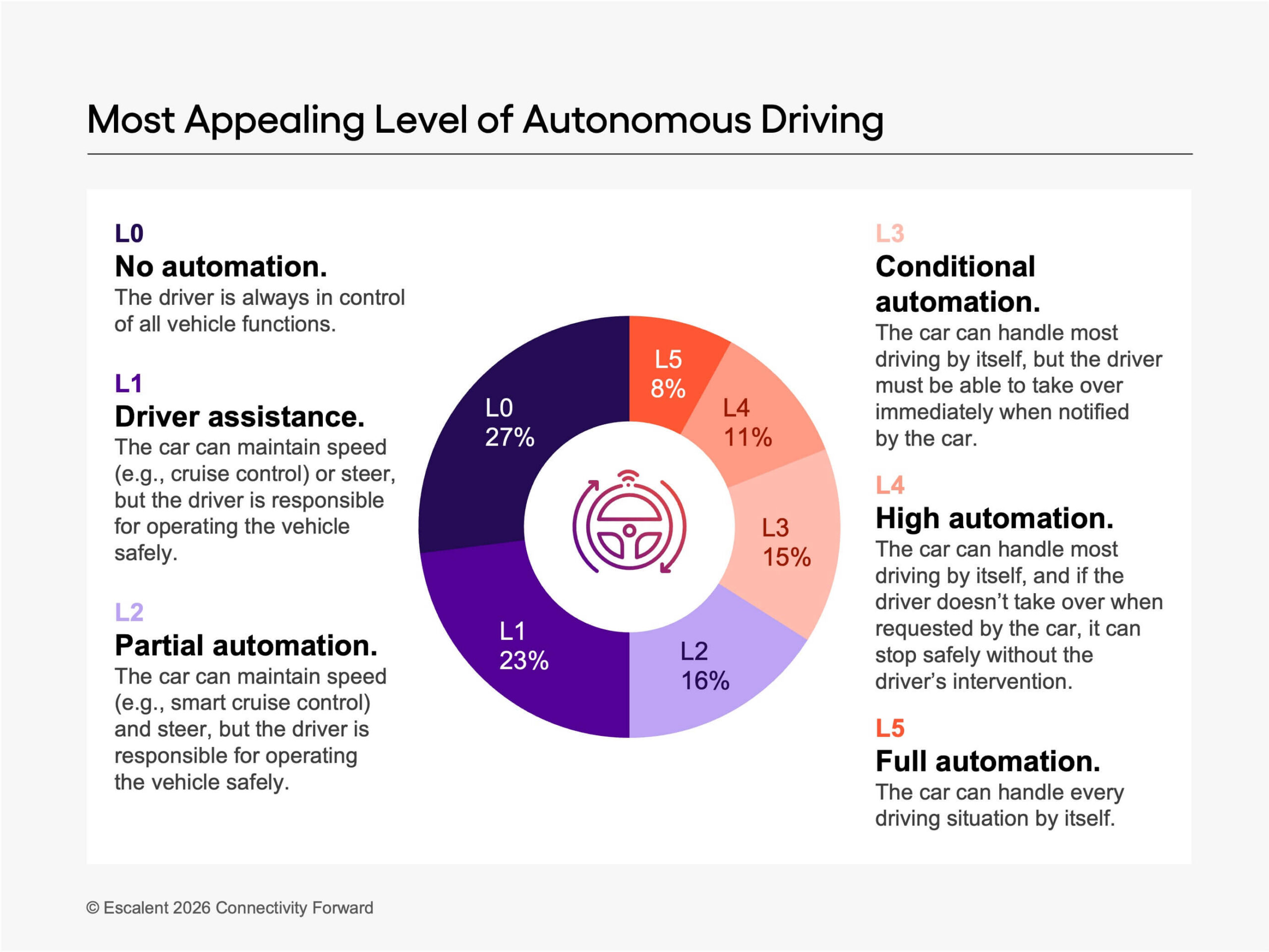
Our 2026 Autonomy findings indicate most drivers do not currently select higher levels of vehicle automation as their preferred experience, with half selecting “no automation” at all or the “driver assistance” description corresponding to SAE Level 1 (L1) driving automation. Thirty-four percent of drivers say that L3 or higher is most appealing to them, echoing Connectivity Forward’s 2025 findings on overall appeal of vehicle autonomy.
As expected, drivers who find no vehicle automation most appealing have the lowest level of interest in specific autonomy features; however, across six tested automated driving features, an average of nearly one-quarter (24%) of these drivers indicated interest in the features. Some features garnered even higher interest among this group of drivers. For instance, 27% were very or extremely interested in a feature that coordinates in real-time with other vehicles for traffic efficiency.
This means that a consumer’s stated preference for less vehicle automation doesn’t necessarily mean rejection of every automated driving feature.
Even among consumers who prefer higher levels of automation, this preference does not translate into uniformly higher automated driving feature interest. Drivers who prefer L4 autonomous driving showed slightly greater interest in nearly every automated driving feature tested than those who prefer L5. The exception was highway hands-free driving across a wider range of conditions, which was very or extremely interesting to 70% of L5-preferring drivers. Highway travel may therefore be a particularly promising context in which to explore the value of greater vehicle automation.
Taken together, these findings suggest that the market may not progress neatly from lower to higher levels of driving automation. Demand is likely to depend on the use case, driving environment, and the value consumers associate with delegating a specific task to their vehicle.
Why Consumer Trust and Competency Matter for Autonomous Vehicle Adoption
If consumers can see value in particular features but still resist higher levels of vehicle automation, trust may be the bridge between feature interest and adoption. Indeed, our report shows that while 33% of drivers trust autonomous driving features, 26% do not.
Using Escalent’s proprietary Tech TrustBuilder™ framework, we see that the underlying reason drivers don’t trust autonomous features in their vehicles is competency—that is, perceptions about the technology’s ability. For researchers and strategists, that finding raises a set of questions they can explore with consumers:
- Does the autonomous vehicle system behave predictably at the edge of its operating domain?
- Does the driver understand when and why responsibility is being transferred?
- Can the system communicate uncertainty without creating confusion?
- Does a difficult event strengthen trust through effective recovery, or weaken it?
- When does trust earned in one driving situation carry over to another?
Competency is not established simply by telling consumers that an autonomous vehicle system is safe or capable. Drivers need experiences that help them understand what the system can handle, where its limits are, and what happens when conditions change. For researchers, this means evaluating not only successful automated vehicle operation, but also handoffs, boundary conditions, system communication, and recovery.
Escalent has developed a future-vehicle framework for product research to help automakers evaluate these moments before features reach the market, combining consumer understanding with realistic scenarios involving system behavior, communication, handoff and recovery.
"Consumer trust in automated driving features is not earned through broad promises of safety. It is earned when drivers can see what the system can handle, where it stops and how it recovers."
What This Means for Connected Vehicle Services and Autonomous Vehicle Strategy
The implication is that automakers and suppliers should not evaluate vehicle autonomy as a single proposition. They need to identify the use cases in which vehicle automation solves a meaningful problem, determine which consumers value those use cases, and understand what experiences will demonstrate competency before asking drivers to place greater trust in the system.
For connected vehicle service and autonomous vehicle feature strategy, this means research should help answer three practical questions:
- Which automated driving tasks create enough value to overcome consumer hesitation?
- Which consumer segments are most receptive to those tasks and why?
- What system behaviors, handoffs and communication are needed to establish trust?
Consumers may not be asking for vehicle autonomy. But they are telling us where they want help. The opportunity for automakers and suppliers is to listen at the level of the driving task, then build the competency and trust required to deliver it.
To learn more about our Connectivity Forward study and how Escalent can help you develop connected vehicle services and automated driving features consumers want and are willing to pay for, fill out the form below to talk with us.
About Escalent’s Connectivity Forward™ Autonomy Study
Escalent conducted a survey of 4,176 US vehicle owners by online data collection in August 2026. The sample was drawn from multiple panel source partners. To qualify, respondents had to be owners of new or used vehicles whose primary vehicle must have been purchased within the last five years and they had to have at least 50% of the vehicle purchase decision. The data were weighted by age, gender and vehicle segment ownership. Escalent will supply the exact wording of any survey question upon request.
Key Questions: Consumer Demand, Vehicle Autonomy and Automated Driving Features
1. Do consumers actually want autonomous vehicles?
Consumers may not want autonomy as an abstract, all-or-nothing proposition. Escalent’s Connectivity Forward findings indicate many drivers are more receptive to specific automated driving features when those features address a recognizable driving situation or pain point.
2. Which automated driving use cases may create stronger consumer interest?
Highway travel may be one promising context, especially because highway hands-free driving across a wider range of conditions was very or extremely interesting to 70% of drivers who prefer L5 driving automation. More broadly, interest appears to depend on the driving environment and the value consumers associate with delegating a specific task.
3. Why don’t some drivers trust autonomous driving features?
Escalent’s research points to competency as the underlying issue. Drivers need confidence in the technology’s ability, including whether the system behaves predictably, communicates clearly and handles difficult moments effectively.
4. How can automakers research trust in autonomous vehicle systems?
Automakers and suppliers should evaluate more than successful operation of vehicle autonomy. Research should examine handoffs, boundary conditions, system communication, uncertainty, recovery and whether trust earned in one driving situation carries over to another.

K.C. Boyce
Vice President, Automotive & Mobility and Energy
K.C. Boyce is a vice president in Escalent’s Automotive & Mobility and Energy industry practices. He works with energy providers and automakers to craft compelling products and programs that accelerate the energy transition. Throughout his career, K.C. has worked across industries and sectors to develop innovative solutions to complex problems and translate subject matter expertise into actionable insight. He is a nationally known speaker on topics such as electric vehicles and solar and was the co-host of the weekly Energy Matters radio show, which won a 2024 Gabby Award from the Georgia Association of Broadcasters for “Best Podcast Series," until the show ended in December 2025. Before joining Escalent, K.C. was senior vice president at Chartwell, where he led industry and consumer research, conference production and marketing. He also served as the Smart Energy Consumer Collaborative’s assistant director, leading its consumer research program. K.C. holds an MBA from Georgia State’s Robinson College of Business and a bachelor’s degree in political science from Colorado College.