May 13, 2026
Executive summary: Fleet telematics adoption is widespread, but its impact is falling short as many fleet businesses struggle to translate data into meaningful operational action, according to Escalent’s Fleet Advisory Hub™ study findings. While telematics is valued for its potential to improve safety, efficiency and utilization, disconnected systems, limited business integration and lack of implementation support are preventing fleets from fully realizing these benefits. To unlock their full potential, telematics solutions must evolve beyond standalone tools into integrated, flexible ecosystems that align with diverse fleet business needs and enable coordinated, data-driven decision-making.
Fleet telematics has become a near-norm in commercial vehicle operations, promising safer drivers, improved efficiency and better visibility into vehicle performance. Yet despite widespread adoption, many fleet businesses are still not seeing those promises fully translate into day-to-day operational impact. As data volumes grow and systems become more complex, a clear gap is emerging between what fleet decision-makers expect telematics to deliver to the business and what they actually experience when they integrate and use a telematics solution.
In this mini-blog series, we explore the findings from Escalent’s latest Fleet Advisory Hub™ report, The Next Generation of Telematics Growth, to understand why this gap exists and what it will take to close it. In part 1, we examine the current state of fleet telematics, highlighting a value gap as well as the integration challenges that cause many solutions to fail to drive meaningful action. In part 2, we shift the focus from problem to solution, examining what it will take for telematics providers to move beyond providing standalone tools and evolve into true collaborative partners in fleet business performance, particularly as expectations rise and the need for connected, intelligent fleet ecosystems becomes more urgent.
Fleet Telematics Is Everywhere, So Why Isn’t It Working?
Telematics has become a foundational part of modern fleet operations. It promises safer drivers, more efficient routes, better vehicle utilization and lower costs.
On paper, telematics delivers. In practice, it falls short for many.
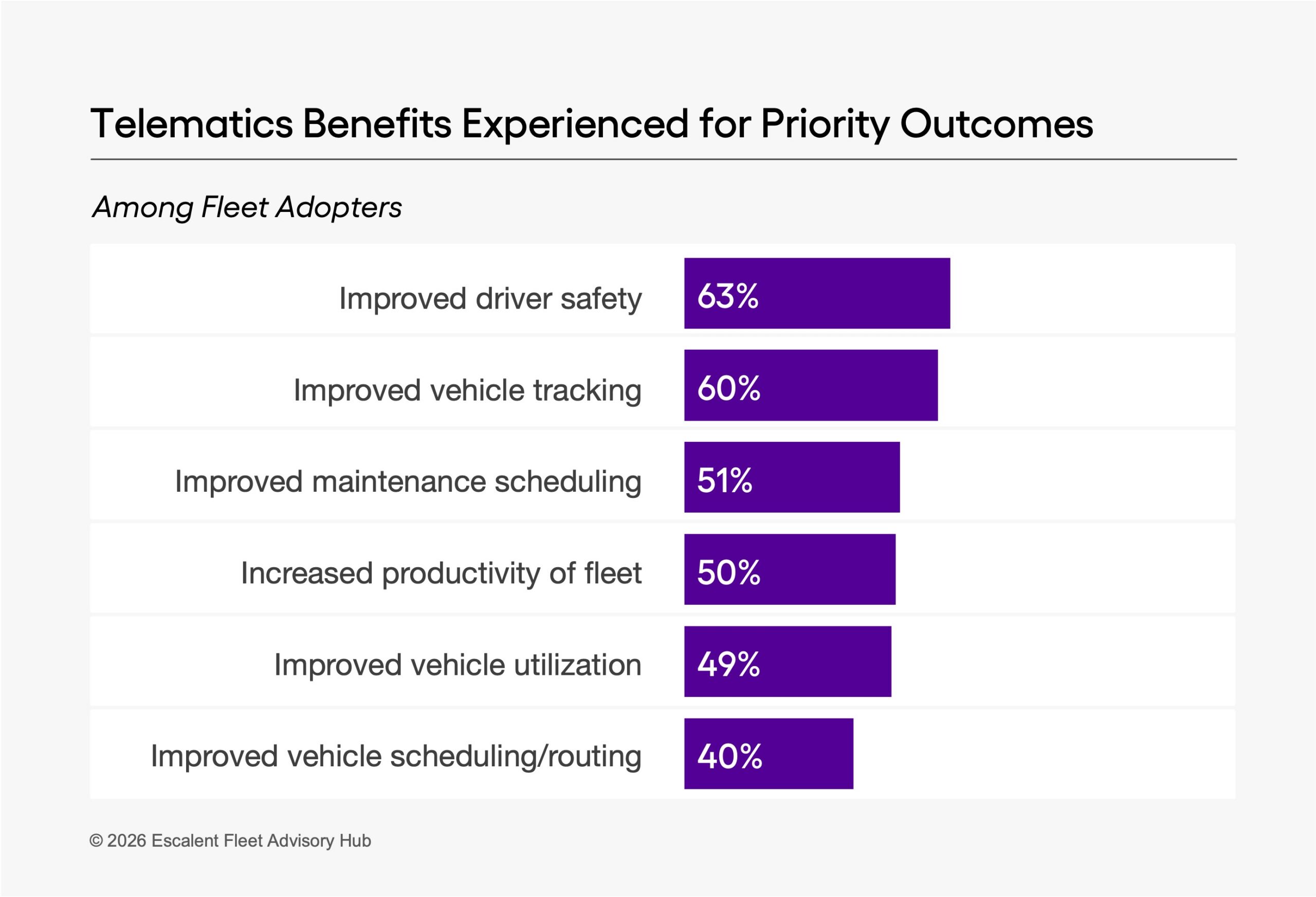
According to data from our recent Fleet Advisory Hub™ report, The Next Generation of Telematics Growth, fewer than half of fleet decision-makers (45%) strongly agree their telematics solutions fully meet their needs. What is even more telling is while fleets consistently point to “must-have” benefits such as driver safety, productivity and utilization, only about 40%–60% say they actually experience them.
That disconnect isn’t just a data point. It’s the whole story.
The next phase of telematics growth won’t be driven by adoption. It will be driven by whether fleets can turn data into meaningful action that impacts business performance.
The Telematics Value Gap: Why Adoption Isn’t Equal to Impact
At the heart of our findings is a clear tension: telematics is widely implemented but not fully leveraged.
Fleet businesses aren’t questioning the idea of telematics. They believe in its potential. In fact, expectations are very high: providers have done an effective job positioning telematics as essential to modern fleet performance. But expectations have outpaced execution.
This creates what can only be described as a “value gap,” the space between what telematics should deliver and what it actually does in day-to-day fleet operations. And importantly, this gap is not caused by a single failure. It’s the result of multiple, compounding challenges, including:
- Data without direction
- Tools without integration across the business
- Insights without operational follow-through
- Technology without implementation support
On paper, telematics is technically “working.” Commercial vehicles are connected. Data are flowing. Dashboards are populated. But operationally, it’s underdelivering for some fleet businesses.
The Root Problem for Fleet Businesses: Telematics in a Vacuum
One of the most important insights from the report is deceptively simple: telematics alone is not enough. Too often, telematics solutions are deployed in isolation. Plug in the device, access the dashboard and expect transformation to follow. This “dump and run” approach leaves fleet businesses with raw data and tons of reports, but no clear path to action.
Without integration into broader fleet business systems, such as maintenance platforms, routing tools or enterprise systems, telematics becomes reactive:
- Alerts flag issues after they happen
- Data require manual investigation and validation
- Insights remain disconnected from broader business workflows
The promise of telematics has always been proactive fleet management. While artificial intelligence may help, it’s also not the cure-all. The next generation of telematics performance requires something more: a connected ecosystem.
Why Fleet Telematics Integration Is Key to Turning Data Into Actionable Intelligence
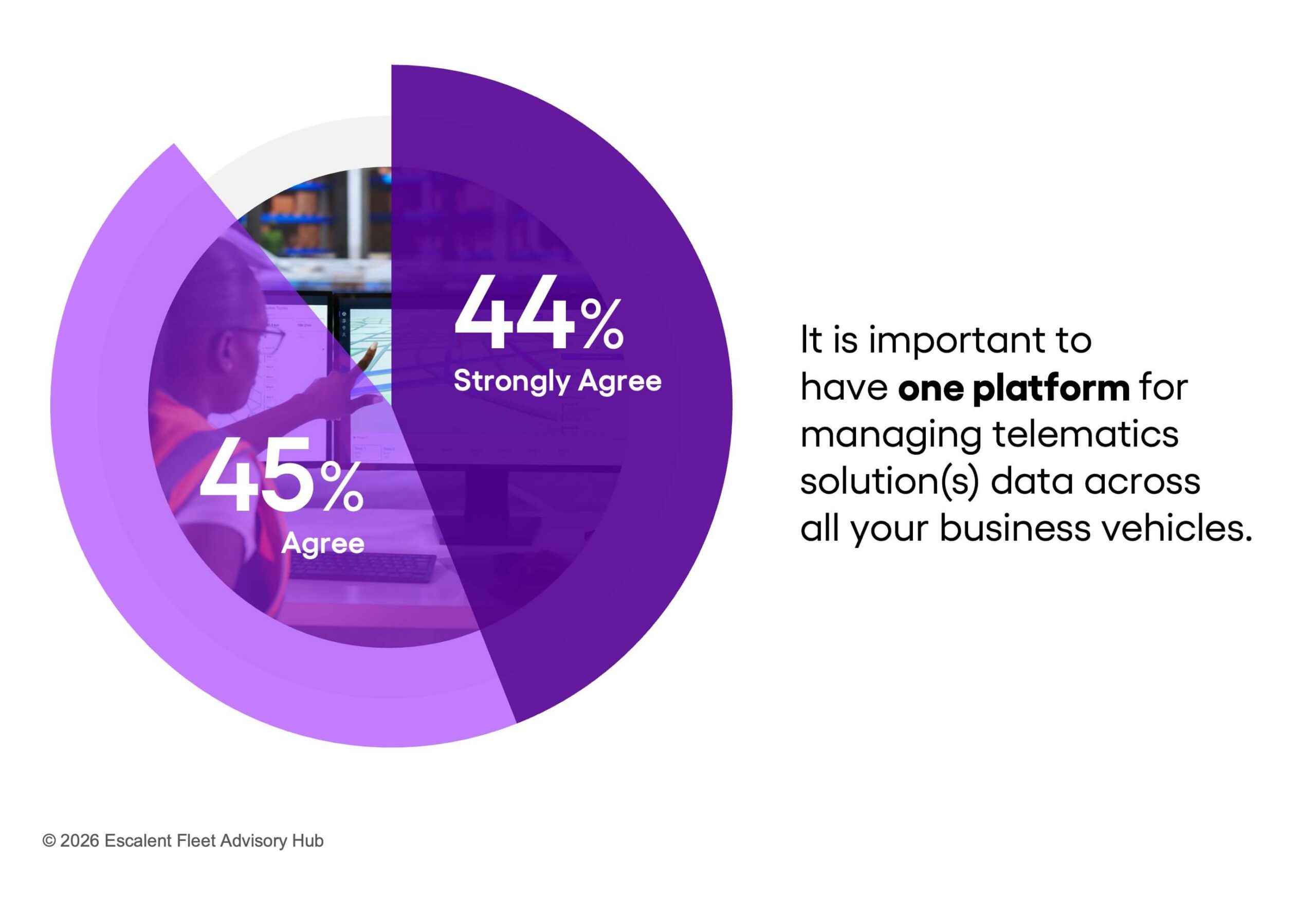
Fleet decision-makers and operators know what they need. Nearly 9 in 10 say it’s important to have a single platform to manage telematics data across all business vehicles. They’re looking for simplicity, visibility and alignment across systems. But the reality is far more complex.
Many fleets operate across multiple tools and providers. Telematics integration is difficult, resource-intensive and often out of reach, especially for smaller fleet businesses without dedicated data teams. This creates a critical tension:
- High demand for integration
- Low ability to execute it
And yet, integration is where the real value lives. When telematics data connect with commercial vehicle maintenance systems, fuel management, routing and broader business intelligence, the data transform from isolated insight into coordinated action. Telematics data integration enables:
- Predictive vehicle maintenance instead of reactive repairs
- Smarter routing tied to real-world conditions
- Cross-functional decision-making across operations
In short, the integration of telematics data shifts fleets from just connected vehicles to connected businesses.
One Size Doesn’t Fit All and Fleets Know It
Another layer of complexity: fleets are not uniform. Even within a single organization, needs vary across vehicle types, roles and operational goals. A sales fleet behaves differently than a service fleet. A light-duty vehicle has different priorities than a heavy-duty truck. And yet, many telematics solutions are still positioned as universal.
Only 21% of fleet managers strongly agree, with another 42% who agree, that their telematics needs are consistent across all vehicles—meaning more than one-third of fleet managers are navigating fundamentally different vehicle use cases with the same fleet and telematics program.
This highlights a key takeaway: firmographics such as fleet size or industry simply aren’t enough to adequately position telematics solutions to respond to the unique needs of the business.
What matters is telematics providers understanding:
- Operational maturity
- Fleet business priorities (efficiency vs. uptime vs. cost)
- Specific use cases across the fleet
The future of telematics isn’t solely about adding more features. It’s about aligning solutions to real-world complexity.
The Path to Realizing Telematics Value for Fleet Businesses
Closing the gap between what telematics promises and what fleets actually experience will define the next phase of growth for telematics providers.
While adoption is widespread, our findings make clear that having a telematics solution alone is not enough to maximize value to fleets. The real opportunity lies in how effectively telematics providers can help fleets integrate and operationalize telematics data into broader business systems and translate insights into coordinated, day-to-day action that improves business performance. Without that shift, telematics risks remaining a passive reporting tool rather than an active driver of business value.
In part 2 of this mini-blog series, we will explore what the next generation of telematics needs to look like in practice, and how fleet businesses, providers and ecosystem partners can move from fragmented data to truly connected, intelligent operations.
Interested in learning more? Connect with one of Escalent’s commercial vehicle and fleet industry experts to discuss our findings and how you can leverage our insights to better meet fleet business needs by completing the below form.
Want to learn more? Let’s connect.

Lucas Lowden
Insights Consultant, Automotive & Mobility
Innovation strategist and business analyst, Lucas has over 15 years of experience in market research and automotive. He is the program lead for Fleet Advisory Hub™—an innovative, cost-effective way for companies to secure a substantial portion of their annual commercial and fleet vehicle insights. Lucas has spent significant time working with senior management to frame Escalent's automotive strategy around the next generation of research and consulting solutions. He also led the facilitation of a cross-functional team to develop Escalent's big data and IoT strategy, capabilities and partner network.

Dania Rich-Spencer
Vice President, Automotive & Mobility
Dania is a highly accomplished market researcher with a track record of designing and implementing complex research and analytical programs that positively impact business performance.