July 16, 2026

EXECUTIVE SUMMARY
- Escalent’s 2026 Fleet Technology Index shows that market readiness for commercial vehicle and fleet technology adoption is slowing.
- Using Escalent’s proprietary BeSci x AI™ technology, the study found that fleet decision-makers generally recognize the value of new technologies but often lack confidence in operational fit, seeking proof points to validate marketed claims.
- Environmental opportunity and reflective motivation are the primary behavioral science barriers to adoption.
- To reengage fleet customers, vehicle manufacturers and technology providers should focus on demonstrating real-world performance, clear ROI and practical fit within fleet operations through education, evidence and ongoing consultative engagement.
For the first time since the midst of the COVID-19 pandemic in 2021 and 2022, Escalent’s Fleet Technology Index (FTI) score—a measure of market readiness for commercial fleet technologies—has decreased year-over-year.
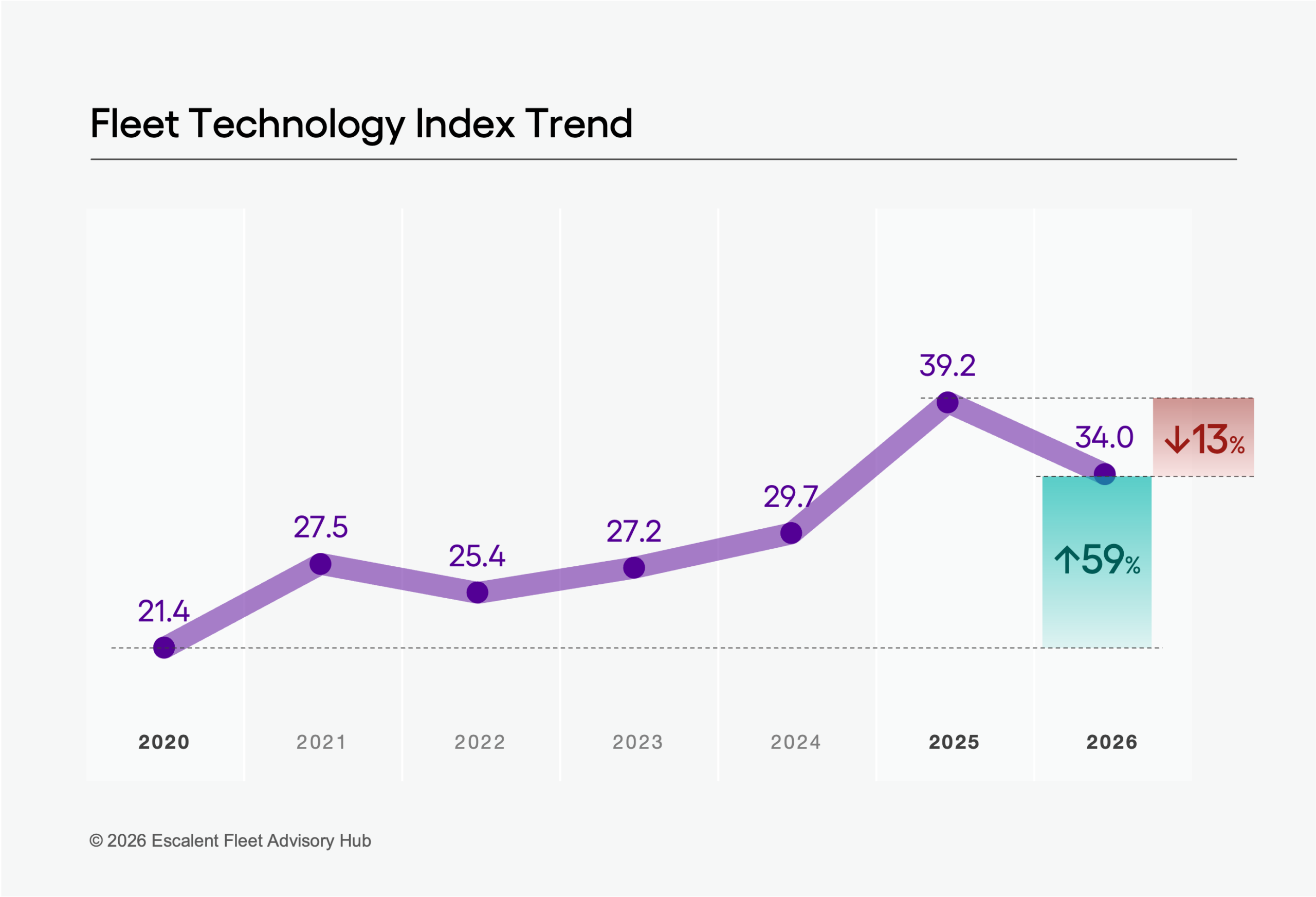
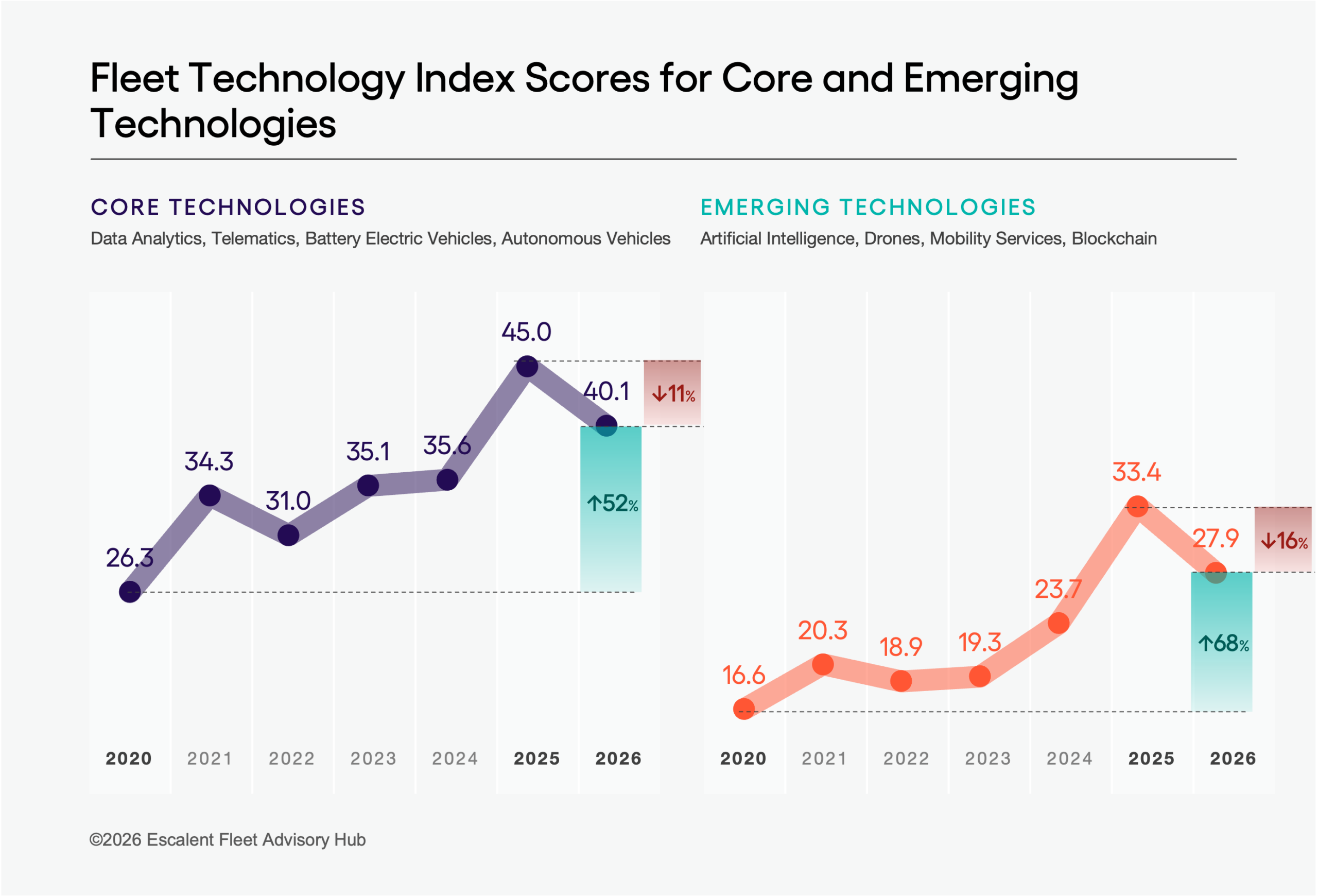
The 2026 Fleet Technology Index 7.0 study from Escalent’s Fleet Advisory Hub™ insights program surveyed more than 1,000 fleet decision-makers to assess their attitudes toward consideration and adoption of commercial vehicle and fleet technologies. Fleet decision-makers evaluated four core technologies: battery electric vehicles (BEVs), telematics services, autonomous vehicles and data analytics. They were also asked to weigh in on four emerging technologies: artificial intelligence, blockchain, mobility services and drones.
Feedback suggests a softening in fleets’ near-term readiness for both categories. Over the past year, the core technology FTI score declined 11%, while the emerging technology score fell 16%. To better understand the underlying fleet decision-maker sentiments, we applied Escalent’s proprietary BeSci x AI™ framework to understand the factors that move fleet businesses closer to adoption, the barriers holding them back and the interventions that will encourage greater uptake.
The findings reveal that, while market readiness for fleet technology adoption has softened, vehicle manufacturers and technology providers have clear opportunities to reignite enthusiasm.
Using BeSci x AI to Understand Fleet Technology Engagement
BeSci x AI™ is Escalent’s proprietary AI-powered behavioral science insights model that blends proven behavioral science frameworks, advanced AI and human expertise to explain why people act—and what it takes to nudge people toward better outcomes. The model’s central premise is that three themes—capability, opportunity and motivation—must interact for any behavior to occur.
For our 2026 Fleet Technology Index 7.0 study, our BeSci x AI analysis looked at six factors that define the three overall themes that can either drive or prevent behavioral change:
- Capability: Can they do it?
This includes psychological factors such as understanding, knowledge and cognitive function, as well as physical skills, strength and stamina. - Opportunity: Does the environment allow it?
This covers environmental opportunity factors such as time and resources along with social/cultural norms, peer influence and stakeholder expectations. - Motivation: Do they want to do it?
This includes automatic habits, gut responses and emotional reactions as well as reflective reasoning, planning and cost-benefit evaluation.
By applying these six validated dimensions of human behavior, the framework classifies likelihood to effect change with 98% accuracy, helping sellers move beyond what customers say to uncover the real behavior drivers shaping decisions.
In the context of fleet technology, adoption happens when decision-makers have the knowledge and skills to act, the environment to support adoption and the motivation to move forward.
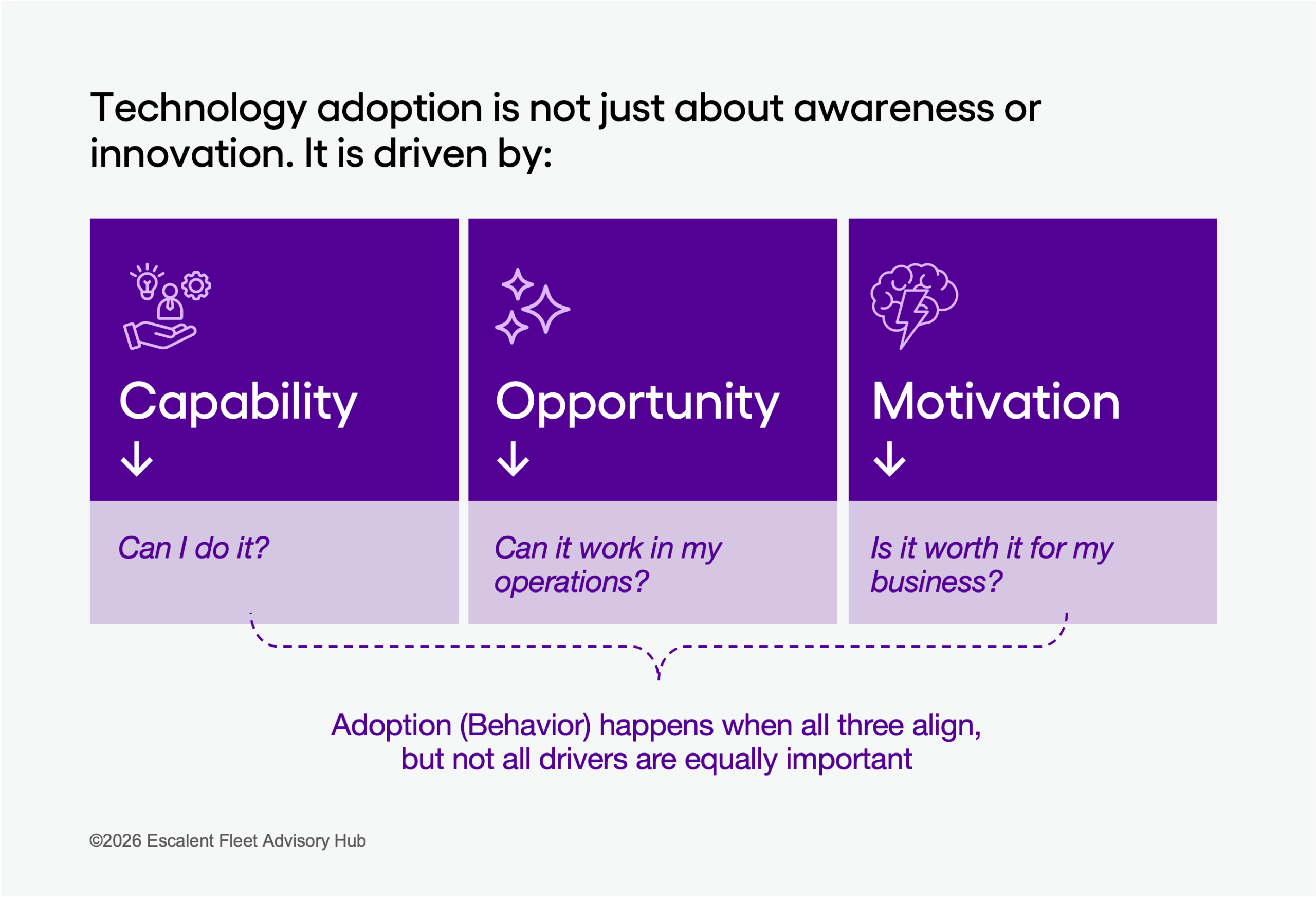
Our analysis reveals the primary barriers to adoption are opportunity and motivation. At a high level, fleet decision-makers understand these technologies and recognize their potential value, but the real barriers to adoption stem from the operational and regulatory environment. These challenges can make it difficult for fleet professionals to dedicate the time and resources needed to manage tech integrations, as well as available relevant proof points to support characteristically slow and rational decision-making. The key themes—confidence in proof of operational fit and clear return on investment (ROI)—hold consistent across the four core technologies analyzed.
Translating Behavioral Diagnosis Into Activation Strategies for Fleet Customers
With the underlying adoption barriers diagnosed, our analysis can be applied to specific business challenges to identify potential solutions. For instance, in the case of BEV adoption, we found that the most prominent levers are within environmental opportunity.
Increased BEV adoption will require credible proof of real-world applications in like-for-like fleet operation examples and clear economic justification. Adoption is blocked when doubts about safety and reliability persist, the ROI is unclear and the paradigm shift from liquid fuel to charging raises concerns around downtime, route disruption and infrastructure complexity.
As a result, the most effective interventions would show decision-makers how:
- BEVs perform in comparable fleet businesses
- Keeping BEVs on the road fits into daily operations
- BEVs deliver a measurable economic payoff
Meanwhile, trust gaps in BEV readiness should be addressed directly. Vehicle manufacturers should use education and persuasion to combat anxieties related to safety, battery and quality issues, countering hesitation with testing data, warranties and operational evidence.
For Technology Providers, Persistence Is Persuasion to Influence Fleet Decision-Makers
We believe these technologies are still in early market stages and are progressing through natural growing pains of a maturing market. Our findings suggest that cooled enthusiasm for fleet technologies and growing skepticism are behaviorally driven by environmental barriers to adoption. Continuing to demonstrate to decision-makers how fleet technologies are readily applicable and beneficial is one of the best ways for technology providers to weather the current dip in enthusiasm.
For vehicle manufacturers and technology providers, this is a critical time to deepen engagement with fleets. When it comes to rebuilding momentum for commercial vehicle and fleet technology, persistence is persuasion. Providers need to lean in, rather than pull away, from fleet relationships. Our study findings indicate that fleet decision-makers will be more likely to embrace new technologies when they see concrete use cases, demonstrated outcomes and relatable, business-specific evidence that those technologies can work in fleets’ operating environment. By positioning themselves as educational resources and consultative partners, providers can help fleets work through uncertainty and reduce friction at the exact points where they are hesitating.
To learn more about the 2026 Fleet Technology Index and how behavioral science insights can help accelerate fleet technology adoption, fill out the form below to connect with one of Escalent’s commercial vehicle and fleet industry experts.

Lucas Lowden
Insights Consultant, Automotive & Mobility
Innovation strategist and business analyst, Lucas has over 15 years of experience in market research and automotive. He is the program lead for Fleet Advisory Hub™—an innovative, cost-effective way for companies to secure a substantial portion of their annual commercial and fleet vehicle insights. Lucas has spent significant time working with senior management to frame Escalent's automotive strategy around the next generation of research and consulting solutions. He also led the facilitation of a cross-functional team to develop Escalent's big data and IoT strategy, capabilities and partner network.

Dania Rich-Spencer
Vice President, Automotive & Mobility
Dania is a highly accomplished market researcher with a track record of designing and implementing complex research and analytical programs that positively impact business performance.

Aimee Jamison
Associate Director
Aimee Jamison is an associate director on the Behavioral Science team with Escalent. She brings deep expertise in uncovering the drivers of human behavior and translating those insights into actionable strategies for clients. Drawing on a background in forensic interviewing and psychological profiling, she has built her career around understanding the "why" behind decision-making and helping organizations move beyond surface-level insights. Aimee applies a behavioral science lens to qualitative research, guiding clients across industries including technology, health, retail and finance to uncover the cognitive and emotional factors that shape consumer choices. Her ability to navigate complex conversations and deliver clear, evidence-based insights enables clients to make confident decisions and develop solutions that align with how people truly think and behave.