April 28, 2026

Executive summary: Escalent’s EVForward research shows that pricing remains one of the most powerful levers for accelerating BEV adoption in Europe. While product improvements remain essential, strategic price positioning—particularly for price-sensitive vehicle buyers—could significantly expand BEV consideration and market share.
Why Pricing Still Matters for BEV Adoption in Europe
Accelerating the adoption of battery electric vehicles in Europe continues to be a challenge for automotive manufacturers.
In simple terms, auto brands have two levers to pull: product and price.
Findings from Escalent’s EVForward study of electric vehicle (EV) buyers and electrified powertrain adoption indicate that even in 2025, 40% of new-car buyers in Europe’s five biggest markets (France, Germany, Italy, Spain and the UK) consider BEVs to be a “work in progress”—a clear indication that the product needs to evolve before BEVs are widely recognized as a fully credible alternative to internal combustion engine (ICE) vehicles.
While we’ll explore optimal BEV product specifications likely to deliver BEV viability in a future analysis based on a survey currently in field, this blog focuses on the power of the pricing “lever” to accelerate BEV adoption and how it can be used strategically and sensitively to achieve sales goals.
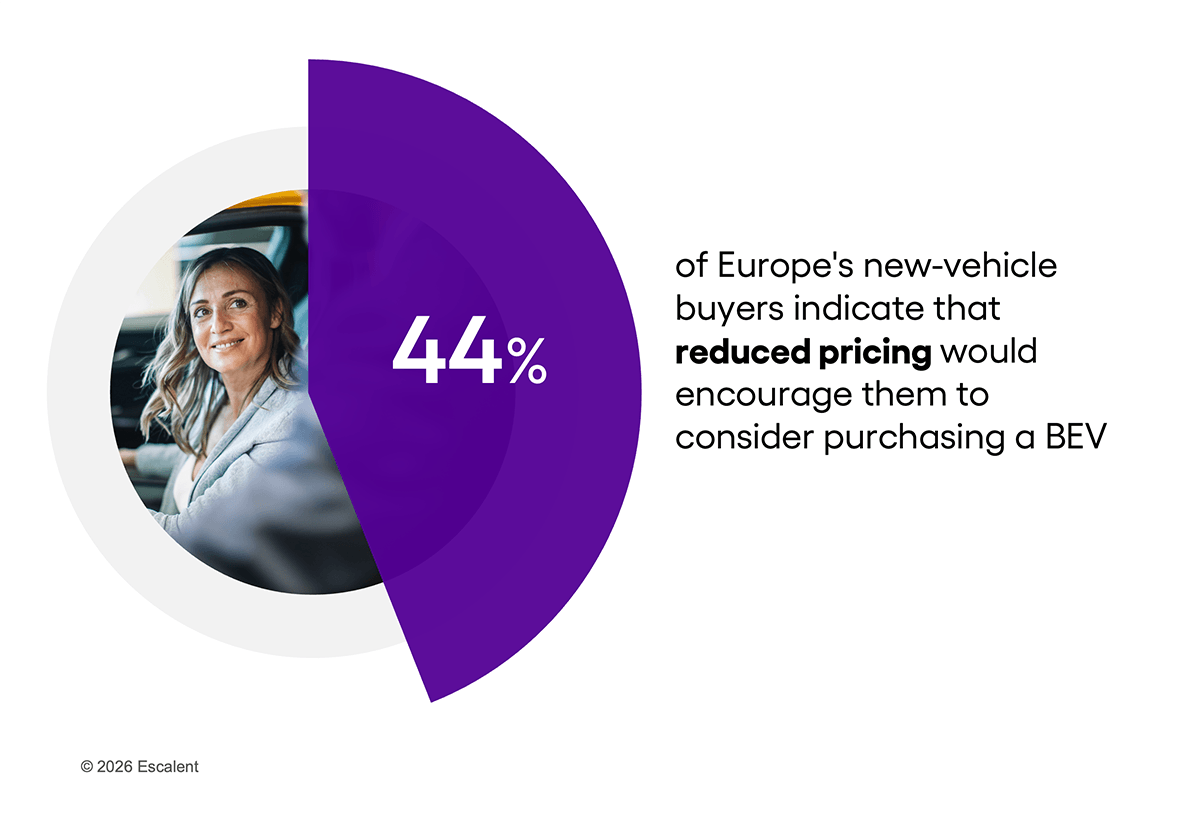
In our EVForward Europe 2025 Incentives DeepDive study, we asked new-car buyers what would motivate them to actively consider buying a BEV, and 44% of Europe’s buyers indicate that reduced pricing would encourage them to engage.
There is consumer recognition that BEVs are priced at a significant premium to ICE vehicles and, as 40% of new-car buyers still view BEVs as a work in progress, there is a distinct risk that the price premium is seen as unjustifiable.
Unless the BEV product proposition evolves to justify higher pricing, BEVs will need to become more affordable to accelerate mass-market adoption.
“When a large share of consumers still views BEVs as a developing technology, pricing becomes more than a commercial lever—it becomes a signal of value, credibility and readiness for the mainstream car buyer.” – Mark Carpenter, Managing Director, Automotive & Mobility Europe, Escalent
How Influential Are Pricing Incentives in Electric Vehicle Purchase Decisions?
The “windshield sticker” price has always commanded attention in the automotive market.
Similar to supermarket promotions, special offers and discounts can generate opportunistic consideration among buyers who might otherwise delay purchase decisions.
Key findings from Escalent’s EVForward Europe research show:
- Almost half (47%) of Europe’s new-car buyers acknowledge that incentives are very influential at the time of any new vehicle purchase.
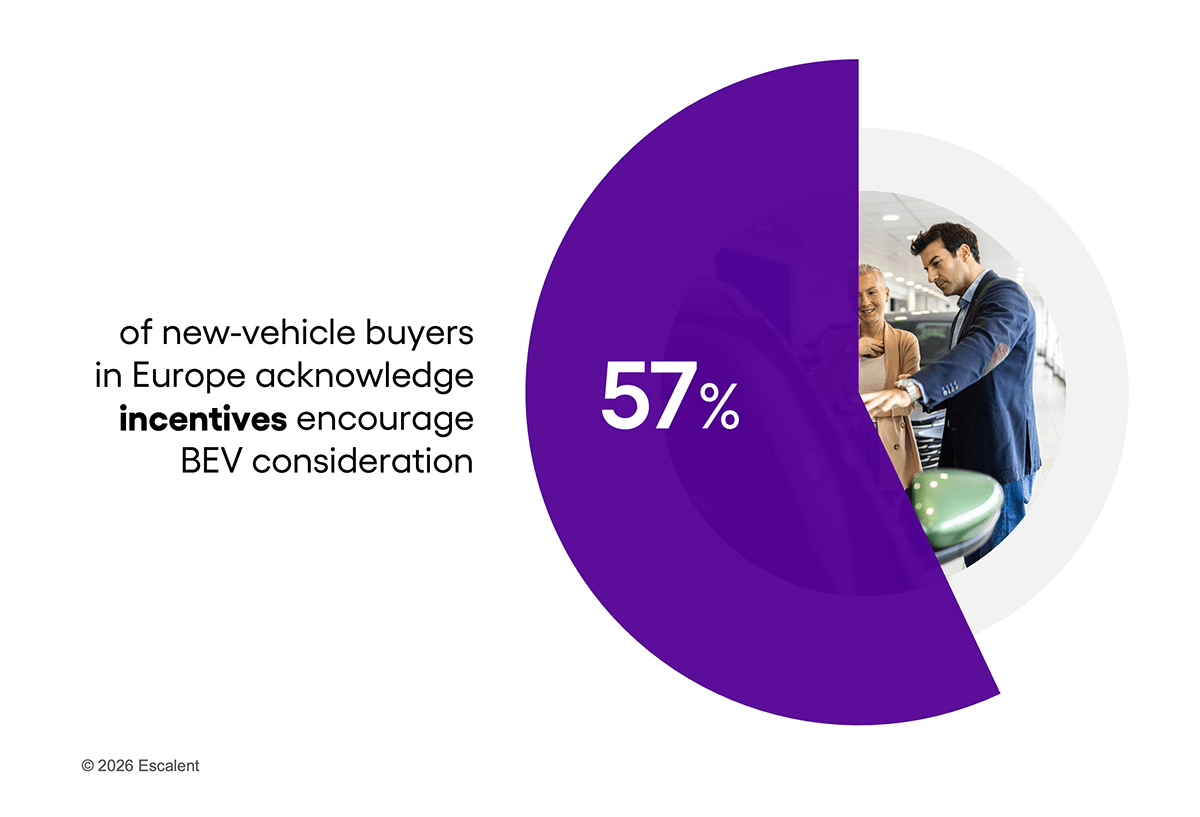
- In a BEV context, this rises to 57%.
- 44% of buyers say lower BEV prices would encourage active consideration.
However, most vehicle manufacturers cannot adopt the classic supermarket tactic of “pile it high, sell it cheap.” The vast investment in BEV research, development and platform engineering requires a path toward suitable returns.
To find optimal price points that increase BEV sales volumes while providing decent returns, auto manufacturers must understand price elasticity dynamics.
Price elasticity indicates how sensitive buyers are to both upward and downward price changes.
“Discounting alone won’t transform the BEV market. What matters is understanding where price actually shifts behavior—and where it simply erodes value without changing BEV purchase intent.” – Steve Hill, Senior Director, Automotive & Mobility Europe, Escalent
Understanding BEV Price Elasticity Across European New-Vehicle Buyers
According to our EVForward findings, Europe’s new-car buyers fit into three almost equally sized groups when it comes to price elasticity:
- EV Owners, who already own a BEV, and EV Intenders, consumers who are more than 15 times more likely than the average new-car buyer to purchase a BEV as their next vehicle, according to Escalent’s EVForward algorithms.
- EV Resistant new-vehicle buyers, who remain strongly opposed to BEV adoption.
- EV Open, a middle-ground segment that is neither strongly for nor against electric vehicles.
To test price elasticity, we invited all three groups to tell us how likely they would be to consider a BEV at different price points relative to a comparable ICE vehicle. We randomized the pricing scenarios so that our respondents had no way of knowing whether the next BEV price would be more or less attractive to the ICE vehicle. This promotes honest responses and eliminates the ability to “game play.”
What Escalent’s BEV Price Elasticity Findings Show
Two of our new-vehicle buyer groups are inelastic: for completely contrasting reasons, BEV consideration levels vary by relatively modest amounts for EV Owners and EV Intenders, and EV Resistant groups.
EV Owners and EV Intenders
- Already strongly favorable toward BEVs, so they are very likely to buy with minimal encouragement from reduced prices.
- Seven in ten would consider a BEV even if it were priced 10% higher than the comparable ICE vehicle.
EV Resistant
- Already strongly opposed to BEVs.
- Even if BEVs were priced 11% below the comparable ICE vehicle, only one in three would consider a BEV.
Where Price Has the Greatest Influence
The EV Open segment demonstrates the highest levels of price sensitivity.
- Only one in three would consider a BEV if it were priced 10% higher than an ICE equivalent.
- However, as BEV pricing becomes more advantageous, consideration more than doubles.
This middle-ground segment represents one of the largest untapped opportunities for accelerating BEV adoption in Europe.
What Role Could Chinese EV Brands Play in BEV Pricing Dynamics?
When analyzing price dynamics solely among established automotive brands from Europe, Japan, South Korea and the USA, it’s inviting to dismiss a scenario where BEVs are priced 11% below ICE equivalents as hypothetical.
However, that scenario becomes more realistic when Chinese automotive manufacturers enter the equation. China-based manufacturers have enthusiastically embraced BEV production, ensuring they got in at the start of the new powertrain direction.
The sheer scale of Chinese industrial capacity coupled with lower production costs means that a whole new spectrum of Chinese brands is competing for share in what has always been an intensely competitive European automotive market for well established brands.
It might have taken Japanese brands more than 20 years to achieve reputational parity in Europe and South Korean brands just more than 10 years, but this raises an important strategic question: What sort of consumer acceptance trajectory will Chinese brands follow in Europe?
Escalent has already carried out two waves of our Chinese Automotive Brand Impact Study in Europe and our findings provide clarity on this.
In our first study in 2024, we found any initial skepticism that European new-car buyers had toward Chinese goods because China has been painted as the geo-political “bad guy” quickly erodes when car buyers encounter credible vehicles offered at compelling prices.
One year later in our second study in 2025, we found:
- Cars from China have the biggest increase in consideration, jumping 16 percentage points year-over-year, from 31% in 2024 to 47% in 2025.
- 42% of new-vehicle buyers indicate that Chinese ownership of a European car brand “doesn’t matter as long as the product quality is good.”
How Price Can Accelerate Consumer Acceptance of Chinese EV Brands
Escalent’s European Chinese Automotive Brand Impact Study research also shows:
- At price parity with a comparable BEV from an established European brand, around one in ten car buyers would be somewhat or much more likely to buy the Chinese vehicle.
- A modest price advantage could more than double this share.
In an inertia-led market, one in ten represents a meaningful foothold.
Why Pricing Strategy Will Shape the Next Phase of BEV Adoption
In the near future, it’s clear the European car market is going to become more complex and challenging.
Current BEV registration levels remain barely beyond the Early Adopter phase of the innovation adoption curve—a stage at which price reductions are not typically expected.
However, several forces are reshaping the market:
- Regulatory pressure from European CO2 targets and the threat of serious penalties if those targets are unmet.
- Heavy BEV investment commitments from established automakers.
- Competitive pressure from new Chinese EV brands.
Notwithstanding tariff tactics, Chinese vehicle brands are likely to have the ability to simultaneously make BEVs more affordable while also capturing share from incumbent brands.
This makes pricing strategy more important than ever.
Automakers must create pricing strategies that are carefully informed by the price elasticity dynamics of several distinct factors that impact the European car buyer, ensuring automakers can accelerate BEV adoption without undermining long-term profitability.
Q&A: Common Questions About BEV Pricing and Adoption in Europe
Why are battery electric vehicles considered expensive in Europe?
Many consumers perceive BEVs as significantly more expensive than comparable ICE vehicles, especially when consumers view the BEV technology as still evolving. Unless product capabilities clearly justify the premium, price reductions or incentives may be required to drive wider BEV adoption.
Which consumers are most influenced by BEV price reductions?
Escalent’s EVForward research shows EV Open new-vehicle buyers are the most price sensitive. They are neither committed nor resistant to electrification, meaning competitive pricing can significantly increase their likelihood of considering an EV.
Striking the right balance between vehicle volume, price and profitability has never been more complex for automakers.
We can help. Contact us to access the EVForward Europe 2025 Incentives DeepDive and uncover how you can better understand price elasticity, evaluate incentive impact and build a strategy grounded in real market behavior.
Want to learn more? Let’s connect.
About Escalent’s EVForward Europe Study
Findings referenced within come from Escalent’s EVForward Europe 2025 Incentives DeepDive study that was conducted across five European countries—France (n=410), Italy (n=424), Germany (n=418), the United Kingdom (n=422) and Spain (n=415)—and included a survey that was fielded from October 16 to November 17, 2025. Respondents were aged 18 to 80 with a primary vehicle model 2019 or newer and planning to purchase a new vehicle within the next five years. Data were weighted by age and gender to match the demographics of the new-vehicle buyer population and by vehicle segment and battery electric vehicle powertrain to match current vehicle sales. The sample for this research comes from an opt-in, online panel. As such, any reported margins of error or significance tests are estimated and rely on the same statistical assumptions as data collected from a random probability sample. Escalent will supply the exact wording of any survey question upon request.

Mark Carpenter
Managing Director, Automotive & Mobility Europe
Mark is a Managing Director with Escalent's Automotive & Mobility Europe practice and is based in our Guildford, UK office. With over 30 years of creativity, experience, and passion for research combined with deep technical know-how, Mark leads business development in Europe for the automotive practice, in conjunction with Escalent’s global development strategy.

Steve Hill
Senior Research Director, Automotive & Mobility Europe
Steve Hill is a Senior Research Director in Escalent’s Automotive & Mobility Europe practice and is based in our Guilford, UK office. With over 20 years of client-side experience working across the automotive and tech sectors before joining Escalent, Steve has a strong understanding of client needs and how consumer research can drive business decisions in an industry going through seismic change. Working at JLR through a period of huge expansion, he led the brand and product development research underpinning the new Land Rover Defender and the expansion of the Range Rover range, winning a Market Research Society award for international research in the process. While at Amazon, he worked across the Prime Video brand, understanding how market research can come together with broader data sets to revolutionize and speed up decision-making. With experience working across all continents, Steve has a keen eye for how cultural nuance is vital to market success.