March 2, 2026

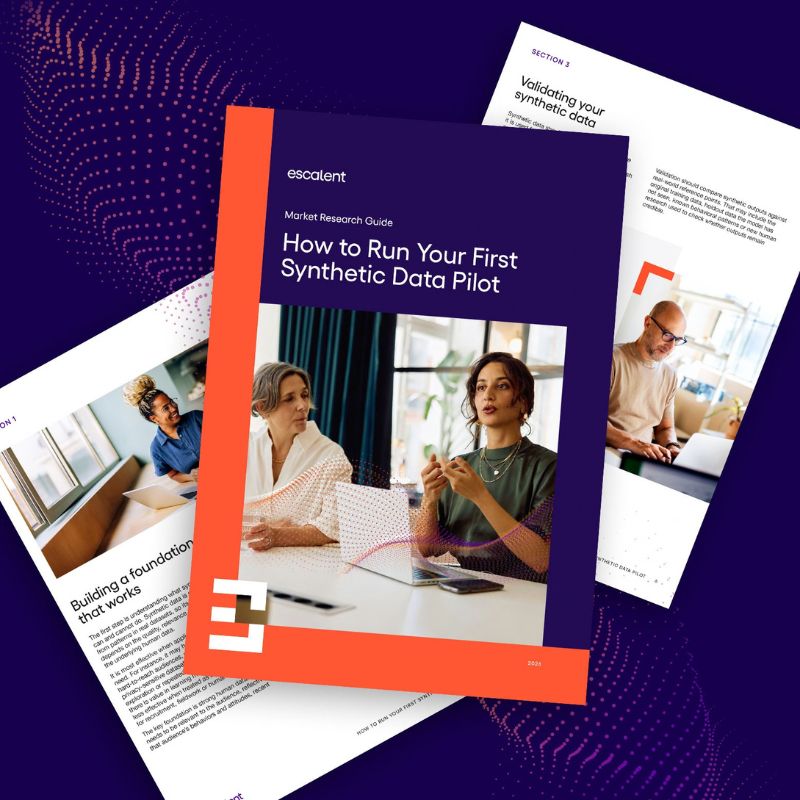
Editor’s Note: Watch “Synthetic Data Without the Hype,” Escalent’s on demand webinar hosted by Chris Barnes and Dyna Boen where they share practical guidance based on what we’ve learned from training our teams and working with F100 clients.
Who should read this?
CMOs, market researchers and insight leaders exploring how to use synthetic data responsibly—while maintaining research rigor and decision-grade standards.
What Is Synthetic Data in Market Research—and Why Is Everyone Talking About It?
Synthetic data has become the latest thing in the research toolkit that promises to fix the parts of our jobs that are slow, expensive or just plain painful. Depending on who’s talking, it’s either the future of insights or the beginning of the end for talking to real people.
From what we’ve seen in real projects, the truth is less dramatic and more useful: synthetic data is neither hero nor villain. It’s a powerful, fragile tool that only works when we treat it with the same rigor we’d use on any other source of insight—and when we remember that, at the end of the day, we’re still trying to understand human beings.
At Escalent, we approach synthetic data through what we call human-guided AI—combining advanced modeling with experienced researcher judgment to ensure outputs are decision-grade, not just statistically impressive.
Three Mindset Shifts for Using Synthetic Data Effectively
1. Is Synthetic Data Really “Free Sample”?
The most common temptation is to think of synthetic data as free extra respondents.
On paper, it looks amazing. You start with a tough audience—say, institutional investors with more than a billion in assets—and suddenly you can go from n=100 to something closer to n=300 by augmenting your sample synthetically. Brand scores stabilize, NPS looks more “reliable” and it feels safer to slice the data.
Here’s the catch: 300 synthetically boosted isn’t the same thing as 300 more humans. Boosting the N this way does not reduce sampling error in the same way we’re used to, because we’re not drawing more people from the population; we’re asking a model to generate lookalikes based on the people we already talked to.
What’s the Right Way to Think About Synthetic Sample Augmentation?
The mindset shift: Don’t celebrate the bigger N by default.
Ask: “Is this enough to stand in front of the C-suite and say, ‘This is decision grade?’”
Anchor every synthetic augmentation in the specific metrics that matter—if the synthetic boost doesn’t improve our confidence in those, it’s just decoration.
Applied well, sample augmentation can help us hear from hard-to-reach segments with more clarity. Applied lazily, it just gives us more decimal places on a shaky foundation.
2. How Should Synthetic Data Be Validated?
Too many synthetic data conversations start with, “Look what this model can do.” A more productive question is, “What problem are we actually trying to solve and how would we know if this approach works?”
The way to answer that looks surprisingly familiar: define the problem, form a hypothesis, set up a procedure, run a pilot and then really look at whether the results make sense. That’s exactly the discipline synthetic data needs.
What Does Good Validation Look Like in Practice?
A few practical practices:
- Use holdouts. Take some of our real data, hide it from the model, let the model generate synthetic data and then see how well the synthetic and real line up—especially on the relationships between variables, not just the top-line percentages.
- Check the relationships, not just the frequencies. For marketers, the magic is in the “levers”—how changing satisfaction, ease or trust moves outcomes like NPS or purchase intent. If synthetic data breaks those relationships, it’s not ready for prime time, no matter how nice the charts look.
- Be okay with “no.” Some pilots will fail: digital twins that deviate by 10+ points, personas that mangle skip logic and age checks, models that overestimate purchase intent because the “twins” want to please us. Saying “this isn’t good enough to use yet” is a sign of maturity, not failure.
“Treat synthetic data like a science experiment, not a magic trick. If we’re not testing, we’re guessing—and now we’re guessing at scale.” —Chris Barnes, President, Escalent
3. When Should You Simplify—and When Should You Protect?
Synthetic data also forces us to confront the complexity of our own instruments.
Our questionnaires are often overloaded—big grids, intricate routing, lots of open ends—because we’re trying to squeeze every last bit of value out of every respondent. Humans can struggle with that. Synthetic methods struggle even more.
From real-world pilots, a few patterns emerge:
- Synthetic approaches violate skip patterns and survey logic on complex designs.
- Quality-control variables like age create unexpected issues for some models.
- The more variables we try to synthesize (in one case, over 4,000), the more things drift and the more hand-tuning is required.
What Should Researchers Do Differently?
Two actions follow:
- Where we can, simplify. Don’t make things unnecessarily complex. If we want synthetic methods to be part of our operating model, we’ll get paid back for making some instruments simpler and more focused—especially big batteries and complex routing. That’s good for the models and good for our humans.
- Where we can’t, protect. Some work simply shouldn’t be handed to synthetic tools today: new topics with no human “truth” yet, sensitive or highly nuanced segments, or high-stakes decisions where nuance and emotion matter more than scale. That’s where we lean harder into real human research and keep the synthetic side as a supporting act at most.
“Synthetic data is not an excuse to keep every bad habit in questionnaire design and then “fix it in post.” It forces us to decide what we really need to measure and where we really need to listen.” —Greg Mishkin, Senior Vice President, Telecom, Consumer & Retail, Escalent
What Does This Mean for Marketers and Insight Leaders Today?
The question isn’t, “Should we use synthetic data or not?” It’s, “Where does it genuinely help us make better, faster decisions, and where does it put those decisions at risk?”
A few practical habits to build:
- Where is the human anchor? For every project that uses synthetic data, ask: “What real, high quality human data is this grounded in?” If the answer is vague, we have a problem.
- What’s the validation story? Don’t just ask if a tool works; ask how they know. What pilots have they run? What holdouts did they use? Where did it fail? What changed because of that?
- What specific decisions have changed because of synthetic data? Instead of, “We used synthetic data,” ask, “What did synthetic data actually change in our decision versus what we would have done with human data alone?” If the answer is “not much,” we may be adding complexity without value.
- Are we keeping people at the center? When we’re talking about brand, experience, messaging, or innovation, we are still talking about memory, emotion and context. No matter how good synthetic methods get, we’ll always need real people to tell us what it’s like to live with our product, to love our brand or to leave it.
- Are we keeping it fresh and current? Synthetic data isn’t a “set it and forget it” asset. If we’re not regularly feeding the engine with fresh, high-quality human data, the models will drift, the outputs will get stale, and the synthetic results will stop reflecting how the world, and our customers, are actually changing.
That’s the line we draw: synthetic data is a force multiplier, not a replacement. It can help us explore, stress-test and extend what we know—but only if we stay very clear about what we don’t know and very committed to the idea that the point of all this data is still to understand humans, not models.
“Synthetic data doesn’t replace human insight—it strengthens it when guided by the right expertise. The future isn’t AI versus researchers. It’s human-guided AI working together to make smarter, faster decisions.” —Dyna Boen, Managing Director Consumer Goods & Retail and Telecom, Escalent
Key Questions
1. How do we know if synthetic data is strong enough for high-stakes decisions?
Synthetic data is decision-ready only when it passes disciplined validation. That means testing against holdout samples, checking whether key variable relationships hold (not just top-line percentages) and evaluating whether it meaningfully changes a business decision. If it can’t stand up to executive scrutiny or clearly improve confidence in priority metrics, it’s not ready for high-stakes use.
2. Where does synthetic data genuinely create advantage—and where does it introduce risk?
Synthetic data creates advantage when extending insight into hard-to-reach segments, stress-testing scenarios or stabilizing directional signals grounded in strong human data.
It introduces risk when used on new topics without human benchmarks, highly nuanced audiences or emotionally complex brand decisions where lived experience matters more than modeled scale. The key is clarity on whether it is extending human insight—or attempting to replace it.
3. What does a responsible operating model for synthetic data look like?
A responsible model combines AI capability with researcher oversight—what Escalent calls human-guided AI. That includes:
- Clear problem definition before modeling
- Pilot testing and validation discipline
- Transparent documentation of limitations
- Explicit linkage between synthetic outputs and real business decisions
- Synthetic data should function as a force multiplier within a rigorous research framework—not as a shortcut around it.

Greg Mishkin
Senior Vice President, Telecom, Consumer & Retail
Greg is a senior vice president in the Consumer Goods & Retail and Telecommunications industry groups, with additional focus at the intersection of consumer and health, and is in high demand as a speaker and author in the market research and telecom fields. Greg’s responsibilities include managing and growing key client relationships while pushing the envelope on how Escalent’s methods solve complex business challenges through the thoughtful combination of multiple research approaches. He is known for turning extremely complex data into actionable insights and transforming research into competitive advantage for his clients, often by harnessing emerging methods such as AI and synthetic data to expand what’s possible in modern insights work. He currently holds multiple patents related to data-focused market research methodologies. Greg earned a master’s degree in business administration from Kennesaw State University in Kennesaw, GA; a master’s degree in clinical psychology from the University of Hartford in Hartford, CT; and a bachelor’s degree in psychology from Union College in Schenectady, NY. He lives outside Atlanta and, when not working, can usually be found playing tennis and pickleball, enjoying long walks with his wife Christine and their dog, Boots, or traveling up and down the East Coast to visit their kids and their parents.