March 31, 2026

Key Takeaways:
- For energy utilities, Brand Trust is not just a “soft” concept—it has measurable financial impact. Utilities with higher Brand Trust receive better regulatory outcomes (such as higher approved return on equity, or ROE), which can translate into millions of dollars annually.
- Customers who trust their energy utility are more digitally engaged, prefer self-service, adopt e-billing, and enroll in programs such as outage alerts. This reduces operational costs (such as call center volume) while improving customer satisfaction.
- One of the most compelling insights from Escalent’s Cogent Syndicated energy utility market research is that regulators reward energy utilities with stronger Brand Trust. Even small differences in approved returns can have significant financial implications, making brand a strategic lever in rate cases—not just a marketing tool.
At the 2026 CHARGE Energy Branding conference in San Antonio, Texas, I posed a question many regulated energy utilities have wrestled with for years: What is the financial return of having a strong brand?
It’s a fair question. In a regulated monopoly industry defined by cost control and infrastructure investment, “brand” can feel abstract—something that matters more in retail or tech than in the world of poles, wires and rate cases. But our energy utility research at Escalent shows the opposite: brand strength delivers clear, measurable financial value for regulated utilities.
Brand Trust: A Comprehensive, Data‑Driven Measure for Energy Utilities
To unpack that value, we started with the Brand Trust Index from Escalent’s Cogent Syndicated Utility Trusted Brand & Customer Engagement: Residential study, a robust measurement grounded in six factors that shape how customers view their electric, natural gas or combination utility:
- Customer Focus
- Company Reputation
- Communications Effectiveness
- Reliable Quality
- Community Support
- Environmental Dedication
Each factor captures tangible perceptions—from whether customers feel the energy utility is easy to work with to beliefs about environmental commitment and the utility’s ability to handle emergencies. Together, these dimensions provide a holistic view of how customers view their energy utility’s brand.
How High Brand Trust Drives Customer Engagement With Energy Utilities That Lowers the Cost to Serve
Escalent’s Cogent Syndicated data reveal something surprising: customers with high Brand Trust have more service interactions than low‑trust customers. But instead of those interactions being costly interactions with a person, they’re efficient. High‑trust customers overwhelmingly prefer self‑service channels and enroll more frequently in programs that reduce energy utilities’ cost to serve them:
- High‑trust customers are more likely to choose self‑service options.
- They adopt e‑billing at significantly higher rates.
- They sign up for proactive outage alerts more often.
This means high‑trust customers aren’t just more engaged—they’re more digitally engaged. And that engagement reduces call volume, improves operational efficiency and increases customer satisfaction.
Where Customer Brand Trust in Energy Utilities Really Gets Interesting: Regulatory Outcomes
While these customer‑level efficiencies matter to an energy utility’s bottom line, the breakthrough finding comes from looking at regulatory performance.
We examined 68 energy utilities with accessible data on requested and awarded return on equity (ROE) since 2020. When sorted by Brand Trust quartile in the year of their rate cases, a clear pattern emerged: utilities with stronger Brand Trust received more of their requested ROE and higher ROEs in their rate cases.
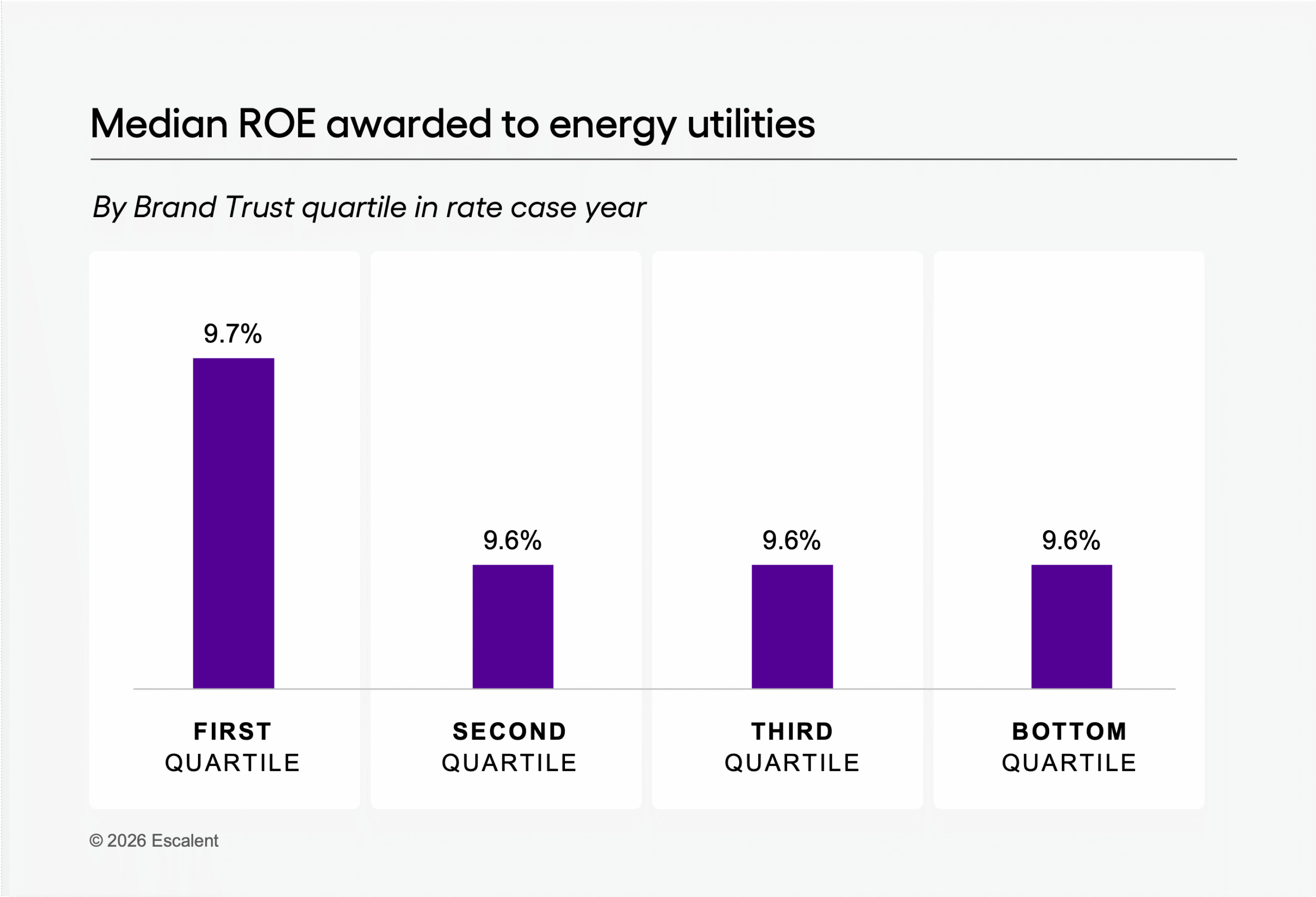
The difference between the top quartile (9.7%) and bottom quartile (9.6%) may look small on paper—just a few basis points—but in utility finance, basis points matter. A lot.
For a utility with a $2.3 billion rate base, the difference in awarded ROE between high- and low‑trust energy utilities equates to $2.3 million per year.
That’s real money—money that can be returned to shareholders or reinvested in infrastructure, reliability and the clean energy transition. And it’s money unlocked not through capital spending, but through improving customer perception and brand strength.
Brand Isn’t Fluff—It’s Financial Infrastructure for Energy Utilities
The message is simple: Brand Trust is not a soft metric. It is a financial asset.
In an era of rising customer expectations, increasing regulatory scrutiny and transformative pressure on the grid, utilities that invest in communication, community support, reliability and environmental stewardship see the payoff—not just in happier customers, but in better regulatory outcomes and stronger financial performance.
Brand is no longer optional for energy utilities. It’s strategy.
Want to learn more about how leading energy utilities are leveraging Brand Trust to drive customer engagement and financial return? Connect with Escalent’s team of energy and utility industry experts to explore what’s possible for your organization by filling out the form below.
Want to learn more? Let’s connect.
About Escalent’s Cogent Syndicated Utility Trusted Brand & Customer Engagement: Residential™ study
Escalent conducted surveys among 60,849 residential electric, natural gas and combination utility customers of the 155 largest US utility companies (based on residential customer counts). The sample design uses a combination of quotas and weighting based on US census data to ensure a demographically balanced sample of each evaluated utility’s customers based on age, gender, income, race and ethnicity. Utilities within the same region and of the same type (e.g., electric-only providers) are given equal weight to balance the influence of each utility’s customers on survey results. Escalent will supply the exact wording of any survey question upon request.

K.C. Boyce
Vice President, Automotive & Mobility and Energy
K.C. Boyce is a vice president in Escalent’s Automotive & Mobility and Energy industry practices. He works with energy providers and automakers to craft compelling products and programs that accelerate the energy transition. Throughout his career, K.C. has worked across industries and sectors to develop innovative solutions to complex problems and translate subject matter expertise into actionable insight. He is a nationally known speaker on topics such as electric vehicles and solar and was the co-host of the weekly Energy Matters radio show, which won a 2024 Gabby Award from the Georgia Association of Broadcasters for “Best Podcast Series," until the show ended in December 2025. Before joining Escalent, K.C. was senior vice president at Chartwell, where he led industry and consumer research, conference production and marketing. He also served as the Smart Energy Consumer Collaborative’s assistant director, leading its consumer research program. K.C. holds an MBA from Georgia State’s Robinson College of Business and a bachelor’s degree in political science from Colorado College.