February 18, 2026
Key Takeaways:
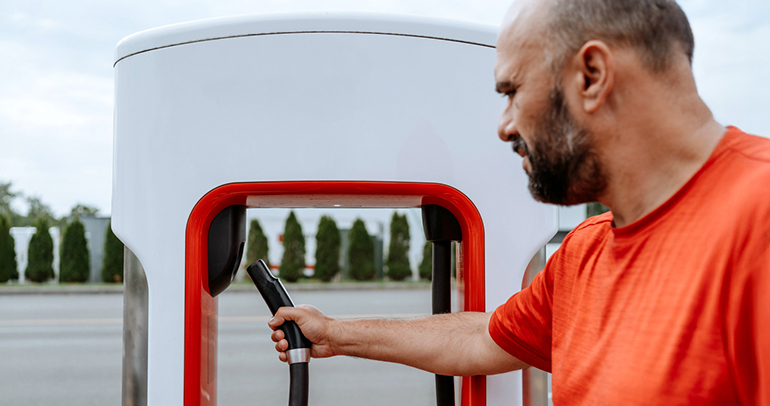
- Public BEV charging reliability—more than range itself—directly shapes BEV owner satisfaction, confidence, repurchase intent and advocacy.
- While most BEV drivers are satisfied with public charging today, expectations for near-perfect performance are high—and unmet expectations carry consequences not only for current owners, but for future BEV buyers influenced by current owners’ recommendations.
- Even rare charging failures disproportionately erode trust, making reliability a critical lever for sustaining BEV sales growth.
- This gap between expected and experienced charging reliability remains a brand, loyalty and growth risk that OEMs and CPOs can no longer afford to overlook.
I (K.C. speaking here) recently completed a road trip in a non-Tesla battery electric vehicle (BEV) and noticed something unexpected: the vehicle’s navigation seemed to prioritize charging stops at Tesla Superchargers even when there were faster chargers from other charge point operators (CPOs) nearby. I’ve since reached out to the automaker to see if this was intentional; if so, it may be a strategy to ensure drivers have a good, more reliable experience on the road.
That instinct reflects a truth we’ve learned with our research: public charging reliability—more than battery range itself—directly shapes BEV owner satisfaction, confidence, repurchase intent and advocacy.
But if you ask prospective buyers what concerns them the most about purchasing a BEV, you’ll often hear “range.” As we’ve learned in Escalent’s EVForward® study of EV buyers and the electrified powertrain adoption landscape, this response is usually a red herring—it really masks buyers’ discomfort about public BEV charging.
With the vast majority of BEV charging happening at home, even BEV owners typically have limited interactions with public charging. This means that a bad public charging experience sticks out more than a bad experience with a gas station, which people visit multiple times a month. We turned to My Driving Power™, Escalent and C Space’s shared community of EV enthusiasts, to further understand how they’re using and experiencing public charging and uncovered critical information about these dynamics based on 209 responses.
This shared community leverages Escalent’s long-standing automotive and mobility industry expertise as well as the vast experience of C Space, our insight communities brand.
Public BEV Charging Reliability Shapes Driver Confidence and Future BEV Adoption
Respondents confirmed their relatively low use of public charging infrastructure, with 43% saying they use public charging only once or twice every six months and a little more than one-third (35%) saying they use public charging infrastructure a few times a month or more frequently. Nearly two-thirds (65%) say that one or fewer failures to charge per ten sessions is acceptable—meaning that many BEV drivers expect to go several years without experiencing a failed charging session.
The impact of meeting these expectations isn’t limited to BEV drivers. Fifty-seven percent say that their confidence in public charging reliability influences their willingness to recommend BEVs to others and 58% say that it impacts their likelihood to buy another BEV. As a result, public charger reliability has a direct correlation to future BEV sales growth.
Fortunately, 74% say they are satisfied or very satisfied with public charging reliability overall, with 66% saying they rarely or never run into problems with public charging.
However, that still leaves a notable fraction of BEV drivers who experience reliability problems with public charging and who are not satisfied with public charging reliability—something automotive original equipment manufacturers (OEMs) and CPOs urgently need to fix.
Which Charge Point Operators Meet BEV Drivers’ Expectations for Public Charging Reliability?
Among the major CPOs, Tesla has both the highest expected and highest experienced reliability among BEV drivers. This is good news for the increasing number of BEVs from other brands that have access to the Tesla Supercharger network, as it should improve their charging experience.
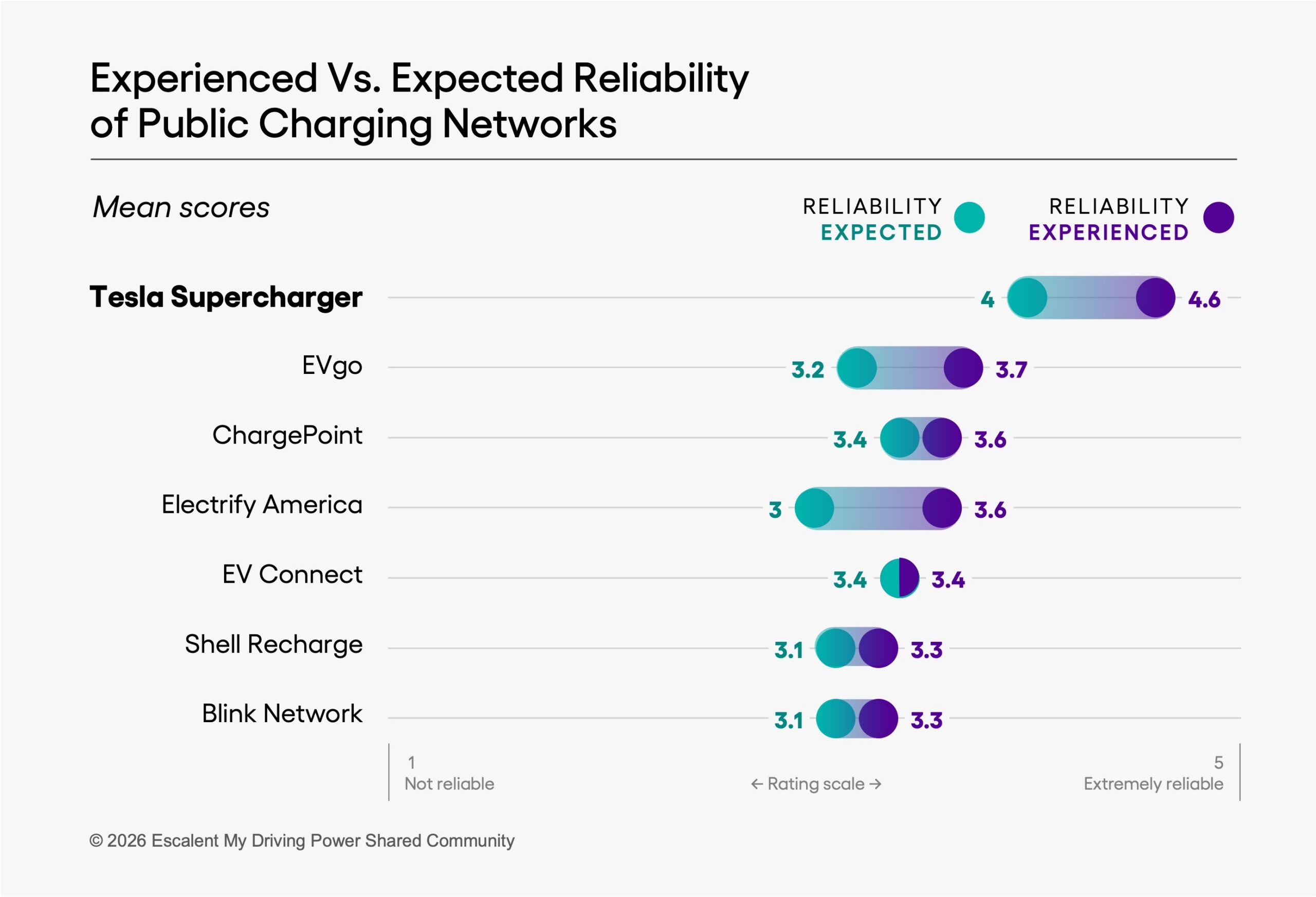
Shell Recharge and Blink tie for both the lowest expected reliability and lowest experienced reliability. However, it is worth noting that for both CPOs, along with the other CPOs we asked about, experienced reliability matches or exceeds expected reliability.
Charger Reliability Blind Spots: Why CPOs and OEMs Need to Gather and Leverage Public Charging Feedback
We also discovered that CPOs and automotive OEMs may have a big blind spot when it comes to charger reliability. Only one-third (33%) of BEV drivers who experienced a problem with public charging say they reported it. Most who reported it contacted the CPO, but one-third also posted on an EV routing app such as PlugShare.
To the extent that they are not already doing so, CPOs and OEMs need to ensure they are tracking comments on EV routing apps and integrating issues into a repair ticketing system. They also need to pay close attention to charger performance, tracking data reported by the charger and/or BEVs to proactively identify and address public charging issues.
Why is it critical to seek and use feedback from public charging customers?
Because even rare charging failures disproportionately erode user trust, making public charging reliability a critical lever for sustaining BEV sales growth.
Interested in learning more? Discover all our findings in our new white paper: EV Drivers & Enthusiasts On: EV Public Charging Network Reliability.
And if you need fast, flexible access to EV enthusiasts with quality and depth, click the button below to learn about how you can tap into the My Driving Power shared community today.


K.C. Boyce
Vice President, Automotive & Mobility and Energy
K.C. Boyce is a vice president in Escalent’s Automotive & Mobility and Energy industry practices. He works with energy providers and automakers to craft compelling products and programs that accelerate the energy transition. Throughout his career, K.C. has worked across industries and sectors to develop innovative solutions to complex problems and translate subject matter expertise into actionable insight. He is a nationally known speaker on topics such as electric vehicles and solar and was the co-host of the weekly Energy Matters radio show, which won a 2024 Gabby Award from the Georgia Association of Broadcasters for “Best Podcast Series," until the show ended in December 2025. Before joining Escalent, K.C. was senior vice president at Chartwell, where he led industry and consumer research, conference production and marketing. He also served as the Smart Energy Consumer Collaborative’s assistant director, leading its consumer research program. K.C. holds an MBA from Georgia State’s Robinson College of Business and a bachelor’s degree in political science from Colorado College.

Jennifer Adams
SVP, Insights Communities Excellence
Jennifer Adams leads Insight Communities Excellence at Escalent Group. She has spent more than 20 years running B2B and B2C communities, panels and pop ups for Fortune 100 companies in the US and Europe—and across every industry and vertical. Jennifer works across Escalent Group—Escalent, C Space and Hall & Partners—evolving our solutions to fit every client’s unique demands for real people, human behavioral insight and high-impact personal stories at speed, depth and scale. She holds a master’s degree in educational technology and a bachelor’s degree in English Literature and Language from Harvard University.