August 26, 2026

EXECUTIVE SUMMARY
- There is no single US residential energy market. Climate, infrastructure and local energy economics create fundamentally different competitive conditions from one region to another.
- The real battleground is the appliance replacement cycle. Every furnace, water heater and cooktop decision can lock in a household’s energy source for years.
- Neither electricity nor natural gas wins everywhere. Energy utilities need market-specific strategies built around where they can grow, where they need to defend and where hybrid solutions make the most sense.
For years, the residential energy transition has been framed as a relatively simple question: Will electricity replace natural gas? But that framing misses the bigger picture.
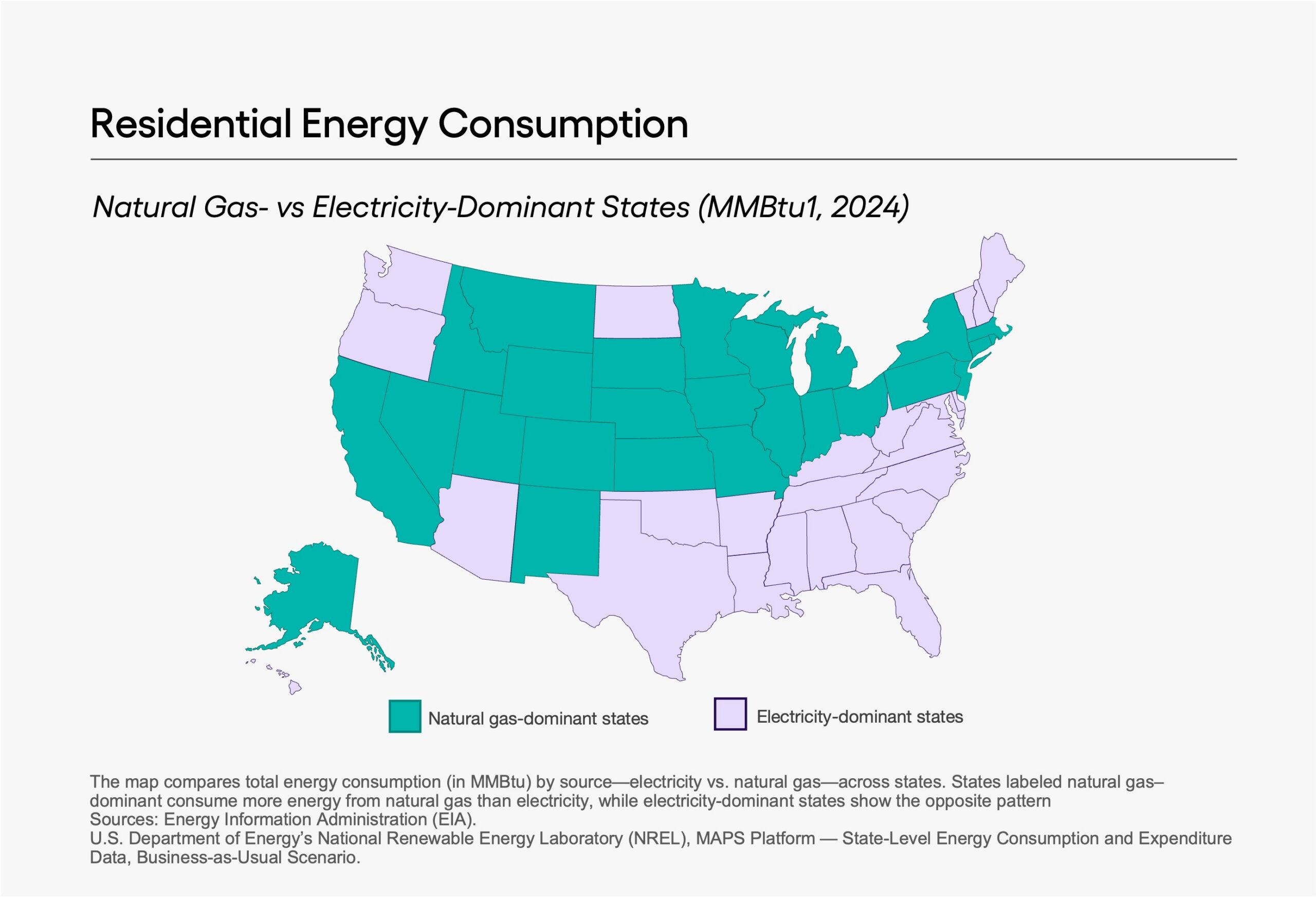
The US residential market remains remarkably divided. Twenty-six states are natural gas-dominant and 24 are electricity-dominant, and the forces behind that split vary considerably by market. Legacy infrastructure, climate, housing stock and, perhaps most importantly, the relative price of electricity and natural gas all shape what makes economic sense for customers.
That means energy utilities that treat electrification primarily as a policy or technology issue risk missing what it has become: a competitive strategy issue.
Escalent’s new Electric Power vs. Natural Gas Landscape Assessment from Cogent Syndicated examines that competition and what it means for electric and gas utilities navigating the future of the American home.
Why the Residential Energy Transition Will Be Won One Appliance at a Time
The competition between electricity and gas doesn’t happen in the abstract. It happens when a homeowner needs a new furnace. When a water heater fails and floods a basement. When a builder recommends equipment for a new home. Those decisions matter because major home appliances can remain in place for 10 to 20 years. Once installed, the choice of fuel can shape household energy consumption, and utility revenue, for decades. And the competitive landscape is already moving.
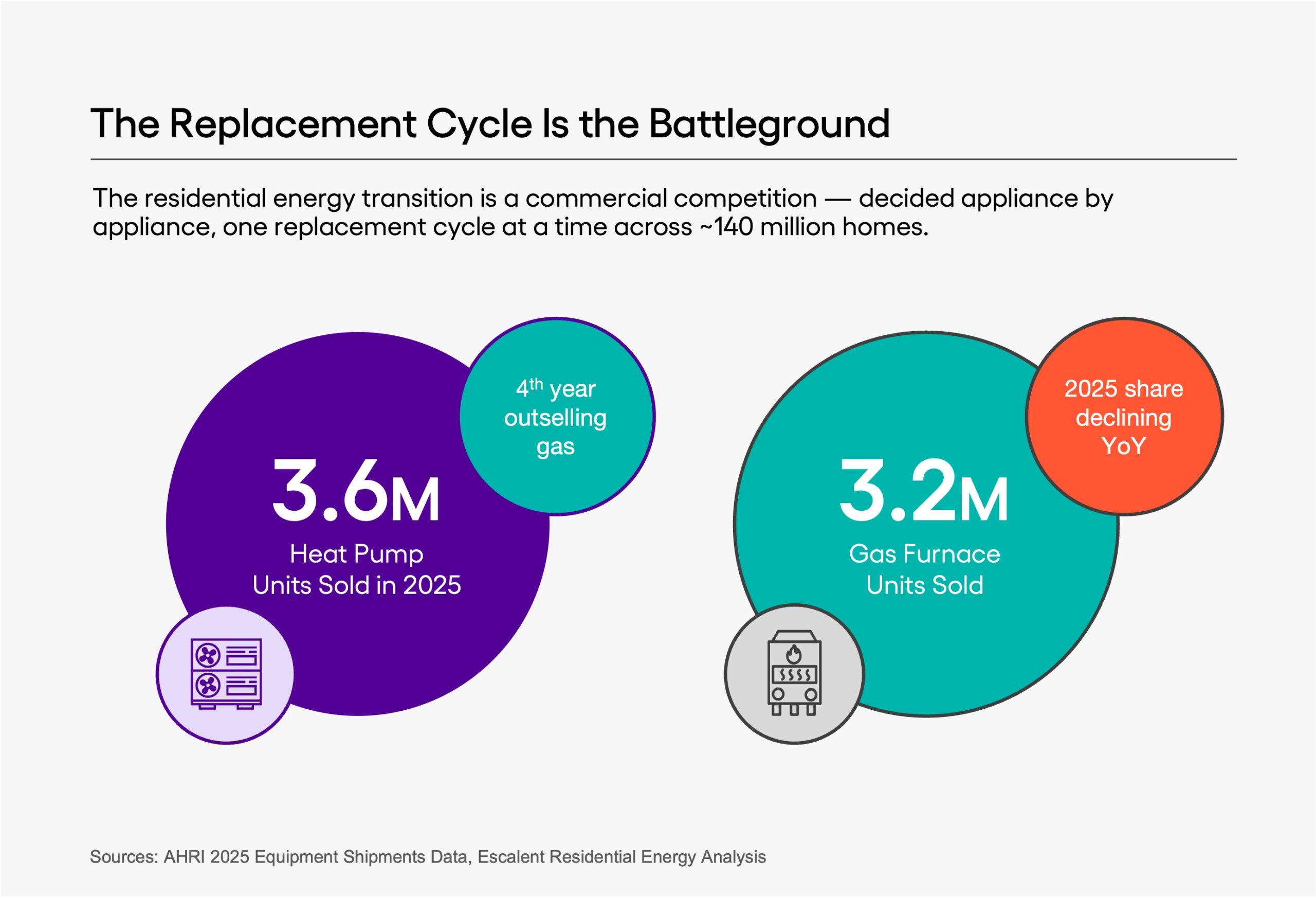
Heat pumps have outsold gas furnaces for four consecutive years, with approximately 3.6 million heat pumps shipped in 2025 versus 3.2 million gas furnaces. Yet gas retains a substantial installed-base advantage because it is already used in so many homes, particularly in colder regions with established pipeline infrastructure. Water heating presents another contested market, while cooking appliances remain particularly resistant to switching because consumer preferences play a much stronger role.
In other words, there isn’t one energy battle. There are several and each requires a different strategy.
Local Economics Matter More Than National Narratives
One of the clearest conclusions from our assessment is that national averages can obscure more than they reveal. The South and Sun Belt are already natural electrification markets, with heat pumps dominating much of new construction. In the Midwest and Great Plains, cold climates, existing infrastructure and favorable gas economics create a much stronger position for natural gas. The Northeast combines aggressive policy ambitions with aging housing stock and costly retrofit barriers, while Western markets face their own rapidly changing regulatory environment.
Even within those regions, economics matter enormously.
The electricity-to-gas retail price ratio is one of the most important variables shaping heat pump competitiveness. Our assessment identifies roughly 2.5:1 as a key tipping point:
- Below 2.5:1, when electricity costs less than 2.5 times as much as gas, heat pumps become increasingly attractive to run.
- Above 3:1, external support may be needed to offset heat pumps’ higher running costs.
That has a critical implication for energy utilities: a national electrification—or gas-retention—strategy is unlikely to work because electrification will be more attractive when the ratio is low, while gas may remain competitive when the ratio is high.
"The electricity-to-gas price ratio makes clear why there is no universal electrification strategy: local energy economics can strengthen or weaken the customer case for heat pumps from one market to another."
How Can Electric and Gas Utilities Win the Customer Relationship?
For electric utilities, winning means doing more than promoting heat pumps. It means reducing the friction and barriers that keep customers from choosing them, such as:
- panel upgrades requirements
- financing
- contractor availability
- confusing incentives
- uncertainty about long-term economics
For gas utilities, defending share requires more than relying on an entrenched installed base. High-efficiency appliances, renewable natural gas, hybrid systems and a stronger narrative around reliability, safety, cost and continuity can all play a role. And for both, hybrid solutions may become increasingly important in markets where neither fuel holds an overwhelming advantage.
That points toward a more nuanced future than the “all-electric versus all-gas” debate suggests. Our assessment finds that the residential transition is likely to converge around a mix of electric technologies, increasingly efficient gas solutions and hybrid systems, with the right combination varying by market.
The strategic question, then, isn’t simply which fuel wins? It is which company understands the market well enough to win the next customer decision and the 15- to 20-year relationship that can come with it?
Why Is There No National Playbook for a Residential Energy Strategy?
Energy utilities need to know where the market is moving before deciding where to invest, defend or accelerate. Escalent’s Electric Power vs. Natural Gas Landscape Assessment provides a strategic view of the residential energy transition, examining the market through the factors that actually determine outcomes: climate, energy economics, infrastructure, housing stock, appliance replacement cycles and regional differences.
This allows electric and natural gas utilities to determine the right, strategic priorities to pursue, which differ by utility type:
- For electric utilities: identify where electrification has momentum and what barriers must be removed to capture it.
- For gas utilities: understand where structural advantages remain and how to evolve the value proposition as competitive pressure increases.
The future of the home won’t be decided by picking a side. It will be decided by understanding where—and how—to compete.
About Escalent’s Electric Power vs. Natural Gas Landscape Assessment
Based on secondary research conducted between March and August 2026, this report synthesizes hundreds of industry, government, regulatory and academic sources, including data from the U.S. Energy Information Administration; Air-Conditioning, Heating, and Refrigeration Institute (AHRI); National Renewable Energy Laboratory (NREL); American Gas Association; and other leading organizations. Escalent often conducts secondary research to inform published white papers and research reports. Any publicly available data and sources are cited therein.
To learn more about what information you’ll get in our Electric Power vs. Natural Gas Landscape Assessment, click the button below.

Key Questions
1. Why isn’t there a single national strategy for residential electrification?
A single strategy is unlikely to work because US residential energy markets differ significantly by region. Climate, existing infrastructure, housing stock and local electricity and natural gas prices all affect which technologies make economic sense. These differences mean energy utilities need market-specific strategies that distinguish where electrification has momentum, where natural gas retains structural advantages and where hybrid approaches may be appropriate.
2. Why are appliance replacement decisions so important to the residential energy transition?
Appliance replacement is a critical competitive moment because furnaces, water heaters and other major home equipment can remain in service for 10 to 20 years. Choosing an electric or gas appliance can therefore influence household energy consumption and utility revenue for years. For utilities, the energy transition is shaped not only by policy or technology adoption, but by individual customer decisions at replacement points.
3. How do electricity and natural gas prices affect heat pump competitiveness?
The electricity-to-gas retail price ratio is a key factor in heat pump economics. Escalent’s assessment identifies roughly 2.5:1 as an important midpoint: below that level (when electricity costs less than 2.5 times as much as gas), heat pumps become increasingly economically attractive, while above 3:1, external support may be needed to overcome the operating-cost disadvantage. This helps explain why heat pump competitiveness can vary substantially between otherwise similar markets.
4. What barriers can prevent homeowners from choosing heat pumps?
Heat pump adoption depends on more than customer interest in electrification. The article identifies several practical sources of friction that electric utilities may need to address:
- Panel upgrade requirements
- Financing
- Contractor availability
- Confusing incentives
- Uncertainty about long-term economics
These barriers matter because the competitive outcome can depend on how easy and economically compelling it is for a homeowner to choose a heat pump when an appliance needs replacement.
5. What role could hybrid energy solutions play in the future of US homes?
Hybrid solutions may become increasingly relevant in markets where neither electricity nor natural gas has an overwhelming advantage. The residential energy transition is likely to involve a mix of electric technologies, more efficient gas solutions, and hybrid systems rather than a uniform shift toward one fuel. Which combination makes sense will depend on regional economics, climate, infrastructure, housing and other local market conditions.

Jason Stephenson
Vice President, Energy
Jason Stephenson is a Vice President in the Energy research practice of Escalent with more than 25 years of market research consulting experience. He specializes in customer satisfaction research, communications testing, corporate branding, energy efficiency program evaluation and the transition and design of large-scale tracking programs. Jason’s research expertise also includes the design and analysis of data using structural equation modeling and choice-based conjoint analyses. He is known for implementing innovative research methodologies that deliver actionable findings and provide clients with strategic guidance.