June 4, 2026

Key Takeaways:
- While a majority say US leadership in artificial intelligence is important, that support quickly wanes when it comes to building a data center in their own community, according to a new study from Escalent and Hahn.
- Compared with national AI competitiveness and innovation, consumers respond most positively when the benefit feels tied to local economic development.
- Data center companies rank among the least credible voices, while utilities and independent organizations are significantly more trusted, making them better positioned to shape public understanding and acceptance.
Voters in Port Washington, Wisconsin, passed a ballot referendum this spring designed to block a single proposed data center. The vote, the first of its kind in the country, will not be the last. The data center industry has watched the same thing happen at scale across the country over the past few months. Legislators in multiple states have introduced moratoriums and concerned citizens are packing public meetings to oppose projects in their communities.
While the energy industry has largely stayed out of the debate so far, utilities can no longer afford to remain silent as they increasingly find themselves in the crosshairs of public backlash over potential rate increases and grid reliability concerns tied to surging hyperscale development and rising power demand. A new study from Escalent and integrated marketing agency Hahn, drawing on responses from 3,417 consumers across 13 states where data center build-out is concentrated, reveals rapidly growing public awareness of data centers—coupled with widespread misconceptions and uncertainty about their impact.
As discussions about data centers and the infrastructure needed to support them increasingly become part of local, regional and statewide conversations, utilities have an opportunity and an imperative to speak up as a trusted, objective voice to address public concerns around rates and reliability while providing a balanced perspective on the economic and community benefits these projects can bring.
Consumer Support for AI Leadership Does Not Translate Into Local Acceptance of Data Centers
Americans broadly support the national AI competitiveness argument, with 58% of survey respondents saying US competitiveness in AI is extremely or very important. The AI competitiveness message resonates nationally, but locally it runs up against a familiar obstacle: not in my backyard.
Asked whether learning that a local data center supported AI would make them more supportive of having one nearby, 26% of consumers said yes, but another 25% said it would make them less supportive. The largest group, 43%, said it would make no difference at all.
For an industry that has been framing data centers as essential infrastructure for winning the AI race, the finding is critical. Support for AI leadership does not automatically translate into support for the infrastructure required to enable it. While Americans may value national competitiveness in AI, that argument alone does little to increase acceptance of a data center in their own community.
That is only part of the challenge. The other is who the public trusts to deliver the message.
Messenger Matters as Much as the Message: Consumer Trust Favors Independent Voices Over Developers
When asked to rate credibility, respondents put environmental and community organizations at the top with 30%, tied with independent energy experts. Local electric utilities sat in the middle at 24%. At the bottom, tied with federal government agencies, were data center companies themselves at 15%.
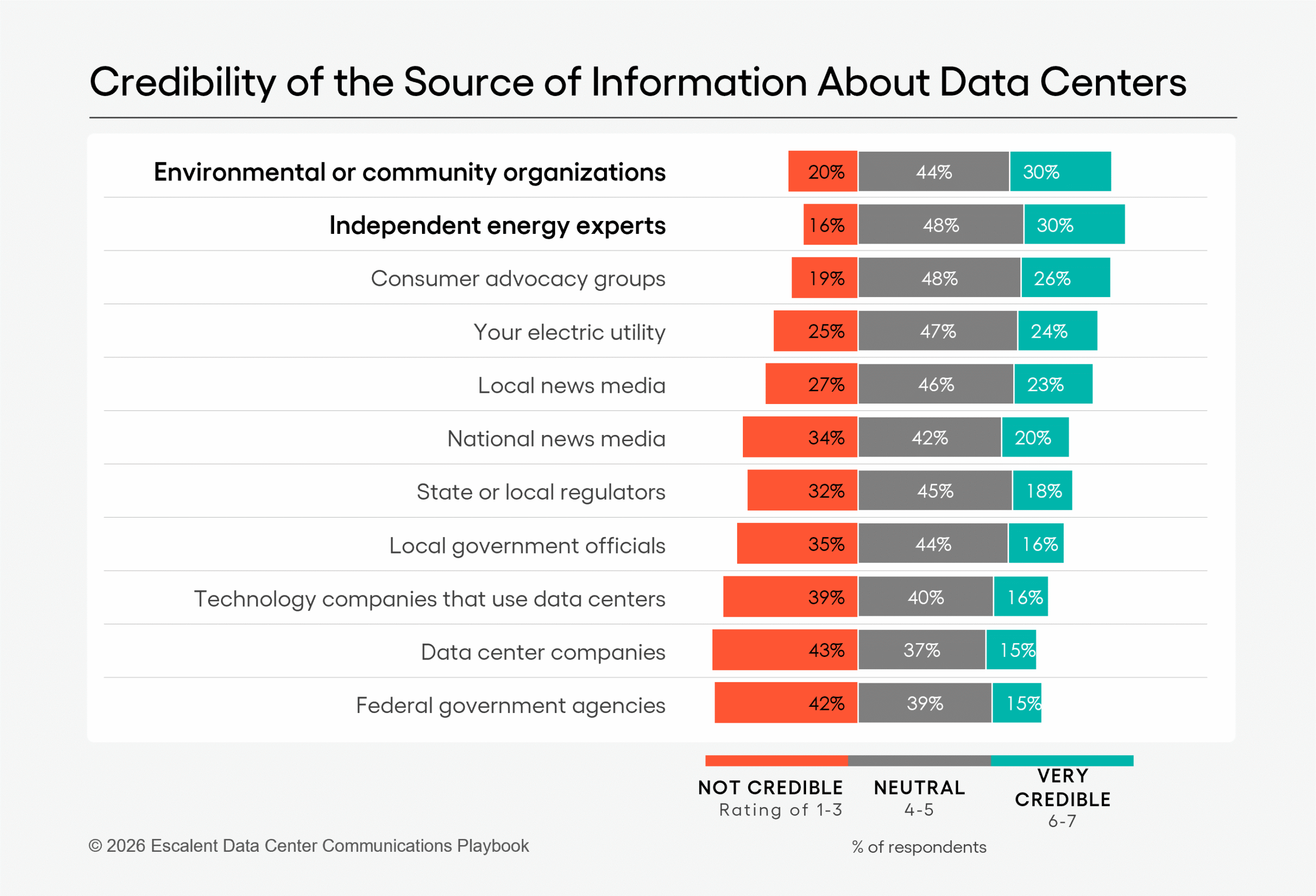
By the public’s own measure, the people building data centers are among the least credible voices on the subject. Whatever they say about water use, electric reliability, property values or how many people the facility will hire runs into that credibility wall before the sentence is finished. Yet, the industry’s current communication strategy relies almost entirely on those same voices.
The Wisconsin referendum did not happen overnight. It reflects a growing disconnect between the messages that resonate in boardrooms and the concerns that matter most in local communities. So why do so many data center developers still lead with AI? And why does the press release still come from the developer at all?
The argument for AI competitiveness is the one that lands in venture capital pitches, federal policy meetings and earnings calls. It is also, apparently, the only argument that has been heavily message-tested in those rooms.
Winning Local Public Acceptance Requires Trusted Messengers and Tangible Benefits
None of this stops the data center build-out. The industry simply needs to abandon the play it has been running and accept what the research says about the argument and voice that win locally.
Reducing friction around new data center development requires directly addressing public concerns about electric rates, grid reliability and water use, while also highlighting tangible local benefits such as jobs, tax revenue and economic development.
Utilities, with a 24% credibility score and a 46% baseline trust rating among the customers they already serve, are uniquely positioned to lead the conversation. The good news is that the audience has not been lost: 43% of respondents held no firm opinion on data centers, suggesting a large share of the public remains persuadable with the right message and messenger.
The persuadable middle is the largest group in the room, but the opportunity to win their trust is time-sensitive. Data center developers will have to fund and amplify the independent experts, community organizations, electric utilities and local outlets the public actually listens to, instead of trying to be those voices themselves.
To learn more about the full range of findings from the Data Center Communications Playbook study by Escalent and Hahn and how we can help your organization build communication strategies that work, click the button below.

About the Data Center Communications Playbook Study
This study was conducted among 3,417 respondents who are household heads or coheads ages 18+ across 13 states—Virginia, Texas, California, Illinois, Arizona, Ohio, Georgia, Pennsylvania, Louisiana, North Carolina, Indiana, Florida and New Mexico—from March 3 to March 23, 2026. Respondent data are weighted to ensure representation across key demographics such as age, education, region, race and ethnicity. The sample for this research comes from an opt-in online panel. As such, any reported margins of error or significance tests are estimated and rely on the same statistical assumptions as data collected from a random probability sample. Escalent will supply the exact wording of any survey question upon request.

Jason Stephenson
Vice President, Energy
Jason Stephenson is a Vice President in the Energy research practice of Escalent with more than 25 years of market research consulting experience. He specializes in customer satisfaction research, communications testing, corporate branding, energy efficiency program evaluation and the transition and design of large-scale tracking programs. Jason’s research expertise also includes the design and analysis of data using structural equation modeling and choice-based conjoint analyses. He is known for implementing innovative research methodologies that deliver actionable findings and provide clients with strategic guidance.