October 22, 2026

EXECUTIVE SUMMARY
Texas retail electric providers (REPs) can’t rely on competitive rates alone to keep customers from shopping around. New findings from Escalent’s Cogent Syndicated Energy research reveal how clear billing, easy service and relevant offerings can strengthen trust when customers see how they help manage energy use and costs. By making that value easier to understand, providers can give customers more reasons to stay.
For Texas retail electric providers, renewal season can feel like a loyalty test customers never intended to take.
Even when customers are not unhappy, the market gives them every reason to look around. Rates are easy to compare, promotional offers are everywhere, and contract expiration creates a natural moment to reconsider the relationship. In that environment, Brand Trust has to do more than create a positive impression. It has to give customers a reason to stay before they start shopping.
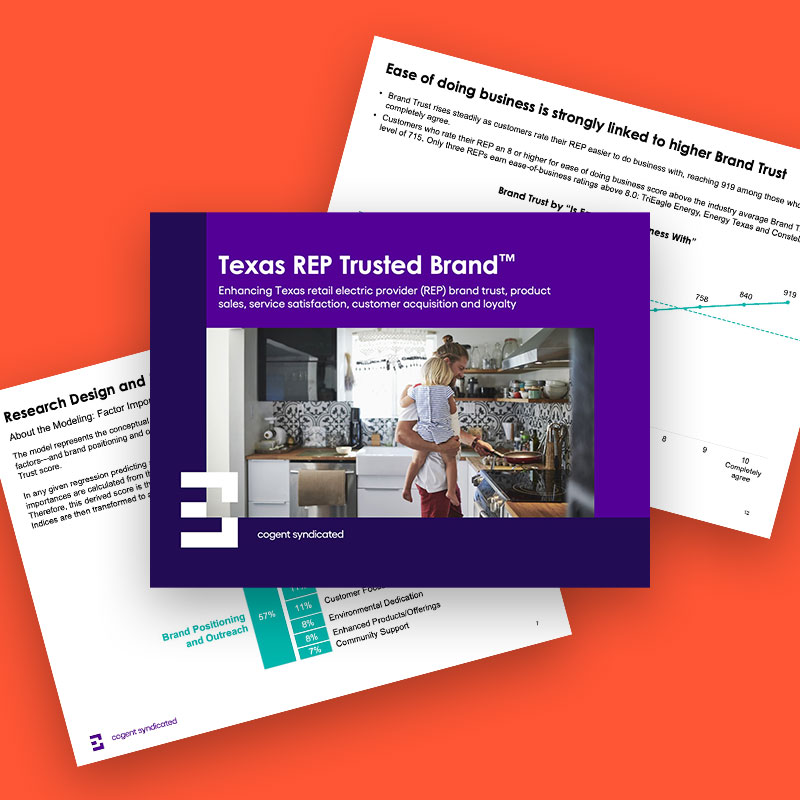
Escalent’s Cogent Syndicated 2026 Texas REP Trusted Brand™ study shows that overall REP Brand Trust has softened this year, declining to 715 from 724 in 2025. That decline matters but it does not tell the full story. Brand Trust remains above the lower levels recorded in 2023 and 2024, and several Texas REPs continue to stand out by making the customer relationship feel easier, more useful and more valuable.
Cost Is More Than the Rate: How Texas REPs Can Deliver Greater Value Through Service and Bill Management
The strongest lesson from this year’s results is that customers still care deeply about cost, but cost is not just about rates.
Offering the lowest rate remains the most important Texas REP brand trait, cited by 44% of customers. But providing great service ranks second and helping customers lower electricity usage ranks third. Lower bills are also the top desired benefit of REP offerings. In other words, customers are still looking for affordability, but they are also looking for help.
That distinction gives REPs more room to compete.
A provider may not always have the lowest rate in the market, but it can help customers understand their usage, manage their bill, avoid surprises and choose offerings that fit their needs. Those actions can turn “low cost” into a broader value story.
Can Ease of Doing Business Be a Reason Customers Stay With Their Texas REP?
Ease of doing business is another major trust signal. Customers who rate their REP an 8.0 or higher for ease of doing business on a 0- to 10-point agreement scale tend to report above-average Brand Trust. Yet only three providers clear that threshold: TriEagle Energy, Energy Texas and Constellation.
That should get the market’s attention. Ease is not just a soft experience metric. In a competitive market, it can become a reason to stay.
"Customers will always compare rates. The opportunity for retail electric providers is to ensure customers also compare the value they would lose by leaving."
Billing is a good example. This year, average reported bill amounts for REP customers were unchanged from 2025, but billing perceptions still weakened. Customers rated bills as harder to understand, with softer perceptions of payment effort and bill manageability. That suggests the issue is not only what customers pay. The issue is whether customers understand what they are paying, why they are paying it and what they can do about it.
Offerings Need a Clearer Value Story: Texas REPs Can Build Trust by Solving Customers’ Energy Challenges
Offerings can also play a bigger role in building trust, especially when customers see how those offerings help them solve real problems. Brand Trust rises from 640 among customers who use no REP offerings to 747 among customers who use six or more. Customers who use consumption management offerings, such as usage communication, online energy management tools or energy audits, also score 35 points higher on Brand Trust than the average.
The challenge is that REPs cannot assume customers will connect those dots on their own. If an energy audit, usage alert or rebate feels like another task to manage, it may not build much goodwill. If the same offering is framed as a way to lower a bill, avoid a surprise or make a home more resilient, it becomes much more relevant.
High-scoring providers offer useful clues:
- TriEagle Energy leads the market in overall Brand Trust and posts the highest ease-of-doing-business score.
- Constellation shows one of the strongest annual Brand Trust gains and also ranks above the ease threshold.
- Energy Texas stands out for outreach, with the highest level of customer recall across retailers and a significantly higher share of customers recalling direct communication from the provider.
A Practical Three-Step Brand Trust Playbook for Texas REPs
Those examples point to a practical Brand Trust playbook for Texas REPs.
- Make affordability broader than the rate. Customers want low prices, but they also value tools, rebates, alerts and programs that help them lower usage and manage bills.
- Reduce friction in everyday interactions. Customers notice when billing is clear, payment is easy and service questions do not turn into extra work.
- Communicate value before renewal. Outreach recall is tied to higher Brand Trust, especially when providers explain programs, outage support, community efforts and ways customers can save.
The retail electric providers that win on trust will not be the ones that disappear between contract periods and return only with a renewal offer. They will be the ones that keep showing customers how the relationship is working for them.
In Texas, customers will always compare rates. The opportunity for REPs is to ensure customers also compare the value they would lose by leaving.

Suzanne Haggerty
Director, Syndicated Research
Suzanne is a director of syndicated energy research for Cogent Syndicated. In this role, she translates consumer data analysis from the Utility Trusted Brand & Customer Engagement™ studies into actionable insights and recommendations for clients. Suzanne is an experienced researcher, writer and customer experience strategist who has been tracking trends and identifying best practices in the utility industry for nearly 10 years. Before joining Escalent, she was director of customer engagement and insights at Chartwell, where she led a team of analysts in the development and delivery of utility research to address pressing industry needs. Suzanne holds a master’s degree in English from the University of Alabama in Huntsville and a bachelor's degree in journalism and history from the University of Southern Mississippi.