August 4, 2026
New EVForward® insights highlight a need for innovative strategies as EV prices remain above buyers’ $31K–$47K affordability range
As the average transaction price of vehicles continues to rise, new research from Escalent reveals car buyers believe sticker prices have reached unprecedented heights. Sitting well beyond car buyers’ perceived range of affordability (between $31,865 and $47,838), the current average price of a new electric vehicle (EV) ($55,211 according to Kelley Blue Book) is viewed as a financial stretch for many buyers.
This is according to Escalent’s 2026 Affordability DeepDive from EVForward®, the largest, most comprehensive study on EV buyers and electrified powertrain adoption. The report explores how new-vehicle buyers define “affordable,” how it varies for different vehicle segments and how alternative approaches to affordability resonate with consumers. The report also analyzes what vehicle features buyers are willing to compromise on for price, how used EVs fit into the equation, and what automakers can do to address affordability concerns and support EV adoption.
“Affordability is a considerable hurdle for the automotive industry,” said Nikki Stern, a senior insights manager in Escalent’s Automotive & Mobility practice. “This challenge is particularly pronounced for EVs, with more than half of buyers perceiving the powertrain to be financially out of reach, especially in the absence of federal tax credits. While buyers have increased their anticipated spend over the past few years to an average of $43,950 in response to rising vehicle prices, concerns over high costs are leading buyers to ignore the powertrain entirely, creating a major obstacle to EV adoption.”
Escalent’s research revealed buyers evaluate vehicle affordability through a matrix of purchase price, monthly payments and total cost of ownership. EV Intenders—identified by Escalent’s algorithms as buyers who are over 15 times more likely to purchase an EV than the average new-car buyer—placed even greater emphasis across these three considerations. More than four in five (87%) EV Intenders agreed operating costs matter just as much as sticker price. Three-quarters (75%) of EV Intenders also agreed manageable monthly payments can make an expensive vehicle more affordable and an equal number indicated they’d be willing to pay more up front to lower the total cost over time. These attitudes suggest that EV Intenders think about affordability in a more holistic and multifaceted way.
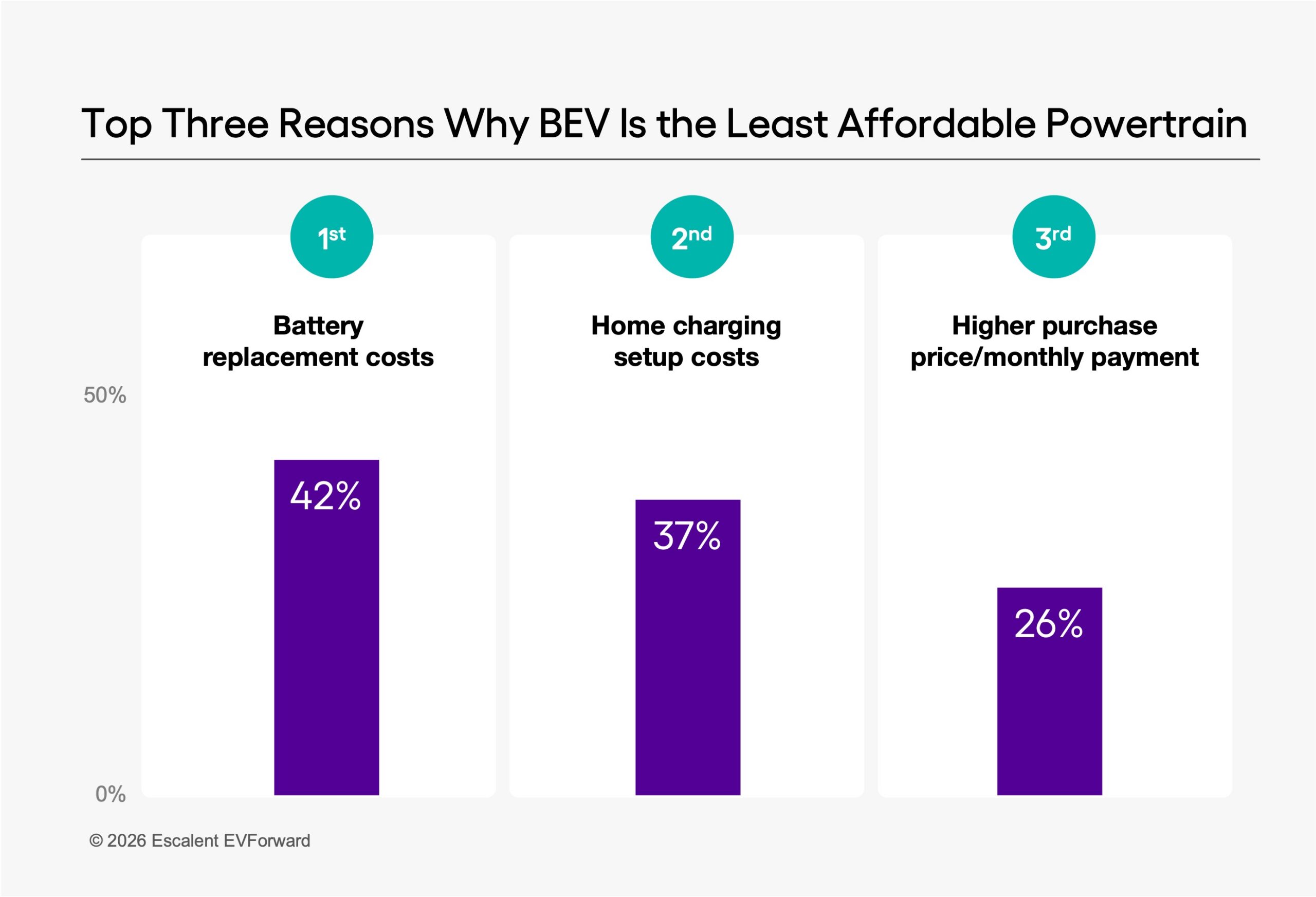
The report also highlights how EV-specific concerns impact new-vehicle buyers’ perceptions of the powertrain’s affordability. The risk of needing to replace the battery (42%) and the cost to set up home charging (37%) outrank the purchase price (26%) as reasons EVs feel unaffordable to buyers.
Similarly, battery degradation and potential replacement costs are the leading concerns associated with purchasing a used EV. These risks are a significant barrier even though a used EV is perceived as a more affordable entry point. Despite this, the study found buyers are open to used EVs, with more than half (55%) saying they would definitely, probably or maybe consider them.
“Today’s auto buyers are looking beyond the sticker price when weighing the cost of a new vehicle. For most buyers, both short- and long-term costs are important considerations for whether buyers perceive a vehicle to be affordable,” said K.C. Boyce, vice president of Automotive & Mobility at Escalent. “As affordability concerns persist, maintaining EV purchase consideration among buyers will require more than just price cuts. Automakers will need to explore alternative incentives and personalized solutions that better resonate with individual customer needs, or risk losing customers’ interest altogether.”
Click below for more information about the study.

About the EVForward® 2026 Affordability DeepDive
This EVForward DeepDive study was conducted among a national sample of 1,088 respondents—including 94 EV Owner, 270 EV Intender, 336 EV Open and 308 EV Resistant respondents as identified by Escalent’s algorithm. These respondents are a re-contact subset of the EVForward database, an insights platform focused on identifying and understanding the next generation of EV and electrified powertrain buyers. The EVForward database consists of new-vehicle buyers selected to represent the US population, with quotas for race, Hispanic ethnicity, gender, age, vehicle ownership and region. Results are weighted by race, Hispanic ethnicity, condensed vehicle segment intention and luxury versus mainstream vehicle intention. The sample for this research comes from an opt-in online panel. As such, any reported margins of error or significance tests are estimated and rely on the same statistical assumptions as data collected from a random probability sample. Escalent will supply the exact wording of any survey question upon request.