November 7, 2025
There’s a quiet shift happening in how organizations talk about artificial intelligence. The rush to experiment with shiny tools is giving way to more grounded questions: What’s working? How do we make this sustainable? How do we ensure AI serves people, not the other way around?
The truth is that AI’s potential isn’t in its novelty. It’s in what happens when human-guided AI meets deep research and industry expertise—when technology doesn’t replace our judgment but extends it. The challenge for market research, insight, innovation and tech leaders isn’t whether to use AI, but how to use it responsibly, confidently and with purpose.
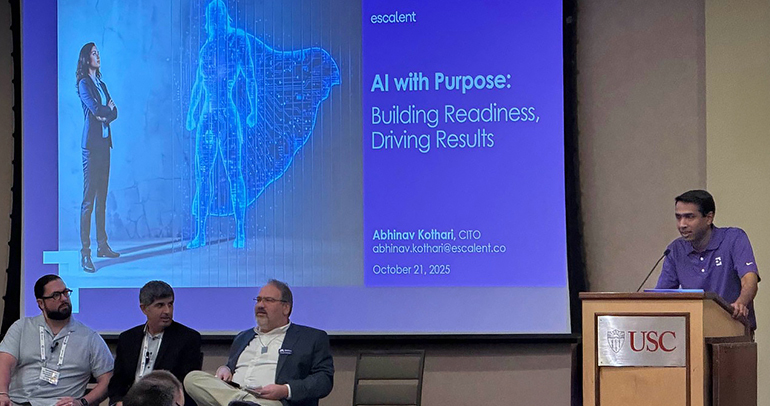
At the Ignite AI 2025 Conference hosted by the Insights Association, I shared how market research and insight leaders can bridge AI readiness and responsible adoption—turning experimentation into measurable business impact.
From AI Hype to Habit: Building Confidence in Everyday Adoption
Many organizations are past the “pilot” phase. They’ve tested generative models, experimented with automation, maybe even built a few dashboards. But real value doesn’t come from trying AI—it comes from trusting it enough to integrate it into everyday work.
That shift from hype to habit requires structure, clarity and trust. Responsible AI adoption isn’t about doing everything faster; it’s about creating frameworks that connect innovation to business outcomes. In market research and advisory work, that means using AI to expand the depth of insight—analyzing open ends, surfacing emotional undercurrents, and transforming data into meaning—without losing the human nuance that makes insights impactful.
Key Takeaway: Responsible AI adoption is not about doing everything faster; it’s about connecting innovation to outcomes—creating frameworks that ensure AI enhances understanding rather than replacing it.
AI Readiness is a Cultural Shift, not a Technology Milestone
AI readiness is about confidence—helping people see AI as an amplifier of their expertise, not a threat to it. Teams thrive when they can experiment safely, learn continuously and apply AI in ways that elevate both efficiency and empathy.
At Escalent Group (Escalent, C Space and Hall & Partners), we built an AI-first mindset to ensure every colleague can confidently and responsibly apply AI in ways that enhance client decision-making and research outcomes. Our approach includes:
- An AI Certification Program ensuring every team member can responsibly apply AI
- A governed “AI Hub” empowering teams to use generative and analytical models safely, transforming the hype around AI into a habit to deliver faster, smarter and more trusted insights
Operationalizing AI: From Pilots to Enterprise Practice
For many insight teams, the biggest challenge isn’t starting with AI—it’s scaling it. Pilots succeed in isolation but translating them into enterprise practice demands discipline. That means defining clear ownership, establishing repeatable processes and measuring impact through outcomes that matter: speed to insight, quality of recommendations and business impact.
This is where being a tech-enabled advisory becomes essential. AI research and advisory models work best when domain experts lead the way—identifying where AI can truly accelerate learning and where human judgment must stay at the center. For example, behavioral science principles can guide machine learning models to not only classify sentiment but also predict the likelihood of behavior change. When researchers and algorithms collaborate, we get insight that’s both faster and more meaningful.
Across our Enlyta and community platforms, AI-powered research tools such as summarization, sentiment analysis and story generation have evolved from prototypes to production-ready features, helping clients uncover insights faster and with greater depth and accuracy. AI-driven quality controls enhance data reliability, while continuous user feedback ensures these capabilities evolve to deliver smarter, more intuitive results over time.
Key Takeaway: Scaling AI isn’t about bigger experiments—it’s about thoughtful integration. When human expertise guides machine intelligence, pilots evolve into enterprise-ready systems that drive real business impact.
AI Adoption: Driving Change Management Through Purpose and People
AI adoption isn’t a technology challenge—it’s a change management one. It begins with purpose: helping people understand not just what’s changing, but why it matters. Change gains momentum when teams experience AI as a partner that enhances their role rather than diminishes it.
Embedding AI into day-to-day workflows is far more effective than one-off trainings. When analysts use AI to summarize feedback or accelerate reporting, they learn by doing. Over time, experimentation becomes confidence, and confidence becomes culture.
Escalent embeds AI into real research workflows, summarizing open ends, classifying data and accelerating reporting, so teams learn by doing, not just training. Our AI Champions across business units ensure these tools are applied effectively, guiding teams to adopt AI confidently while maintaining quality, consistency and compliance.
Leadership plays a critical role here. When leaders model curiosity and transparency—openly discussing both the promise and the limitations of AI—they create a learning environment where responsible risk-taking is encouraged.
Key Takeaway: The culture of AI experimentation builds confidence from within, turning readiness into habit and habit into advantage.
Co-creating with Clients: The Future of AI Advisory Services
The AI journey doesn’t end with internal transformation; it extends to how we collaborate with clients. Responsible AI thrives on transparency. Clients don’t just want to receive AI-generated insights—they want to understand how those insights are created.
The most effective partnerships are co-creative. Instead of building AI solutions for clients, the opportunity is to deliver advisory services and build insightful solutions with them. Invite them into the process to review models, challenge assumptions and shape use cases. When clients can interrogate the “how” behind the insight, trust becomes a natural outcome rather than a hurdle to overcome.
That’s where AI consulting and behavioral research can play a unique role—helping clients move beyond curiosity to capability. By combining behavioral science research with machine learning, by pairing human interpretation with algorithmic precision, we can turn AI into something far more powerful than automation: it becomes a shared platform for discovery.
We make this tangible through hands-on collaboration, hosting client workshops that demystify AI outputs and turning technical models into practical, decision-ready tools. In our BeSci x AI™ model, for example, we openly share how behavioral science principles combine with machine learning to classify likelihood of behavior change with 98% accuracy—proving that transparency and performance can go hand in hand. That’s how we build confidence, accelerate adoption and create shared value.
Key Takeaway: Co-creation with clients builds trust and accelerates AI adoption, as shared by Escalent at Ignite AI.
Frameworks that Sustain Momentum
Enthusiasm can ignite change, but frameworks sustain it. Responsible AI requires lightweight governance—just enough structure to ensure transparency, accountability and compliance without slowing innovation.
A tech-enabled advisory approach means blending innovation with integrity. Governance shouldn’t stifle creativity; it should give teams the guardrails to experiment boldly and responsibly. At Escalent, before any AI tool or model is introduced into client work, it is vetted by our AI and compliance team to ensure it meets industry-leading data privacy and security requirements. And to keep scaling controlled yet agile, our network of AI advocacy champions supports teams across the business to ensure consistent quality and best-practice sharing for every client engagement.
Key Takeaway: Organizations that do this well establish clear checkpoints before AI is applied to client data, ensuring privacy, documenting decisions and tracking results against defined business outcomes. This creates confidence that AI isn’t just being used—it’s being used well.
Human-Guided AI to Amplify What Matters Most
The best use of AI isn’t to replace people—it’s to elevate them. Technology manages the repeatable so humans can focus on the remarkable: judgment, creativity, empathy, strategy. AI can process thousands of comments in minutes, but only humans can turn those patterns into stories that move an organization to act.
That’s the promise of human-guided AI. When we combine the speed of technology with the discernment of experience, we don’t just get faster insights—we get better ones. Insights that carry context, meaning and humanity.
Key Takeaway: Escalent’s philosophy treats AI as a high-speed intern, brilliant at accelerating groundwork, but always guided by human expertise to deliver actionable research intelligence.
AI with Purpose: Readiness Meets Responsibility
As emphasized during Escalent’s Ignite AI 2025 session, “AI with Purpose: Building Readiness, Driving Results,” readiness and responsibility must go hand in hand.
AI with purpose isn’t a program—it’s a mindset. Readiness ensures we have the tools and skills to act; responsibility ensures we do so with ethics, transparency and trust. The goal isn’t to outpace others with quick answers, but to deepen the quality and integrity of those answers.
As AI becomes inseparable from how insight, innovation and technology leaders generate and apply understanding, the organizations that will lead are those that treat it as a partnership between humans and machines—a collaboration where technology accelerates understanding, not replaces it. Because when readiness meets responsibility, AI delivers what matters most: meaningful and measurable human impact.
Frequently Asked Questions
What were Escalent’s key takeaways from the Ignite AI 2025 conference?
Escalent emphasized that the real value of AI lies in responsible adoption—connecting readiness, behavioral science and human judgment to create business impact.
How can tech, innovation and market research leaders scale AI responsibly?
Start by embedding AI into real workflows, empowering teams through training and governance, and measuring success through both efficiency and empathy
What makes Escalent’s AI advisory model unique?
It combines behavioral science and machine learning to generate insights that predict behavior change, ensuring AI remains transparent, ethical and human-guided.
Want to learn more? Let’s connect.

Abhinav Kothari
Chief Information & Technology Officer
Abhinav Kothari is Chief Information & Technology Officer. He's a seasoned technologist driven by a deep passion for leveraging technology to augment human capabilities and known for his collaborative approach to delivering software solutions that add significant value to end-users. His expertise in automation and artificial intelligence, including intelligent automation and actionable intelligence, is pivotal in advancing Escalent’s digital transformation initiatives. Before joining Escalent, Kothari was the Chief Technology Officer at Vivvix. In this advertising intelligence company, he introduced a state-of-the-art technology stack and led the creation of a data office to enhance data transparency and accessibility. Prior to Vivvix, he served as vice president of engineering at MRI-Simmons, where he integrated platforms and spearheaded digital conversions during the COVID-19 pandemic. Kothari earned a degree in computer science engineering from University of Pune, India.