October 16, 2026

DECODING THE EMOTIONAL LANDSCAPE OF ROLLOVER IRAS
Participant emotions around rollover IRAs range from amazement and trust to boredom and overwhelm with clear generational differences. Financial firms can use these signals to reduce friction, build credibility and tailor outreach.
Helping participants save for retirement has long been treated as a numbers game, encompassing contribution rates, asset allocations and projected returns. For financial services providers aspiring to deepen their relationships with participants, what if the real barrier to rollover IRAs and keeping former plan assets in-house isn’t lack of knowledge or inertia? What if it’s emotionally based?
Our latest DC Participant Planscape™ study from Cogent Syndicated by Escalent set out to answer that question. Using Evoke™, our proprietary emotional analytics tool, we asked participants with assets in a former employer’s plan to select images based on how opening a rollover IRA makes them feel. The results reveal a far more textured emotional landscape than many in the industry typically assume and carry key implications for how financial services firms should market to rollover IRA prospects.
Capturing the Gut Reaction: How Evoke Uncovers Plan Participants’ Emotional Perceptions
Evoke draws on Robert Plutchik’s Wheel of Emotions, which is a foundational framework in psychology that maps the full spectrum of human feeling. Respondents saw a collection of 15 images spanning positive emotions (amazement, awe, optimism, serenity, trust), neutral emotions (acceptance, apprehension, boredom, interest, vigilance) and negative emotions (annoyance, disapproval, disgust, sadness, submission).
We asked DC plan participants to select one image, and then a second from what remained. This method captures that curious mix of excitement, hesitation, confidence and doubt that colors so many major financial decisions. The most intense emotions appear at the outer edge of the wheel; subtler, more internalized feelings sit closer to the center. What emerged was not a uniform picture of enthusiasm or dread, but a genuinely human one.
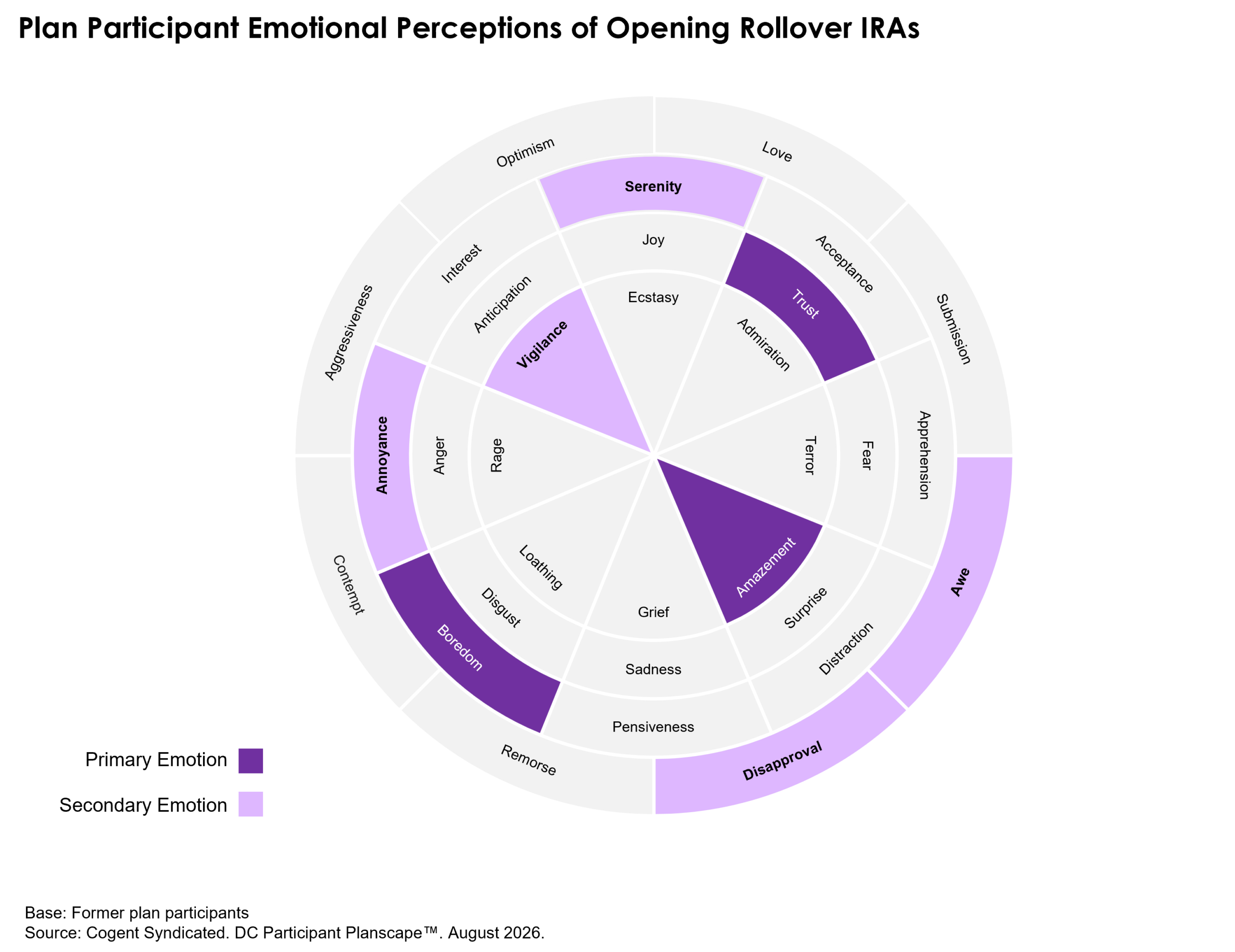
Three Distinct Emotions Dominate Rollover IRA Decisions
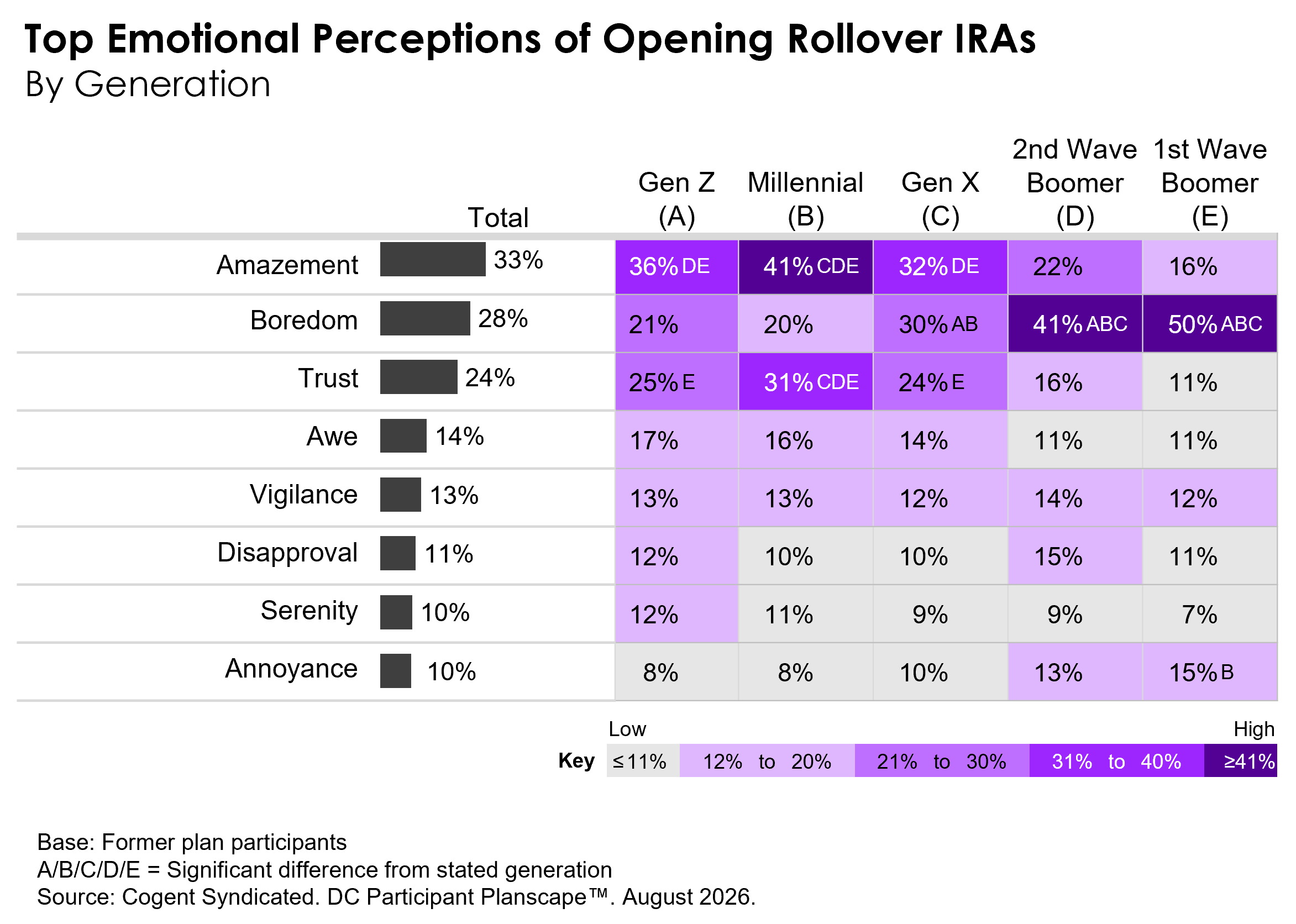
Amazement, trust and boredom. At first glance, these three emotions seem almost incompatible. Yet they collectively define the primary emotional response to the prospect of opening a rollover IRA. That range alone should give financial services marketers pause.
The divide is largely generational, and the contrast is striking. For younger cohorts, the rollover IRA represents possibility, something exciting and new on the financial horizon. The emotional register is expansive.
"I would be very thrilled to open a rollover IRA account in the next year. It is something I have been thinking about for a while and it is about that time."
Gen Z participant, reflecting on amazement
For older cohorts, the same decision barely registers emotionally. That’s not necessarily because they oppose it, but more because the novelty has long worn off. The boredom isn’t resistance, it’s indifference, which can be just as daunting for providers to encounter.
"I am not excited but not opposed, kind of blasé about it. I would need financial advisor input as I trust his knowledge better than the little bit I know about opening a new account."
2nd Wave Boomer participant, reflecting on boredom
Trust Equates to Opportunity
Millennials stand out in another important way given their propensity to associate rollover IRAs with trust. In fact, more than three in ten Millennial participants (31%) selected imagery associated with trust, significantly higher than 24% of Gen Xers, 16% of 2nd Wave Boomers and just 11% of 1st Wave Boomers.
"Opening an IRA rollover is a bold financial move. It frees me from messy, scattered savings, bringing a liberating, confident feeling toward my retirement future."
Millennial participant, reflecting on trust
It’s a leap, but one that is taken with confidence. For Millennials, consolidating retirement assets isn’t just practical. It carries a sense of agency, even liberation. Yet the juxtaposition with 1st Wave Boomers is sharp. For them, annoyance (15%) is a notably more prevalent emotion than for Millennials (8%).
"I really don’t want to hear all the hype ... I’m happy with what I have, why would I change?"
1st Wave Boomer participant, reflecting on annoyance
This validates what our historical quantitative data consistently show: younger cohorts are the most receptive rollover targets. The emotional data not only confirm that finding, they tell us the why, and most importantly, provide a script for marketers to act upon.
What Do Negative Emotions Reveal?
A more detailed analysis of the emotional landscape becomes even more nuanced. Consider sadness and disgust. At first glance, neither seems like a productive emotional entry point. But notice what participants are actually describing:
"For me, managing multiple old retirement accounts feels like a tedious chore that I have been putting off."
Millennial participant, reflecting on disgust
"It’s a hassle to open another account, unless maybe I opened it with one of my current financial service providers. Just the thought of opening yet another account makes me want to cry."
Gen X participant, reflecting on sadness
These participants aren’t opposed to rollover IRAs in principle. They’re overwhelmed by the perceived complexity of the process and quietly waiting for someone to make it easier. That’s a market signal, not a dead end.
How Can Financial Services Firms Tailor Rollover IRA Marketing?
Our latest plan participant findings don’t just describe what participants feel, they suggest how financial services firms can authentically meet those feelings.
Four Takeaways for Marketers
- Lead with levity for the disengaged. For plan participants who find the rollover IRA process dull or burdensome, campaigns built on brevity and humor can cut through. Acknowledge the chore, then make it feel less like one.
- Leverage existing relationships. Providers who already play an established role within a participant’s financial life have a distinct advantage. Consolidating with a familiar partner feels less like starting over and more like coming home.
- Build credibility for the cautious. For those who identify rollover IRAs with interest or vigilance, the priority is establishing trust and transparency. Clear, simple process information outperforms promotional messaging.
"I’m trying to learn more about it, and I have to see if it’s trustworthy. Also, I need to know if it’s legitimate or not and how easy it is to do so."
Gen Z participant, reflecting on interest
- Inspire those who are ready to leap. For participants sitting in the amazement and awe space, the most resonant message is one of renewal, a financial fresh start.
"The possibilities are endless. What an exciting experience to renew and refresh. It’s like a financial makeover."
2nd Wave Boomer participant, reflecting on awe
Conclusion: Emotion Is Strategy
The financial services industry is adept at speaking the language of rates, returns and risk. Yet at the core of many financial decisions is an emotional lever that offers the best cross-sell potential. As such, firms that understand the emotional drivers behind rollover IRA perceptions and build marketing and engagement strategies that genuinely reflect those perceptions will be better positioned to retain assets across each generational cohort. Our study offers firms a unique opportunity to hear that emotional language clearly. The question now becomes how will providers choose to respond?
Want the full picture? Our DC Participant Planscape™ offers firms a unique understanding of what drives participant contribution and investment behavior. It benchmarks the top plan providers on key satisfaction drivers and brand engagement metrics, monitors the brand perceptions of leading financial services providers and identifies the firms best positioned to capture rollover assets.
To learn more about the full report, click below.

Sonia Davis
Senior Product Director, Cogent Syndicated
Sonia is a senior product director in Escalent’s Cogent Syndicated division, where she manages the firm’s defined contribution retirement suite of research with plan sponsors, plan participants and plan advisors. She has more than 15 years of quantitative and qualitative market research experience in financial services industry research, as well as the hospitality, consumer packaged goods and retail sectors. Prior to Escalent, Sonia served as a community manager for C Space, a public relations specialist for Putnam Investments and as a staff reporter for Community Newspaper Company. Sonia earned an MBA from Boston University School of Management and a bachelor’s degree in communications from Simmons University. She’s a proud finisher of the rainiest Boston Marathon on record (2018) and multiple sprint triathlons who now enjoys rowing (sweeps) on the Charles River and outdoor adventures with her husband, two daughters and black lab.