April 29, 2026

Executive Summary: Artificial intelligence is already reshaping US healthcare, from faster workflows and personalized care to clinical decision support, remote monitoring and administrative automation. But its impact is not just operational. As AI becomes embedded in how care is delivered and decisions are made, market researchers need to understand how patients, providers and healthcare organizations perceive its role, where trust and ethical concerns emerge and what this means for future healthcare insights.
You needn’t look far these days to see how Artificial Intelligence (AI) is reshaping the US workforce, and healthcare is no exception. What’s striking, however, is not just how fast AI is being adopted in US healthcare, but how uneven our understanding of its real impact remains. Too often, conversations focus on cost savings or futuristic hype, while missing the much more immediate question: how AI is already changing the healthcare decisions people make inside a deeply human system. The pace of adoption has accelerated quickly with 22% of healthcare organizations reporting using domain-specific AI tools in 2025, a sevenfold increase from 2024 and a tenfold increase from 20231.
AI improves efficiency by reducing manual work and accelerating care delivery. While some project the broader adoption of automation could save the US healthcare system between $200 billion and $360 billion per year2 (equivalent to 5–10% of total healthcare spending) this adoption would have major implications for healthcare consumers.
How AI Is Enhancing Healthcare Delivery and Patient Outcomes
- Organizations are using AI to personalize care based on medical history, lifestyle and patient preferences.
- AI tools can generate tailored recommendations that support treatment planning and help clinicians make more informed decisions.
- Continuous monitoring solutions powered by AI also enable earlier intervention, reducing the likelihood of complications or readmissions.
These trends show beyond doubt that AI is no longer an emerging concept for US healthcare. It is already deeply embedded and transforming how care is delivered, how clinicians work and how patients experience the system. But what’s notable isn’t just the speed of adoption, but how quietly it’s happening. Much of this AI is being embedded into workflows rather than showcased as innovation, meaning patients and providers may already be interacting with AI healthcare solutions without fully realizing it.
As market researchers, this shift is not just interesting background context. It fundamentally changes how healthcare insights are generated, what questions matter, which stakeholders influence decisions and where new opportunities emerge. Despite this shift, much market research in healthcare still assumes a pre-AI reality, treating decision-making as slower, more linear and more human-only than it is today. That gap creates blind spots, particularly around trust, agency and how patients interpret algorithm-driven recommendations.
It’s helpful to first understand how AI is currently being leveraged across the US Healthcare value chain before then taking it a step further to apply AI in a human-centric and ethical way to uncover better, more meaningful insights that create impact.
How AI Is Used Across the US Healthcare Value Chain
AI is transforming the US healthcare sector at every level of the value chain—hospitals, payers, pharmacy benefit managers, pharma/biotech firms, medtech and EHR firms, and digital health startups. Each stakeholder uses AI in different ways to help patients and make work easier from clinical support and drug discovery to administrative automation, claims optimization and remote monitoring (see the table below for a quick snapshot of how AI is being used across the healthcare value chain). What’s often missed in discussions about how AI is used in healthcare is that adoption isn’t happening evenly, or for the same reasons across the value chain. Each stakeholder is optimizing for a different problem, which has implications for how research questions should be framed.
Use of AI Across the US Healthcare Value Chain
| Stakeholders | Key Use Cases |
| Hospitals and Health Systems | Clinical decisions, monitor patients, and reduce administrative tasks |
| Health Insurers / Payers | Connect care teams, streamline claims, and care management |
| Pharmacy Benefit Managers (PBMs) | Evaluate medication histories, track patterns in prescribing, support administrative processes, and identify possible fraud |
| Pharmaceutical and Biotech Companies | Accelerate drug discovery, enhance clinical trial design, and analyze patient data |
| MedTech and EHR Companies | Early detection, automate routine tasks, and organize patient information |
| Digital Health Startups | Clinical tasks, track patient conditions, remote monitoring, and guide treatment decisions |
- The Mayo Clinic, for example, is utilizing AI to identify cardiac conditions, speed up stroke evaluation and help interpret complex heart-related data. It has also been testing generative AI with Microsoft to help with documentation, scheduling, and other routine activities so clinicians can spend more time with patients.
- In 2025, Aetna launched its Care Paths program, which leverages AI to provide tailored recommendations for diabetes, joint health and maternity care through the Aetna Health app. The tool breaks down complicated care processes and aligns them with individual member needs to help determine which members may be at a higher risk of developing chronic conditions, and to reach out earlier in the care process.
- UnitedHealthcare is on Aetna’s heels, recently announcing the launch of Avery, a generative‑AI digital companion embedded in its member experience that provides 24/7 personalized assistance with benefits navigation, coverage details, claims, cost estimates, scheduling and care coordination.
- CVS Caremark uses AI to study patient behavior and prescription activity and has applied similar tools to streamline vaccine and diagnostic testing operations.
- Eli Lilly has partnered with NVIDIA, bringing together a multidisciplinary team of scientists, AI researchers and engineers that will leverage robotics and physical AI to accelerate and scale drug discovery and production.
- And Biofourmis combines AI with connected devices to track patient conditions from home and adjust care plans based on real-time data. These are just a few out of hundreds of examples available demonstrating how healthcare players are utilizing AI to increase speed, quality of care and more.
These examples highlight a critical shift: AI is not just driving efficiency, but enabling new models of care, engagement and innovation across healthcare ecosystems.
From what I’ve seen so far, the most transformative AI use cases aren’t always the headliners. Incremental “behind the scenes” improvements in administrative friction often shape the consumer experience more.
The Human Factor: How Trust and Ethics Shape AI Adoption in the Healthcare System
As AI becomes more common in US healthcare, the attitude of the public and providers remains cautious toward it. Across all industries, concerns about safety, fairness and reliability continue to shape how AI is used and how quickly it is adopted.
A 2025 JMIR study found that individuals with a moderate level of AI knowledge were more positive towards AI use in healthcare, and people who were more disorganized had more positive views of AI in healthcare. Women showed greater caution toward AI applications in healthcare than men3.
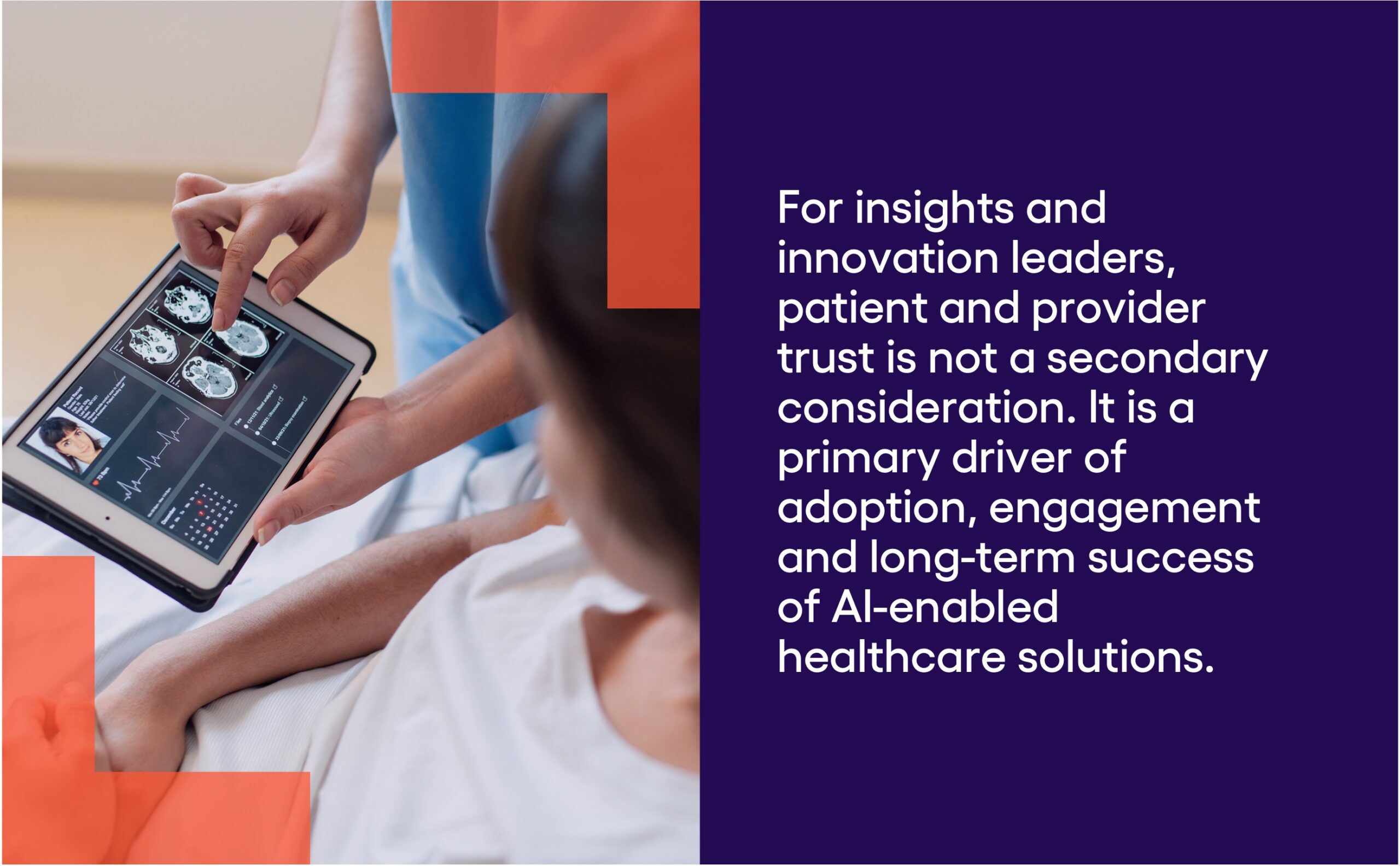
When it comes to what patients, clinicians and providers are willing to hand over to AI, the feelings are mixed. While clear benefits exist for reducing healthcare disparities, predicting future health concerns, or freeing up time by using AI for administrative tasks, concerns remain over how AI will make these decisions and how easily it could overlook the individuality and uniqueness of each person. So ironically, while I have some concerns that consumers won’t trust AI enough to use and reap its benefits, I also worry that some may defer to it too quickly, especially in moments of uncertainty or stress.
AI in Healthcare Decision-Making: Implications for Market Researchers
As AI becomes an integral part of healthcare, market researchers face new challenges and opportunities. To keep up with the rapid pace of change, researchers need to upgrade their skills, use new tools and rethink how they collect and understand data. At Escalent, we’re doing exactly that—combining deep industry research expertise and human-guided AI to generate richer, more actionable insights for healthcare organizations.
Ethical and privacy considerations play a role in shaping research approaches. The HIPAA Privacy Rule gives individuals clear rights over their health information, including the ability to control how it is accessed or shared. Any AI system using protected health information must follow HIPAA’s standards, meaning researchers, as third-party entities, must be careful about how they collect and analyze data from healthcare organizations. As AI adoption increases, our team is continuously evaluating data sources for representativeness and identifying potential biases that may affect both AI-generated results and the interpretations drawn from them.
At Escalent, we bring the power of AI together with the rigor, ethics and judgment that trusted decision-making demands. We build AI that elevates people, safeguards integrity and delivers impact you can trust.
Market researchers must also stay current with changing rules and new ways AI is used. At Escalent, AI is not a tool or a feature or a trend for us. It is a strategic capability that empowers our teams to think faster, work smarter and deliver deeper, more trusted insights. Each member of our research team is required to complete a rigorous, 11-session training program and then complete an AI certification test to become an AI Champion. But our learning never stops there. With federal and state regulations always evolving, keeping up to date is part of the job. Health researchers should also watch out for new use cases of AI, from clinical documentation to drug discovery and patient support, as these will shape future expectations for both patients and healthcare providers.
Perhaps most importantly, we’re in the business of understanding people, so consumer sentiment is a key focus area. We’re designing studies that measure trust by demographic factors, digital comfort levels, and past experiences with the healthcare system. And with new tools, such as Escalent’s BeSci x AI™, a proprietary AI‑powered behavioral science model, we’re able to help organizations understand why people behave the way they do—and what it takes to motivate behavior change.
In sum, we believe the most responsible use of AI in research is not to replace human insight, but to challenge it. Push boundaries enough to identify patterns people might miss, while still requiring human judgment. For healthcare organizations, the opportunity is to use AI-enabled market research to move faster without losing sight of the patients, providers and human behaviors behind the data. To learn more about Escalent’s approach to AI in the health space, including how to effectively incorporate it into your research or day-to-day life, get in touch! We’d love to compare notes.
Frequently Asked Questions (FAQs):
1. How can healthcare organizations adopt AI while maintaining patient trust and regulatory compliance?
Organizations must embed transparency, ensure human oversight, align with regulations like HIPAA and actively measure patient and provider trust while addressing bias in data.
This requires careful handling of protected health information and ongoing evaluation of data sources for representativeness. As AI adoption increases, maintaining ethical standards and clearly defining how data is collected and used becomes critical to sustaining trust.
2. How is AI changing healthcare decision-making across patients, providers and systems?
AI shifts decisions from linear, human-led processes to more dynamic systems where algorithms influence diagnosis, treatment and patient engagement, often embedded within workflows and not always visible.
As a result, patients and providers may interact with AI-driven recommendations without fully realizing it. This changes how decisions are experienced and interpreted within the healthcare system.
3. What are the implications of AI for healthcare market research and insights teams?
AI requires research teams to capture AI-influenced behaviors, evolving stakeholder roles and trust dynamics, moving beyond traditional models that assume slower, human-only decision-making.
This shift changes what questions matter, how insights are generated and where new opportunities emerge, particularly in understanding how people respond to algorithm-driven recommendations.
4. How can healthcare organizations address bias and ensure data representativeness in AI-driven insights?
Organizations must evaluate data sources for representativeness, identify potential biases and apply human oversight to ensure insights reflect real-world healthcare experiences.
As highlighted in the blog post, this includes continuously assessing how data is collected and interpreted and recognizing how biases can affect both AI-generated outputs and the conclusions drawn from them.
1 Forbes
3 Journal of Medical Internet Research
Want to learn more? Let’s connect.

Elizabeth Baiocchi-Wagner, Ph.D.
Senior Vice President, Healthcare Payers & Solutions
Elizabeth (Liz) is a senior vice president in Healthcare Payers & Solutions at Escalent. She brings 15 years of quantitative and qualitative research experience to the table, along with solid industry knowledge in technology and telecommunications (after years of lead analyst work in that space). Liz is a former Communications professor (University of Missouri, University of Portland) teaching everything from Advanced Research Methods, to Gerontology, to Communicating in Romantic Relationships. Originally from Detroit, Liz joined the Escalent team in the summer of 2011 and moved to the Pacific NW. When she’s not working or teaching, she is leading marketing and outreach efforts for the nonprofit organization, GiGi’s Playhouse Portland, biking around her VERY hilly neighborhood, or playing DJ for a family dance party.