June 22, 2026

Editor’s Note: Cogent Syndicated’s 2026 Retirement Planscape report has published. Read on to find how plan sponsor loyalty is driven by more than plan performance, fees and outcomes. Emotional factors such as serenity, trust, love and admiration are strongly linked to satisfaction, advocacy and long-term provider relationships.
The defined contribution (DC) retirement plan marketplace is at a pivotal juncture, with plan sponsors widening the lens beyond participation rates and investment performance and asking a harder question: is our 401(k) plan truly setting up our employees for retirement success—and at a fair cost, with acceptable risk, and with a partner we can trust? Service quality expectations of DC plan providers and DC investment managers are also rising, shaped by new pressures around cybersecurity, regulatory oversight, financial wellness and retirement income.
In this environment, firms can no longer rely on scale, product breadth or historical relationships alone; firms must demonstrate measurable plan health, tangible value and a more human understanding of sponsor priorities. What truly differentiates providers now, however, is not just what they deliver, but how sponsors feel about working with them.
Our new Evoke™ emotional analytics tool created by Escalent brings this human dimension into sharper focus, revealing that emotions such as serenity, trust, love, admiration and awe are strongly associated with higher satisfaction and loyalty, while boredom, interest and submission correlate with neutrality, detractor behavior and greater switching risk. By asking sponsors to select images tied to Robert Plutchik’s Wheel of Emotions, we were able to capture “gut level” reactions, or System 1 thinking, that traditional surveys often miss, and translate those reactions into actionable insight. The result is a richer, more nuanced view of DC plan sponsor-provider relationships, one that connects brand, service, outcomes and emotional resonance into a single narrative about why clients stay, renegotiate or leave.
How Does Evoke™ Measure Plan Sponsor Emotions Toward 401(k) Providers?
In this year’s Retirement Planscape study, plan sponsors were exposed to a collection of 15 different images depicted on the wheel, which included positive emotions (optimism, love, awe, trust, admiration), neutral emotions (serenity, acceptance, apprehension, boredom, interest) and negative emotions (submission, disapproval, sadness, rage, annoyance). The most distant emotions are depicted on the edge of the wheel, while the most inward ones toward the center are ones people generally internalize more meaningfully.
Because emotions can often be complex, to get beyond a single dimension, we asked respondents to select one image, and then another from the remaining images. Serenity is the primary emotion among plan sponsors, while awe, admiration, optimism and love serve as secondary emotions with respect to how sponsors feel about their organization’s current 401(k) plan provider.
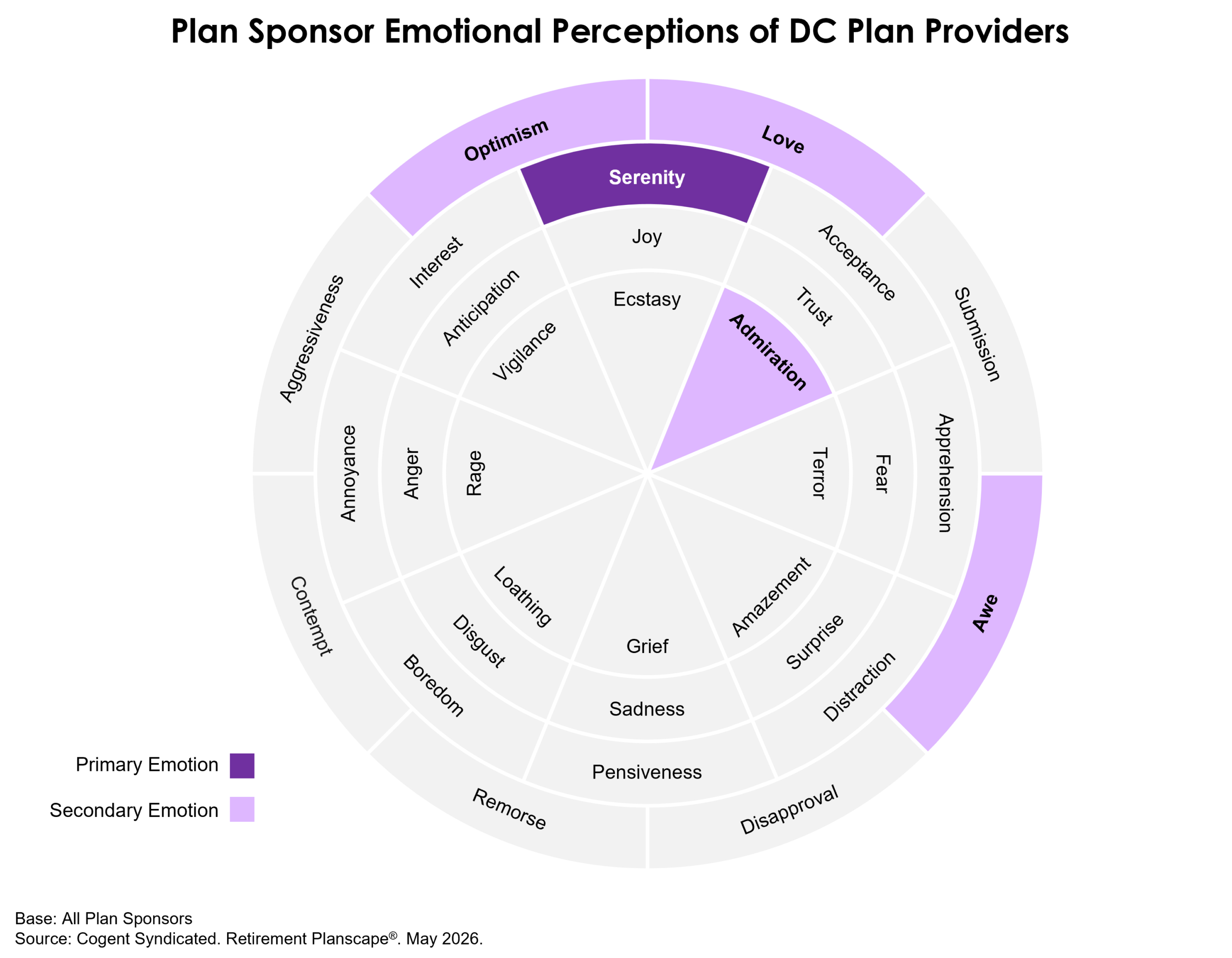
When studying the full wheel of emotions, it’s interesting to note that awe, optimism and love are on the edge of the wheel, while serenity is one level deeper and admiration is part of the core, suggesting a more intensified emotional relationship. In addition, serenity can be interpreted as a combination of optimism and love, while acceptance and admiration can arise from initial feelings of love and submission.
What Emotions Drive Plan Sponsor Satisfaction and Loyalty?
To gain a fuller understanding of plan sponsor sentiments toward their current plan provider, we asked respondents to explain their rationale for selecting each image. The verbatims offer unparalleled insight into plan sponsors’ respective feelings in ways we haven’t heard before. Here, we can glean rich context into harmonious relationships and firms that spark wonder and a sense of ease to tales of angst, gloominess and even outrage that providers can leverage as templates for success or wake-up calls to remedy.
As one Mid plan sponsor who selected the image that maps to serenity describes, “I am at ease, watching them be a fantastic corporate solutions provider. They are on task, so I don’t have to watch over their shoulder on a continuous basis. I am confident that they will execute our plan without me hounding them.”
A Mega plan sponsor reflects on love as, “It represents a harmonious, long-term partnership where both parties are in sync, reflecting my feelings of synchronized trust and collaborative confidence in my relationship.”
In contrast, a Large plan sponsor depicts submission as, “They are big, which can be good, and located in many regions. But they are rigid in terms of process because they cannot adjust their systems or processes to meet our needs.”
Other negative emotions such as rage, for example, are characterized by a Small plan sponsor as, “It was frustrating spending a lot of time going back and forth on the company match into the ESOP. We now plan to leave.”
How Are Plan Sponsor Priorities and 401(k) Success Metrics Evolving?
Our research also explores how plan sponsor agendas are evolving—some remaining laser-focused on cost containment, others elevating retirement readiness, menu modernization and SECURE 2.0 implementation—requiring providers to tailor their value propositions by plan-size segment rather than lead with one-size-fits-all solutions.
As the day-to-day mechanics of running a 401(k) plan are becoming more complex, plan sponsors are increasingly diligent about who they enlist for help whether it be consultants, third-party administrators (TPAs), financial advisors or co‑fiduciary partners for guidance on fee evaluation, regulatory change, tax reporting, plan design and investment menu decisions.
In this Cogent Syndicated study among plan sponsors, we bring together these rational and emotional dimensions of the market: the shifting benchmarks of plan success, the operational and regulatory realities sponsors face, the changing competitive landscape for the top 34 plan providers and 43 DC investment managers, and the emotional currents that shape satisfaction and loyalty. Winning in today’s DC market requires not only performing on the hard metrics of cost, outcomes and risk management but simultaneously earning the serenity, trust and advocacy of the plan sponsors you serve.
For more information on the full report, click below.

Sonia Davis
Senior Product Director, Cogent Syndicated
Sonia is a senior product director in Escalent’s Cogent Syndicated division, where she manages the firm’s defined contribution retirement suite of research with plan sponsors, plan participants and plan advisors. She has more than 15 years of quantitative and qualitative market research experience in financial services industry research, as well as the hospitality, consumer packaged goods and retail sectors. Prior to Escalent, Sonia served as a community manager for C Space, a public relations specialist for Putnam Investments and as a staff reporter for Community Newspaper Company. Sonia earned an MBA from Boston University School of Management and a bachelor’s degree in communications from Simmons University. She’s a proud finisher of the rainiest Boston Marathon on record (2018) and multiple sprint triathlons who now enjoys rowing (sweeps) on the Charles River and outdoor adventures with her husband, two daughters and black lab.