March 23, 2026

Financial advisors are consolidating around fewer high-value digital sources while expanding use of social platforms and streaming video. Insights from Escalent’s Cogent Syndicated research show that firms must rebalance advisor media strategies toward on-demand digital channels.
When it comes to go-to sources for business and financial news, new data from Cogent Syndicated find advisors are consolidating around fewer, higher‑value websites and significantly expanding their use of social platforms and streaming video.
New findings from Escalent’s Annual Advisor Media Consumption Summary report find this shift in preferences is steadily moving advisors away from scheduled TV, print and podcasts and toward more on-demand media types.
As advisors’ media preferences continue to shift, it’s critical for asset managers to be on top of these changes and rebalance marketing tactics for an increasingly on‑demand advisor media landscape.
Above‑Average Media Types: The Core Digital Diet for Financial Advisors
On an on-going basis, Cogent Syndicated monitors advisors’ use and preferences of specific types of media across more than 170 TV networks, print publications, websites, mobile apps, social media sites, audio streaming services, video streaming services and podcasts via our Media Consumption Advisor portal.
On an annual basis, our team takes a step back to look at the calendar year as a whole through the Annual Advisor Media Consumption Summary, providing a comprehensive view of how financial advisors consume media for business and financial news.
In 2025, we found that advisors are going to an average of 2.3 sources across 10 different types of media (including both traditional and digital) per month for business and financial news. Four of the ten media types included in our research exceed that 2.3 monthly average among financial advisors: websites, social media, TV networks and video streaming services.
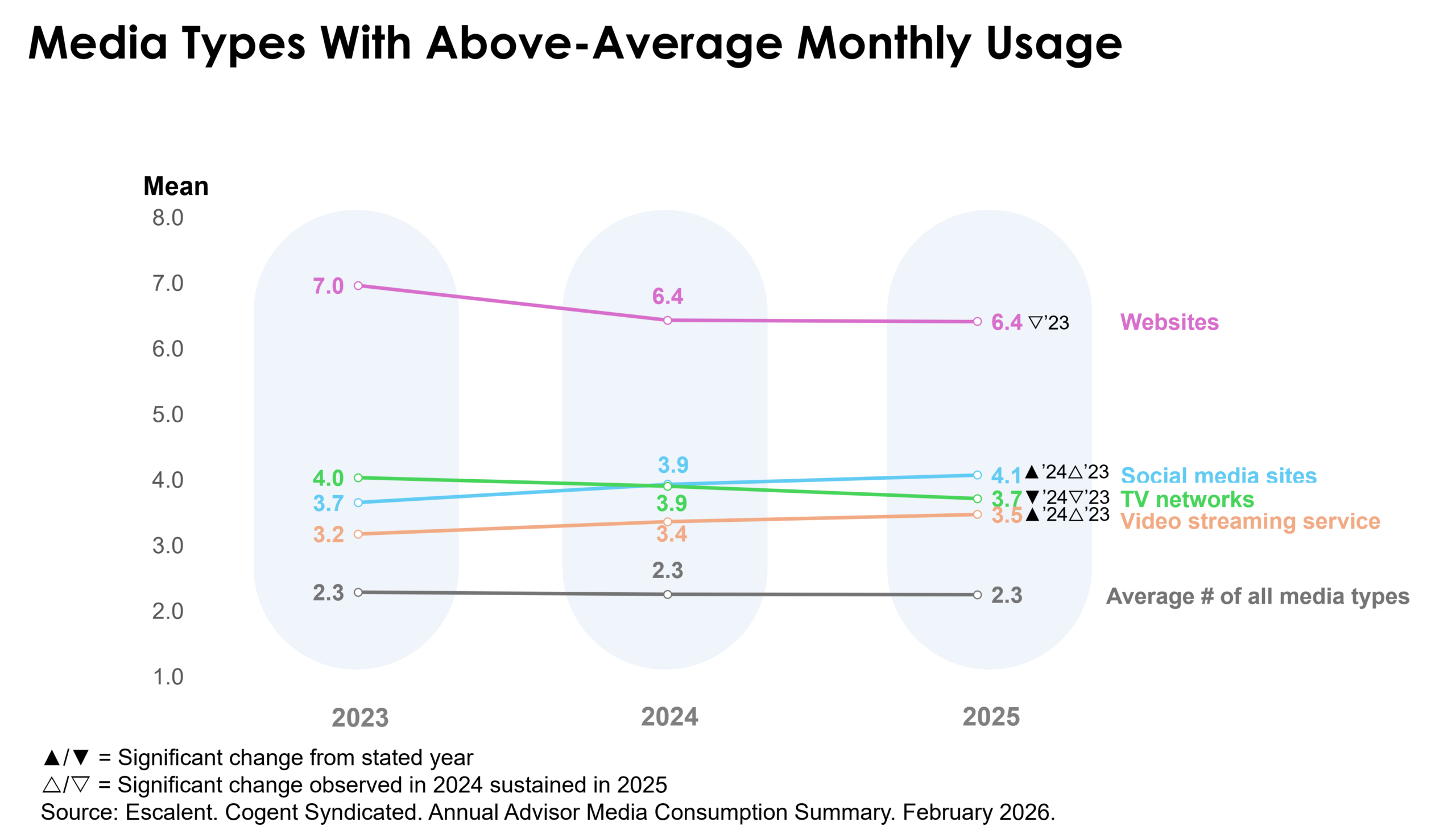
- Websites: Websites remain dominant and should continue to anchor advisor‑facing digital media strategies. While website use edges down from 7.0 sites in 2023 to 6.4 in both 2024 and 2025, they are still nearly three times the average number of properties per media type. The significant drop from 2023 to 2024, sustained in 2025, suggests advisors are concentrating their attention on fewer websites with higher perceived value.
- Social media: Social media presents the clearest growth story and merits a larger role in multichannel advisor media plans. Advisors reported using an average of 3.7 platforms in 2023, 3.9 in 2024 and 4.1 in 2025. The number of platforms used in 2024 and 2025 is significantly higher than in 2023, indicating a broader mix of destinations for financial ideas, commentary and peer perspectives.
- TV networks and video streaming: Video strategy increasingly needs to follow advisors from traditional TV to on‑demand streaming services. Traditional TV networks are losing advisor viewers, declining significantly from 4.0 in 2023 to 3.9 in 2024 and 3.7 in 2025. Meanwhile, video streaming services have moved the other way—3.2, 3.4 and 3.5 over the same period—with a significant increase year-over-year. This trend underscores how on-demand video is becoming a critical channel for reaching financial advisors.
Below‑Average Media Types: Selective but Strategic
Below the 2.3 property average sits six media types: mobile apps, audio streaming services, podcasts and three types of print publications (monthly, weekly and daily).
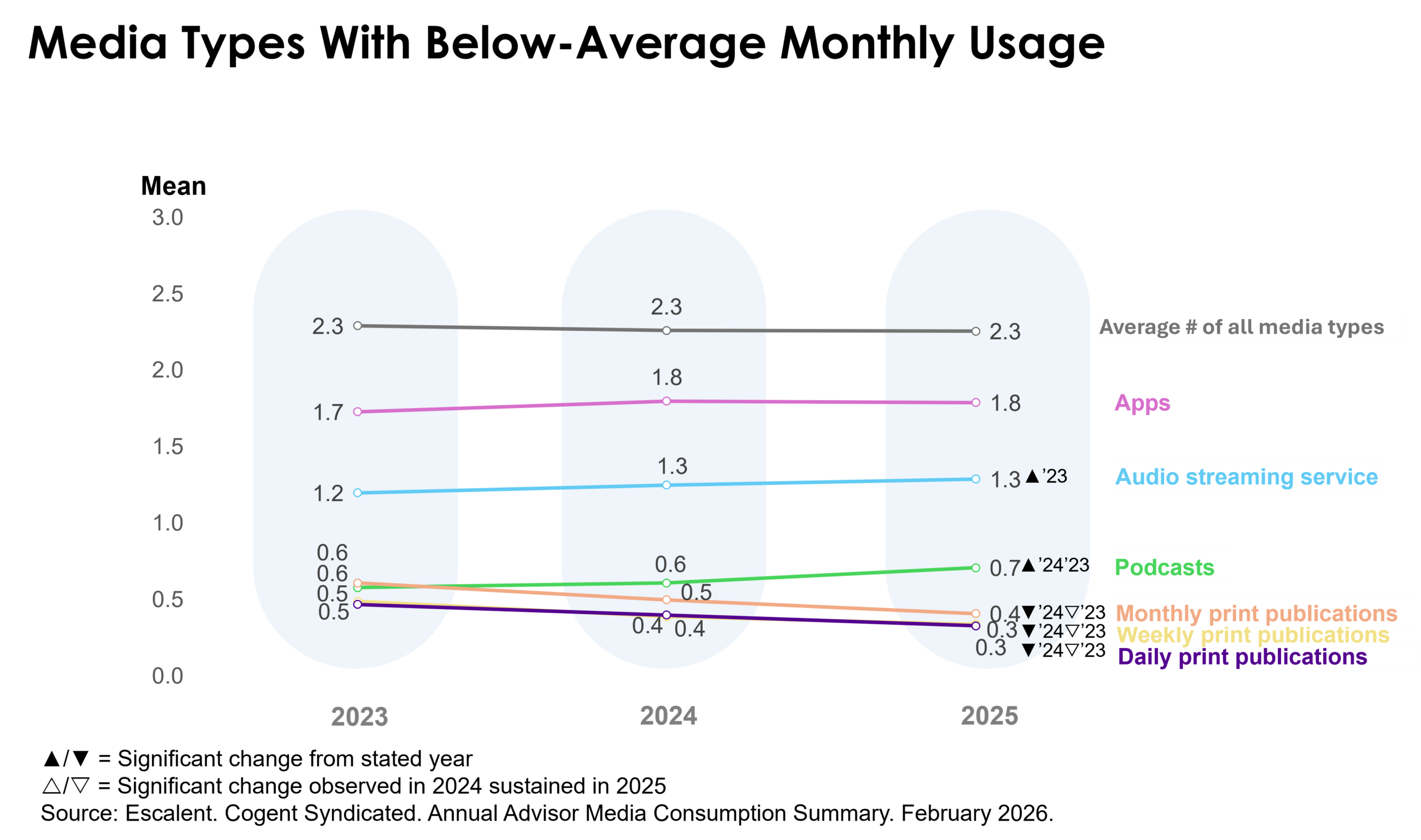
- Mobile apps: Mobile apps are stable but limited as advisors report using roughly 1.7–1.8 apps on average, with no significant change year-over-year.
- Audio streaming: Audio streaming services record significant growth, from an average of 1.2 services in 2023 to 1.3 in 2024 and 2025, as more advisors weave streaming audio into commutes and downtime.
- Podcasts: Podcast use remains selective, with advisors averaging 0.6 shows in 2023 and 2024 and 0.7 in 2025; the increase from 2023 to 2025 is significant but among a relatively small base of users.
- Print publications: Print media incurs the clearest structural decline. Readership of monthly titles falls from an average of 0.6 in 2023 to 0.5 in 2024 and 0.4 in 2025, with each year-over-year drop significant. Weekly and daily titles follow a similar pattern, with significant declines in average readership from 0.5 in 2023 to 0.4 in 2024 and 0.3 in 2025, underscoring a steady shift from print media to faster, more accessible digital sources of advisor news and insights.
How Can Firms Win in an On‑Demand Advisor Media Landscape?
For asset managers seeking to reach advisors effectively, three strategic actions stand out:
- Lead with high‑use digital channels—websites, social and streaming—and use TV more selectively.
- Use audio and podcasts to build content depth, backing a small number of focused series that build trust among advisors.
- Position print as support for digital, emphasizing flagship titles that drive advisors to richer online experiences with consistent themes and calls to action.
The full Annual Advisor Media Consumption Summary from Escalent’s Cogent Syndicated equips firms with the information they need regarding advisors’ media use and preferences to build effective multichannel advisor media plans. And while the overall advisor landscape is important, we dive in to highlight variations by key segments (channel, generation, AUM, DC AUM, product use and active share) to help firms target media buys to where their advisor targets gravitate for financial news. Our report helps firms maximize brand exposure and improve the impact of advisor-focused media placements in a rapidly evolving digital media environment.

Steve Ethridge
Senior Director, Cogent Syndicated
Steve is a senior director in the Cogent Syndicated financial services division, where he directs affluent investor research and consulting. He has more than 30 years of experience in marketing research and consulting, and more than 15 years in financial services including investment banks, mutual funds, retail and commercial banks, and credit unions. He brings in-depth market research (qualitative, quantitative and mixed method) and strategic marketing experience from a wide range of industries. In addition to running his award-winning research consulting firm for many years prior to joining Escalent, Steve headed market research and customer insights for AutoZone. He has also held the positions of senior manager of brand marketing, research for The Holiday Corporation (Holiday Inns) and its spin-off, Promus Companies (Hampton Inn, Embassy Suites, Homewood Suites and Harrah’s Entertainment), as well as executive associate and client manager with Gallup and vice president and director of market research for Cliff Davis Associates, a national strategic business planning consulting firm specializing in financial services. Steve holds a master’s degree in communication from The University of Memphis and a BBA in marketing management from Ole Miss, and has completed coursework in the master of market research program at UGA.