June 9, 2026
Escalent’s Trends in Alternative Investments™ report from Cogent Syndicated reveals affluent investors increasingly lean on financial advisors for guidance as market uncertainty and knowledge gaps lead to a shift away from platform-based access
Influenced by significant market volatility, the alternative investments landscape has reached a critical point. Even as alternative investments become more mainstream and easier to access, retail investors are taking a more cautious approach and increasingly seeking financial advisors to guide them through the process.
This is according to the latest Cogent Syndicated Trends in Alternative Investments™ report from Escalent. The annual report measures the rate of adoption and share of assets dedicated to alternative investments among financial advisors and affluent investors, as well as which asset classes within the category are currently favored and how they are being accessed.
Advisor use of and allocations toward alternative investments continue to rise, particularly among dedicated market participants. The proportion of heavy users—advisors with 10%+ assets under management (AUM) allocated toward alternative investments—is projected to double within the next two years, increasing from 21% to 40%. Additionally, average allocations are expected to rise from nearly 8% to about 11%.
“While demand for alternatives has remained resilient among advisors, liquidity constraints, high costs and complexity pose significant hurdles to expanded adoption. On top of these barriers, concerns around lack of knowledge and understanding of this asset class are prevalent,” said Kristin Hall, senior product manager in Escalent’s Cogent Syndicated division.
According to Cogent Syndicated research, just over one-third (37%) of affluent investors indicated they understand ‘a little’ about alternative investments. “This suggests awareness is expanding, but knowledge remains limited among clients, highlighting a clear opportunity for advisors to provide specialized guidance and education,” explained Hall.
With limited investor understanding serving as a friction point, financial advisors reported that they, rather than clients, frequently initiate conversations about alternative investments. Despite client initiation being less common overall, heavy users of alternatives said that they start these discussions 55% of the time, compared with 32% for light users—underscoring that greater familiarity with alternative investments can drive higher allocations to the asset class.
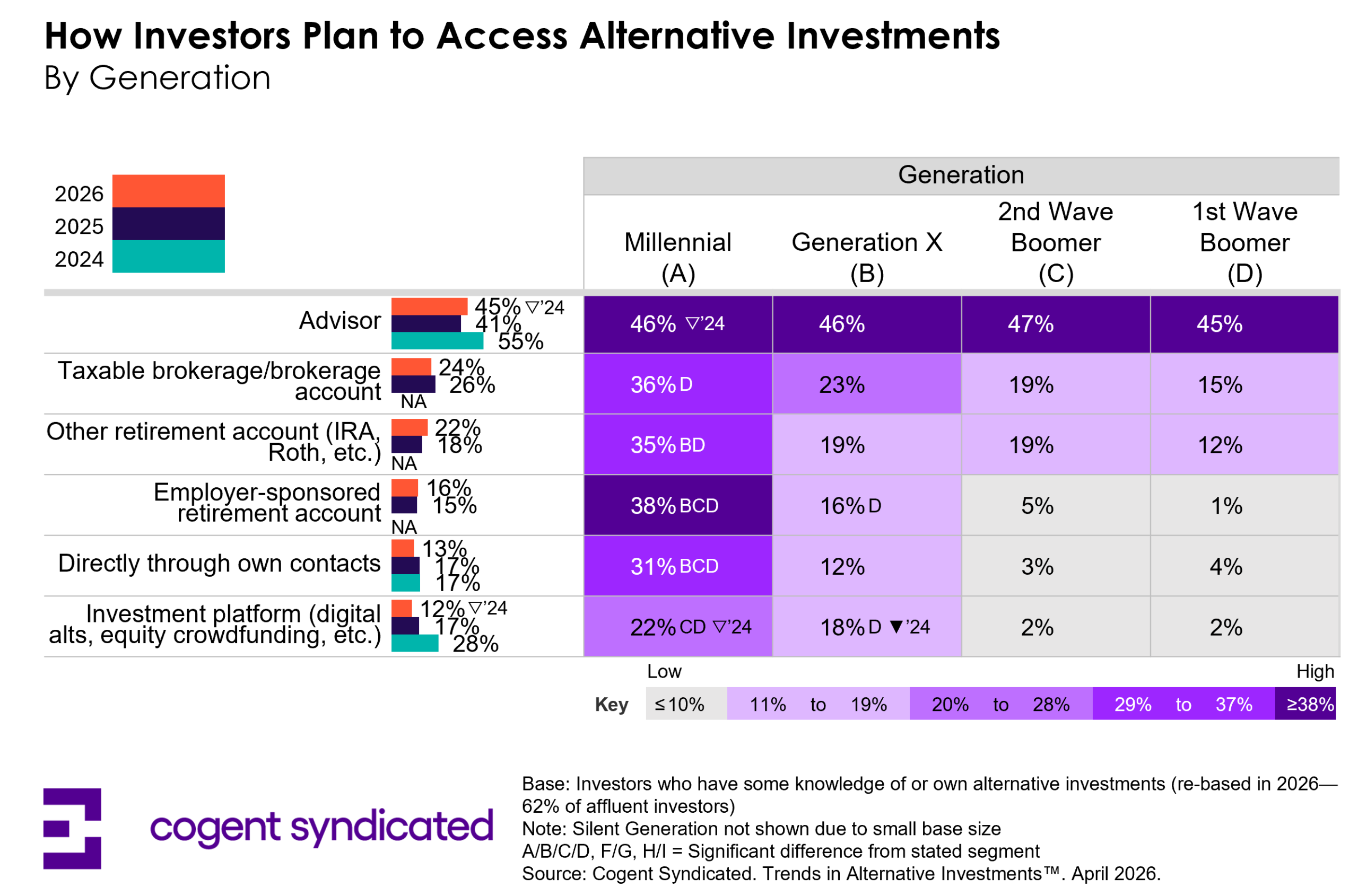
However, a striking paradox has emerged: as investors become more knowledgeable about alternatives, the proportion of those willing to allocate toward alternatives drops. Furthermore, average intended allocations among investors who are familiar with alternatives have fallen from 26% to 19% since 2025, bringing their expectations much closer to the 14 – 16% advisors recommend for liquid alternatives (much lower allocations are recommended for semi and illiquid holdings). A lot of this movement is driven by millennial investors who have shown the most interest in this asset class.
“Initially, millennials wanted to jump on the bandwagon with high allocations toward alternatives. But, as they learn more about the risks, especially following recent volatility, they are becoming much more realistic,” said Meredith Lloyd Rice, vice president in Escalent’s Cogent Syndicated division. “As a result, we’re seeing a shift in how millennials access these investment opportunities, with notable declines in platform-based access and advisors while continuing sustained interest in accessing via brokerage accounts.”
Looking ahead, advisors that can build investor engagement and trust through education will be positioned as the ultimate gatekeepers of the alternative investment market.
About Trends in Alternative Investments™
Cogent Syndicated conducted an online survey from February 9 to February 24, 2026, of a representative sample of 711 financial advisors. In order to qualify for this study, survey participants were required to have a book of business of at least $5 million and offer financial advice or planning services to individual investors on a fee or transaction basis. In determining the sampling frame for this study, Cogent relied upon the most recent Discovery registered representative and RIA databases. To ensure the population for this research was representative of the universe of financial advisors, the databases were analyzed to determine the current distribution of advisors by AUM, channel, age, gender and region. Quotas were then established to produce a final set of respondents that is truly reflective of the advisor population. Minimal weighting was applied to adjust for any deviations from the actual marketplace distribution. The data have a margin of error of ±3.68% at the 95% confidence level. Cogent Syndicated will supply the exact wording of any survey questions upon request.
For more information about the full report, click below.