December 2, 2025
Escalent’s 2025 Investor Brand Build™ report highlights the shifting investment landscape, dominated by more diverse, digitally fluent and opportunity-driven affluent investors
The wealth management industry has reached an inflection point. As the affluent investor population moderates in size, shifts in generation, gender and mindset mark the entry of an opportunity-driven affluent investor segment. With increased interest in digital and hybrid solutions and evolving standards of trust and advice, this new wave of investors highlights the opportunity for wealth management firms to establish market leadership.
This is according to the latest Investor Brand Builder™ report from Escalent’s Cogent Syndicated division. This annual study is designed to support firms with critical decision-making around their competitive positioning in the wealth management space, offering a comprehensive overview of key trends and insights affecting the affluent investor market. It also provides an in-depth analysis of investors with purchase intent and a competitive evaluation of brand health.
The Ready-to-Act (RTA) investor population (those intending to make a new investment in the next 3 months) has experienced significant shifts in decision-making dynamics and how they are leveraging financial advice. Female primary decision-makers now comprise 26% of RTA investors, up from 20% in 2024. Additionally, women now account for just over one-quarter (26%) of primary decision-makers among traditionally advised investors, up from 18% last year, whereas male decision-makers fall from 51% to 45% and the proportion of shared decision-makers declines from 35% in 2023 to 28%.
Sources of advice for affluent investors also continue to evolve, marked by strong momentum in digital and hybrid advisor adoption. The proportion working with a financial advisor reaches new highs, supported by gains among Boomers and higher-wealth groups. At the same time, robo-advisor use reaches its highest level in three years, climbing to one in five affluent investors using the service. This growth is primarily driven by Gen Zers (now 55% vs. 39% in 2023), Millennials (now 42% vs. 34% in 2023) and Gen Xers (now 24% vs. 17% in 2023). While robo-advisor users are more male-dominated, women are increasingly considering the advice model, with 26% indicating they are likely to adopt the service.
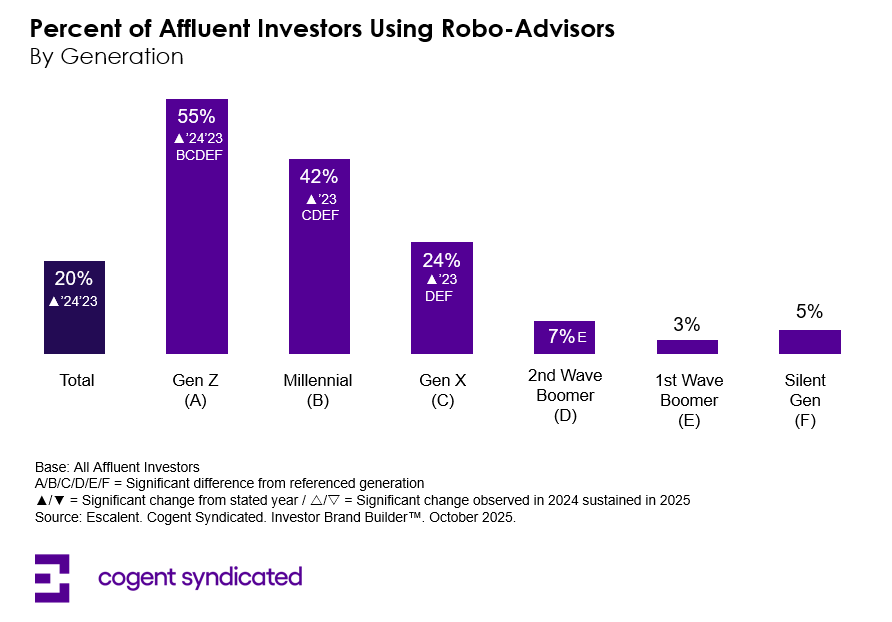
Despite the growing prevalence and interest in automated advice, more than six in ten affluent investors who are likely to adopt or are current users of robo-advisor services rate access to an investment professional as very important. In aggregate, 57% of affluent investors value professional access, up significantly from 53% in 2023, underscoring the enduring need for human support.
“The current affluent investor landscape presents a critical opportunity for wealth management firms to differentiate and drive significant growth with these rapidly evolving segments,” said Steve Ethridge, senior director of Cogent Syndicated. “In this transformative environment, success hinges on a provider’s ability to adapt and align with the wants and needs of diverse affluent investors. They must foster trust through consistent performance, but also leverage digital tools to complement, not replace, the value of their human-centric advice.”
About the Cogent Syndicated 2025 Investor Brand Builder™ Report
Cogent Syndicated conducted an online survey of a representative cross section of 5,038 investors from July 8 to August 11, 2025. Survey participants were required to be 18 years or older, are sole or shared household financial decision-makers, and have at least $100,000 in investable assets including DC plan and IRA assets but excluding the value of primary real estate. Cogent Syndicated uses market-sizing incidence survey findings, which are weighted to US census data, to develop quota targets followed during fieldwork and apply minimal statistical weighting post-fielding to ensure the data reported in this study are representative of the affluent investor universe. The data have a margin of error of ±1.38% at the 95% confidence level. Escalent will supply the exact wording of any survey question upon request.
For more information about the full report, click below.